
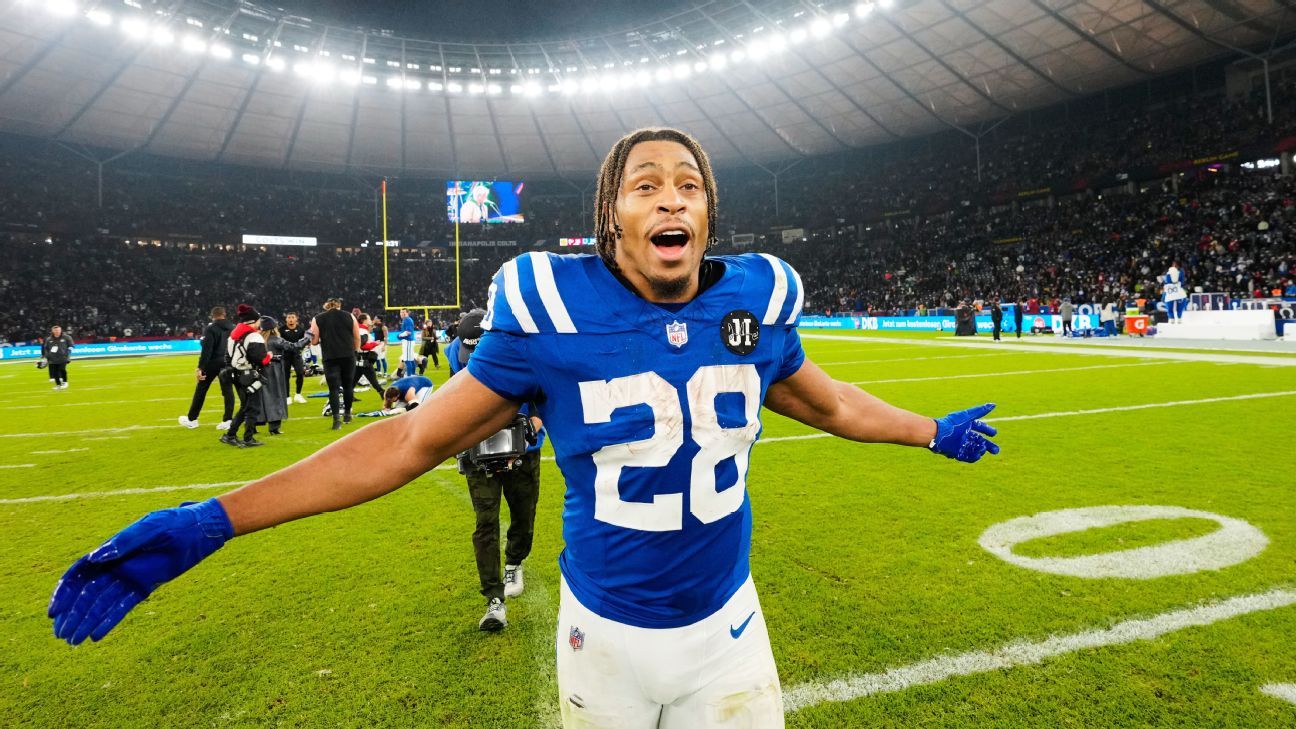
Everything that happens in the NFL has additional context when viewed from a fantasy football perspective. From position battles to injuries and so much more, the news cycle will constantly affect player values in fantasy football.
Our Fantasy Football buzz file, with contributions from our ESPN fantasy writers and our NFL Nation reporters, aims to provide fantasy managers with the intel they need as news breaks around the league.
July 17: Reasons for concern about Jonathan Taylor
Liz Loza: Taylor has become one of the position’s most reliable producers, finishing inside the top 12 among fantasy running backs in four of six campaigns. Volume has long floated his production, as he averages 18.4 carries per contest in his career. The whispers about adjusting his upcoming workload are Indy’s version of summer stock: pure theater.
Entering the final year of his contract and on a roster scant of talent, Taylor figures to remain the centerpiece of the Colts’ offense in 2026. The question is not how often he’ll be fed but, rather, if he can withstand the projected feast.
A running back has cleared 300 totes in consecutive seasons just 15 times over the past two decades. Taylor and Derrick Henry are the only two backs to have done so in the past two seasons.
Just six of the other 13 backs reached 1,000 rushing yards the following season and only four of them played in every game (LaDainian Tomlinson, Chris Johnson, Michael Turner, Marshawn Lynch).
There is one notable constant: a drop in workload. These 13 players averaged 89.9 fewer carries the next season and all of them saw a decline of more than 20 carries.
Daniel Jones’ return from injury further complicates matters for Taylor’s output. The 27-year-old Taylor’s numbers plummeted after Jones tore his Achilles in Week 14. Despite seeing a slight uptick in rushing opportunities, Taylor’s efficiency and fantasy points per outing dropped significantly. While Jones is expected to be under center in Week 1, a setback could torpedo Taylor’s stock.
Taylor’s feature-back status certainly provides potential investors with a high floor. However, his extensive mileage and history of ankle issues make drafting a premium wide receiver — like Amon-Ra St. Brown or CeeDee Lamb — a perfectly viable alternative.
July 15: Why free agent Stefon Diggs is a value right now
Eric Karabell: A notable wide receiver, who caught 85 passes for 1,013 yards last season and outscored Drake London, CeeDee Lamb and Justin Jefferson in PPR formats, remains without a team to perform with as training camp approaches. This receiver can be controversial, of course (though he isn’t alone in that respect), which might explain why he has been employed for three franchises over the past three seasons, but it is hard to argue with the numbers.
What should fantasy managers do about four-time Pro Bowl WR Stefon Diggs?
Diggs, 32, made unfortunate news this offseason for off-field conduct, but there doesn’t appear to be a potential NFL suspension lurking for when he finds a team. Diggs has been vocal recently, stating on his own YouTube channel “you can’t name a better No. 2 [WR] than me,” and, according to ESPN’s Jeremy Fowler, “at least five teams have been checking in on Diggs.” This makes sense. NFL teams covet production, often at any financial (or other) cost.
Other than the 2024 season with the Houston Texans, which was interrupted by a serious knee injury, Diggs has been a model of on-field consistency, topping 1,000 receiving yards seven times, sailing past 100 receptions five times and scoring double-digit touchdowns twice. He starred for the Minnesota Vikings, Buffalo Bills and, last season, New England Patriots, who ostensibly replaced him with former Philadelphia Eagles star A.J. Brown. Perhaps a reunion is possible, perhaps not, but some NFL team must sign the talented Diggs.
Diggs continues to find a home in our weekly mock drafts at ESPN Fantasy, but clearly far later than his 2025 numbers and his potential 2026 statistics warrant. Perhaps there is no “right time” to take the chance, but if Diggs signs with an NFL team tomorrow, those that passed him up in drafts that matter to them may regret it. I selected Diggs late in the 11th round of the Scott Fish Bowl industry slow draft (12 teams, modified PPR), well after the top 100 and a few spots before I took Bills WR Khalil Shakir. I felt the upside of Diggs was worth it there. He had fallen far enough.
In ESPN leagues, Diggs is currently outside of the top 50 for wide receivers in ADP, going in the range of Carolina Panthers third-year option Jalen Coker, New York Jets rookie Omar Cooper Jr. and Tennessee Titans veteran Calvin Ridley. This seems like incredible value. Diggs is rostered in only 32.4% of leagues, though up slightly during the past week. This probably reflects fantasy managers seeing Diggs commenting, perhaps presuming a resolution to his unemployment will soon be remedied.
Who really knows for sure? Perhaps we’re still talking about Diggs in a month, or perhaps no NFL franchise wants to deal with this situation. Both of those seem unlikely. This well-established fellow scored 210.3 fantasy points last season. It will not be long before he finds work and his projection and ranking adjust. If you happen to be drafting soon, get ahead of the news and consider Diggs before it is too late.
July 14: Jalen Coker among trio of WRs to target late in drafts
Matt Bowen: Everyone is looking for some upside late in fantasy drafts. Players who can emerge at some point during the season. Where there’s path to weekly production. Today, let’s look at three players on my radar who are being undervalued at this point of the summer. We’ll start in Carolina.
Jalen Coker, Carolina Panthers
Tetairoa McMillan is the No. 1 in Carolina. We know that. But I saw enough from Coker over the second half of last season to keep him on my draft board this summer. Coker missed time to start last season due to an injury, but from Weeks 11-18 he averaged 11.0 PPG with four games of double-digit production and had a touchdown reception in three. Coker has the vertical stretch ability to win down the field, plus he can run the deep in-breakers or see the ball on three-step quicks underneath. I see a versatile target here with multi-level ability, and the growth of Panthers quarterback Bryce Young in Dave Canales’ system matters here, too. The arrow is pointing up on Coker, the No. 2 in the Carolina route tree. Grab him in the later rounds.
Romeo Doubs, New England Patriots
The trade for A.J. Brown has quieted the talk on Doubs and his role in the Patriots pass game this season. But let’s remember that Doubs signed a four-year deal with New England, which included $39 million in guarantees. Doubs, who averaged 10.3 PPG in Green Bay last season, is willing to work the middle of the field, plus he can uncover in the red zone. Doubs caught four of his six touchdowns last season on throws inside the 10-yard line, and he saw nine end zone targets. As the No. 2 opposite Brown, Doubs doesn’t bring a high-end ceiling to the lineup, but he can be a reliable target with PPR juice for quarterback Drake Maye. And I just landed Doubs in the 11th round of our 12-team PPR mock draft. Good value for a player who could produce some WR3 weeks this season.
Josh Downs, Indianapolis Colts
Michael Pittman Jr. is gone. He’s in Pittsburgh now. That leaves Downs to compete for targets with boundary receiver Alec Pierce and tight end Tyler Warren in Indianapolis. So, let’s target Downs in the Colts’ system as a dynamic mover in the slot — with PPR upside. From Weeks 1-13 last season, before the injury to quarterback Daniel Jones, Downs had five games of double-digit production with six receptions in four. While Downs won’t post big touchdown numbers (11 touchdown receptions over three seasons), he’s in line to see a boost in target volume this season. Put him on the radar as a potential WR3/Flex.
July 10: Five players with breakout potential in IDP leagues
Eric Moody: Individual Defensive Player (IDP) fantasy leagues are often won by finding defenders who outperform their average draft position after the obvious names are gone. These five sleepers all have a clear path to more snaps or a bigger role in 2026, making them worth targeting later in drafts.
Payton Wilson, LB, Pittsburgh Steelers: Wilson could take a big step simply by staying on the field in a strong front-seven environment. He has played every game over the last two seasons and improved his tackle and sack totals from 2024 to 2025. New defensive coordinator Patrick Graham’s simpler defensive scheme should help Wilson play faster, better understand what’s happening around him, and turn his athleticism into more snaps and tackles.
Nic Scourton, DL, Carolina Panthers: Scourton showed flashes late in his rookie season and now gets the benefit of a better supporting cast around him. He finished 2025 tied for the team lead with 5.0 sacks, ranked second with 34 pressures, added 47 tackles and had seven tackles for loss. With improved hand work and more one-on-one opportunities next to Jaelan Phillips and Derrick Brown, Scourton has a real chance to take a major step in his second season.
Malaki Starks, DB, Baltimore Ravens: Starks’ role next to Kyle Hamilton should create big-play opportunities this season. Hamilton does so much work near the line of scrimmage that Starks should get more freedom to play deep, read the quarterback and capitalize on hurried throws. That might cap his tackle upside, but it boosts his chances for interceptions and passes defended in his second NFL season.
Laiatu Latu, DL, Indianapolis Colts: Latu has already shown the fantasy production and pressure rate to support a breakout. He became a full-time starter in his second season in 2025, posted good sack (8.5) and tackle for loss (12) numbers last season and even added three interceptions. Most importantly, he ranked in the top 10 in pressure rate among edge rushers, which points to legitimate double-digit sack upside.
Jalyx Hunt, DL, Philadelphia Eagles: Hunt’s second-half surge is exactly the kind of trend worth chasing late in fantasy drafts this summer. After a slow start, Hunt stockpiled 33 tackles, 5.5 sacks and two interceptions from Weeks 10-18. Even in a part-time role, Hunt led the Eagles in pressures (55) and sacks (8) for the season. If that momentum carries over, he could crush his ADP.
July 9: Houston, we’ve got RB potential!
Tristan H. Cockcroft: The run game hasn’t been stellar during DeMeco Ryans’ three-year tenure as the Houston Texans’ head coach. His teams have placed 22nd, 15th and 22nd in rushing during that time, with nine different running backs getting double-digit carries in a game. Joe Mixon (17th in 2024) was the only one to finish higher than 29th at the position in fantasy points in any of those years.
But after an offseason that saw the Texans trade for veteran running back David Montgomery and bolster their offensive line by adding free agents Braden Smith and Wyatt Teller and drafting Keylan Rutledge in the first round, things might be looking up for the team’s backfield … or are they?
Montgomery, now 29, is coming off the worst of his seven seasons to date, though he was playing in a supporting role behind star Detroit Lions running back Jahmyr Gibbs. In his first two years in Detroit, Montgomery placed in the top 15 at the position in fantasy points per game (12th in 2023, 15th in 2024), and bear in mind the latter came in a season when Gibbs led all running backs in scoring. Montgomery’s speed and big-play metrics, while never top-shelf, remained consistent across his three years with the Lions, and, despite his age, his workloads have never been particularly concerning.
In Houston, Montgomery is expected to serve as the lead back, taking the reins from second-year Woody Marks, whose 79.5 fantasy points after taking over as the starter in Week 10 of last season ranked 32nd among running backs. Marks is expected to maintain a meaningful role, though all indications are that he’ll more likely be used as a change-of-pace and passing-down back.
It’s that passing department where the Texans’ backfield struggles become most clear: Ryans’ teams have targeted the running back on 15.4% of their pass attempts, sixth lowest in the league, signaling Ryans’ and quarterback C.J. Stroud’s preference for their deep crop of wide receivers and tight ends. The team returns largely the same receiving room, meaning this might again be a bottom-half squad as far as running back targets, but there are reasons for optimism nevertheless.
Montgomery’s arrival gives the Texans a much more suitable backfield tandem than their 2025 model. Marks, for example, was a considerably better receiving back in the eight games he played behind Nick Chubb to begin the season, averaging 5.2 fantasy points per game on passing plays with a 20.8% target share, compared with 2.7 and 12.6% after he took over as the starter. Montgomery, meanwhile, has proved to be a capable pass catcher in his own right, averaging 4.3 fantasy points per game on passing plays and having three seasons of 30-plus receptions. He’ll cede most of that work to Marks but should prove at least adequate in that area.
The offensive line remains a concern, however, as Rutledge, Smith and Teller boost what was one of the league’s worst overall units in 2025, though none represents a substantial upgrade. Smith and Teller have injury concerns, missing 17 games between them the past two seasons, while Rutledge will be transitioning to center after primarily playing right guard in college. A lot of things will need to go right on the offensive line if the Texans’ backfield is to truly reach the league’s upper tiers.
Considering that this is Montgomery’s best opportunity for a big rushing workload in three years, and that he’s likely to handle the bulk of goal-line chances, he’s a plenty capable fantasy RB2. His No. 25 positional ADP — behind 22 clear starters and two tandem backs (TreVeyon Henderson, Jadarian Price) — paints the picture of a relative fantasy bargain.
Marks, meanwhile, is going 42nd among running backs, one spot ahead of the running back who inherited Montgomery’s old job in Detroit, Isiah Pacheco. Marks’ potential spike in receiving work, which will better use his skill set, makes him a relative value for the price tag in PPR leagues as well.
More:
July 8: Don’t sleep on 49ers’ Pearsall late in drafts
Eric Karabell: San Francisco 49ers WR Ricky Pearsall has played in only 20 of 34 NFL games since being selected No. 31 in the 2024 NFL draft, as injuries and bad luck (including being shot) have hampered him. Pearsall is healthy today (well, who isn’t?) and in line to start for one football’s most creative and productive offenses. Yeah, MVP candidate RB Christian McCaffrey, WR Mike Evans coming from the Tampa Bay Buccaneers and TE George Kittle are options for QB Brock Purdy, but do not overlook Pearsall.
After all, Pearsall, 25, has performed well when healthy. He started last season with a pair of 100-yard receiving efforts in September before a knee injury cost him six weeks. Pearsall had 96 receiving yards in Week 15 and reached 85 in Week 17. No 49ers WR reached 650 receiving yards for the season, but Pearsall led the squad by averaging 58.7 receiving yards in his nine games.
Predicting injury is dangerous and difficult, and one can see how productive this 49ers offense might be if the key players can simply stay on the field. Purdy averaged 4,000 passing yards for the 2023-24 seasons. McCaffrey, even with volume reduced from last season — how can it not be? — remains stellar. Evans was a 1,000-yard receiver every year until 2025, and Kittle has achieved that mark four times. Purdy’s main targets are at least 30 years old except Pearsall. With a little luck, perhaps we’ll get to enjoy a full season and a full breakout. Consider Pearsall late in fantasy drafts.
July 7: Five players who are value picks in best ball drafts (or any format)
Mike Clay: We’re not quite in the heart of fantasy football draft season, but DraftKings best ball drafts have been running for months. I’ve drafted my fair share of squads, and a close look at my exposure magnified several underrated players scattered throughout the draft pool.
Jeremiyah Love, RB, Cardinals: The third overall pick in April’s NFL draft, Love is looking to become the 10th consecutive running back drafted in the top 12 to finish top 12 in fantasy points as a rookie. Effective as both a rusher and receiver, Love has an elite statistical ceiling but can be had at the Round 2/3 turn.
Michael Pittman Jr., WR, Steelers: The new Steelers’ wide receiver has finished as a top-20 fantasy scorer four of the past five seasons but can be had in the ninth round of drafts. Pittman isn’t a big touchdown scorer, but he has produced 800-plus receiving yards for four years in a row and has a good shot to pace the Aaron Rodgers-led Steelers in receptions.
Jerry Jeudy, WR, Browns: This one might raise an eyebrow, but a 15th-round ADP for a player of Jeudy’s caliber is a bit of a head-scratcher. Yes, 2025 was a disaster (he averaged a career-low 7.1 fantasy points per game), but he was a top-25 receiver in two of the prior three seasons (including 12th in 2024) and is still in his prime at age 27. Even with added target competition, Jeudy is Cleveland’s best pass catcher and well worth a late-round dart throw.
Ray Davis, RB, Bills: The late rounds were made for insurance running back lottery tickets, and Davis is one of my favorites. Sure, he has near zero stand-alone value, but should James Cook III miss time, Davis will be the lead rusher in one of the NFL’s top offenses. We saw that scenario three times over the past two seasons and Davis averaged 21.0 touches, 130.3 yards and 19.4 fantasy PPG in those outings.
Jack Bech, WR, Raiders: Bech didn’t do much during an underwhelming rookie campaign — he cleared three targets in a game only twice and failed to score a touchdown — but the 2025 second-round draft pick has a new offensive playcaller, a new quarterback and minimal target competition. The TCU product is one of my favorite Hail Mary picks in the 19th or 20th round.
July 6: The Buccaneers backfield offers excellent value
Eric Moody: Bucky Irving and Kenny Gainwell are two of my favorite values at their current average draft positions, and I want exposure to this Buccaneers backfield in as many drafts as possible.
Irving is the RB20 in our draft trends and could outperform his average draft position. His 2025 season was disappointing, but it also created the discount. As a rookie, he produced 1,514 total yards, eight touchdowns and 5.4 yards per carry in 17 games while looking like one of the most dynamic runners in football, consistently making defenders miss and turning ordinary touches into explosive gains. Irving then fell to 865 total yards, four touchdowns and 3.4 YPC last season while missing seven games. The statistical drop looks ugly on the surface, but context is important. Irving dealt with foot, shoulder and knee injuries, underwent offseason shoulder surgery, and was running behind a Buccaneers offensive line that was wrecked by injuries and finished 27th in run block win rate.
The Buccaneers’ OL should be healthier entering the season and better up front. Tristan Wirfs, Luke Goedeke, Graham Barton and Cody Mauch give Tampa Bay a solid foundation if the group stays healthy. This OL was a problem last year because it could not stay intact, not because it lacks talent. That positions Irving as a bounceback candidate, especially with sources telling ESPN’s Adam Schefter in late May that he should be ready later this summer as he rehabs his shoulder. We also have Irving projected to lead the Buccaneers’ backfield in touches.
Tampa Bay did bolster its depth behind Irving this offseason, signing the veteran Gainwell. He broke out late last season for the Pittsburgh Steelers, as he averaged 13.3 touches and 17.8 fantasy points from Week 8 on. He did most of his damage as a receiver, which is important in Tampa Bay. The Buccaneers have consistently used running backs in the passing game, and Gainwell gives them someone who can handle that role right away. Tampa Bay also brought back Sean Tucker, who scored eight TDs (seven rushing) as a rookie, and could siphon away goal line opportunities.
Our projections suggest Irving and Gainwell should dominate the backfield touches. Irving has a clearer path to lead-back work and a higher ceiling if he returns to form, making him someone I’m comfortable drafting as my RB2. Gainwell is on the flex radar in deeper leagues and has significant upside if Irving misses time or struggles. This is a backfield I want exposure to in fantasy, and I want to leave as many drafts as possible with at least one of them on my roster.
More:
July 2: Loveland is Chicago’s best pick
Liz Loza: There is a heated debate brewing in the Windy City. It has nothing to do with keeping ketchup off hotdogs or pretending that Pequod’s isn’t the Toddlin’ Town’s best pie. No, this conundrum is borne out of a place of privilege. That’s because for the first time in upwards of 20 years (more if you ask the locals), Chicago is beset with an embarrassment of offensive riches. These modern day Bears boast a charming and creative play-caller, a Madden Cover QB, and three playmaking pass-catchers. What a dizzying display of abundance!
Based on current ADP, fantasy managers appear similarly high on the Bears’ corps. Colston Loveland (44.0) is presently being drafted in the fifth-round while Rome Odunze (73.9) and Luther Burden III (74.2) are both coming off the board in the eighth round. All three figure to benefit from the targets vacated by Olamide Zaccheaus (65) and D.J. Moore (85), Ben Johnson’s YAC-friendly scheme, and their individual connections with Caleb Williams.
Additionally, each member of Chicago’s “Big Three” comes equipped with his own power-up. Loveland could break the position, as he went on a tear over the back-half of 2025, wowing as fantasy’s TE2 from Weeks 9 through 18. Odunze offers big-time red zone appeal and led the team in end zone opportunities (11 looks over 12 games) during his sophomore effort. Burden flashed game-breaking speed while posting jaw-dropping efficiency metrics, registering 2.79 yards per route run (WR3).
While fans squabble over which of the two receivers will emerge as Chicago’s true No. 1, the surest virtual bet figures to be the squad’s tight end. Premier tight ends have regularly stunted the production of their team’s lead wideouts. Over the past decade, with the exception of Tyreek Hill, No. 1 WRs who shared the field with TEs averaging 15 fantasy points per game were all pushed outside of the top-15 FF producers at the position.
Loveland recorded a target share of 22.3% (TE12) while managing 10.3 fantasy points per game as a rookie. He enters 2026 as ESPN’s consensus TE3, projected to haul in at least 80 balls for over 900 yards and upwards of six scores. Either Odunze or Burden could flirt with WR2 fantasy numbers, but neither is likely to finish inside the top 15. Leaning into either receiver’s upside is a completely appropriate choice, as long as one understands the likely statistical limitations of said decision.
July 1: Will Chris Godwin Jr. be one of 2026’s biggest bounce-backs?
Tristan H. Cockcroft: It wasn’t too long ago that Godwin was one of fantasy football’s superstar-caliber wide receivers, with six consecutive seasons (2018-23) finishing among the position’s top 31 in fantasy points. In fact, through the first seven weeks of the 2024 season, he totaled 137.8 points, second-most among wide receivers and only three-tenths of a point behind Ja’Marr Chase’s number.
That, however, was the unfortunate week in which Godwin suffered a season-ending ankle injury, including a dislocation and ligament damage as a result of his leg being caught under Baltimore Ravens linebacker Roquan Smith while trying to make a catch. Godwin would miss the Buccaneers’ final 10 games of that season, as well as the first three and five additional games last year as he worked himself back to full strength. In his absence, Emeka Egbuka, the No. 19 overall pick of the 2025 NFL Draft, emerged as a productive receiving partner to Mike Evans.
Evans has since departed for San Francisco, leaving a logical competition between sophomore Egbuka and 30-year-old Godwin for the honor of being quarterback Baker Mayfield’s top target. Particularly interesting in this battle is that both players fit more of a slot-receiver mold, handling tougher catches over the middle, though Egbuka can, and did last season, handle more of the outside routes.
Fantasy managers are regarding Egbuka (45th player selected overall/WR20) as the clear preferred wide receiver, selecting him 49 overall spots sooner and 18 wide receivers earlier at the position than Godwin (94th overall/WR38). It’s a curious take considering Egbuka, who exploded onto the NFL scene with a third-best-at-the-position 102.4 fantasy points, cooled considerably later in the year, scoring fewer points over his final 12 games (93.3) and placing only 43rd at the position from Week 6 forward. That said, his elevated role following Evans’ departure assures that Egbuka shouldn’t have much trouble performing like a fantasy WR2, even if he’s appearing to come with a hefty price tag in early drafts.
It’s Godwin who looks like a potentially major draft-day bargain. Despite never seemingly playing at 100%, he scored 71.8 fantasy points over the season’s final seven weeks, most among Buccaneers wide receivers and 25th best at the position across the league. Godwin’s health reports were positive throughout the offseason, and he received excellent marks for his performances throughout OTAs and minicamp, all signaling good odds that he, rather than Egbuka, will emerge as Mayfield’s No. 1 target.
Zac Robinson, who takes over as the Buccaneers’ offensive coordinator after serving in the role for the Atlanta Falcons in 2024-25, did get good production from his rotation of slot receivers in Atlanta, with Drake London, Kyle Pitts and Darnell Mooney putting up solid numbers out of the slot in those two years. Robinson’s tendency to rotate receivers in the formation could help maximize the production of both Egbuka, who seems likely to rotate roles the most, and Godwin, but Godwin’s history in the slot should earn him the lion’s share of those snaps.
A 10th-round pick thus far in the preseason, Godwin should be high on your list of wide receivers to stock your position in the middle rounds.
More:
June 30: Why these three rookie receivers are climbing draft boards
Matt Bowen: After jumping into mock draft rooms and also going through our most recent mock at ESPN, I’m starting to focus on a group of rookie wide receivers I want in my lineup this fall.
Today, let’s hit on three who are climbing my summer draft board based on player traits, anticipated usage and value.
Jordyn Tyson, New Orleans Saints: The Saints’ offense is an ascending unit with an advanced playcaller in Kellen Moore, and the arrow is pointing up on second-year quarterback Tyler Shough. So, yes, I’m going to look at Tyson as the No. 2 target opposite Chris Olave. Tyson can stretch defenses vertically, and at 6-foot-2 he has the ball skills to win playmaking opportunities. Plus, in Moore’s offense — which features plenty of in-breaking concepts — Tyson can get loose after the catch on rhythm throws from Shough. I see WR3 upside here, and you can draft Tyson in the middle rounds.
Makai Lemon, Philadelphia Eagles: With A.J. Brown now in New England, Lemon has a clear path to playing the No. 2 role behind top wideout DeVonta Smith in a Philly offense that will have more timing throws (and under-center snaps) for quarterback Jalen Hurts under new coordinator Sean Mannion. Lemon has the foot quickness to separate, and he will accelerate through the ball to create immediate space after the catch. He’s a coverage manipulator in the route tree. We saw that on his USC tape. In that mock we did earlier this week, I drafted Lemon in the 10th round. That’s really good value for a rookie who can produce some WR2 weeks this season.
Germie Bernard, Pittsburgh Steelers: Bernard is my late-round flier. He has the skills to play inside or outside, but I look at the Alabama product as a slot target in coach Mike McCarthy’s offense. Remember, the slot receiver in McCarthy’s system will see the ball, and Bernard, while he’s not a vertical blazer, showed the ability to uncover on his SEC tape. Yes, Bernard has real competition for targets in Pittsburgh with DK Metcalf and Michael Pittman Jr., but he can be viewed as a bench stash, especially in 12-team leagues. There’s potential upside here as a chain mover for Aaron Rodgers in 2026.
June 29: Will Rashid Shaheed break out for the Seahawks in 2026?
Eric Karabell: A mere two members of the Super Bowl champion Seattle Seahawks are going among the top 100 picks in ESPN average live drafts, and one of those fellows wasn’t even on the team last season. That’s Notre Dame rookie RB Jadarian Price, who should emerge with Super Bowl MVP Kenneth Walker III off to the Kansas City Chiefs. Of course WR Jaxon Smith-Njigba is still a superstar, and one of the first players off the draft board. That’s it! Nobody seems to want Seahawks players after that.
Consider WR Rashid Shaheed as a potential breakout option, and when we say “breakout,” that doesn’t mean stats like Smith-Njigba. It means perhaps he becomes relevant. Shaheed arrived in mid-season trade from the New Orleans Saints and made little fantasy impact for his new team, catching only 15 passes in nine games and scoring nary a touchdown, but he played a key role in the playoffs on offense and special teams. Shaheed, 27, signed a three-year, $51-million contract. The Seahawks will involve him far more this season.
ESPN’s Jeremy Fowler reports Shaheed enjoyed a “major spring” in the team’s offseason program and QB Sam Darnold and Shaheed worked well together in spring practices, especially on throws in the intermediate passing game. Smith-Njigba hauled in 37% of Darnold’s passes last season, an extraordinary figure not likely to be repeated. Next on Seattle’s reception list was TE AJ Barner with 52 catches. WR Cooper Kupp caught 47 passes, roughly three per game. Shaheed is faster, younger, healthier and far more dynamic than Kupp, who is now 33. Consider 50 receptions easily attainable, and 75 realistic — with at least five TDs — making Shaheed a name to consider in the middle rounds.
June 26: Three players moving up, three moving down
Matt Bowen: Throughout the summer months, I’ll make changes or tweaks to my preseason rankings. This is based on tape study, projected numbers and sometimes just a gut feel for the position. Here are my most recent changes, with three players moving up and three more moving down.
Three players moving up
Emeka Egbuka, WR, Tampa Bay Buccaneers: A hamstring injury in Week 6 derailed a hot start to Egbuka’s rookie season (20.0 PPG in Weeks 1-5). However, I see a detailed route runner here who can separate at every level of the field. And with Mike Evans now playing in San Francisco, the door is open for Egbuka to emerge as the top target for Baker Mayfield. Egbuka is up to WR15 for me because of the breakout potential here in Year 2.
Travis Etienne Jr., RB, New Orleans Saints: In an ascending Saints offense, Etienne has the makeup of a solid RB2 who can produce some RB1 weeks in Kellen Moore’s offense. Yes, Alvin Kamara could potential stay with the team, but that shouldn’t impact Etienne’s role as the lead back. With his dual-threat traits, Moore can get him loose in space as a pass catcher, plus Etienne can give managers 250-plus carries. I have Etienne slotted as my RB13.
Luther Burden III, WR, Chicago Bears: I had Burden in the WR30 range, but that felt too low. Remember, Burden averaged 15.2 PPG over his last four games in 2025, which includes the 27.8 points he dropped on the 49ers defense in Week 17. Dynamic in the route tree, with high-end ball carrier vision after the catch, Burden is an ideal fit for Ben Johnson’s offense. Schemed targets and touches here. That’s why I moved him to WR22 — in front of teammate Rome Odunze.
Three players moving down
Bo Nix, QB, Denver Broncos: Nix is coming off the ankle injury that knocked him out of the playoffs, and Davis Webb is taking over as the primary playcaller for Sean Payton’s team. Some variables here to think about: Nix has the potential to produce big weeks (five games of 20 or more points last season), but he’s not an elite runner (three games of 40 or more yards rushing) and his lack of passing efficiency lowers his ceiling. He’s a QB2 for me.
Aaron Jones Sr., RB, Minnesota Vikings: Availability concerns with Jones are real, as he’s missed at least six games in two of his past three seasons. Plus, his production declined last season. Jones averaged only 9.9 PPG in 2025, and I see more upside on the tape with backup Jordan Mason in the run game. Jones is down to RB36 in my ranks.
Hunter Henry, TE, New England Patriots: I rostered Henry in multiple leagues last season. He averaged 10.5 PPG and had enough red zone usage (22 red zone targets, seven end zone targets) to provide weekly upside. However, with the Patriots adding receivers A.J. Brown and Romeo Doubs to boost the perimeter passing game, I dropped Henry down to TE 17 in my current rankings. There’s a lower ceiling for him heading into 2026.
June 25: Lawrence’s late-season surge could be a sign of what’s to come
Eric Moody: Trevor Lawrence is one of the better quarterback targets for fantasy managers who prefer to wait on the position in drafts. He is coming off the best fantasy season of his career, finishing as the QB4, and his second-half surge is what really stands out. From Week 12 on, Lawrence finished as the QB1 while averaging 26.3 fantasy points per game. From Weeks 14-17, Lawrence scored 117.9 fantasy points, the most among QBs during that stretch. That’s when managers needed him most, with those games coming during the fantasy playoffs.
The biggest difference was Lawrence’s rushing production. He ran for a career-high 359 yards and nine touchdowns, while also throwing for 4,007 yards and 29 passing TDs. That rushing TD total is the main regression concern. Lawrence had never scored more than five rushing TDs in a season before, so managers should not assume another nine rushing TD season is coming.
But even with some rushing regression, Lawrence is well positioned for success in Jacksonville in 2026. Liam Coen is back as head coach and playcaller, Lawrence is entering his second year in the system and the Jaguars have a deep group of pass catchers. Jacksonville’s offense averaged 27.7 points per game last season, sixth best in the league, and it was even better late in the year. Over the final seven regular-season games, Lawrence had an 18:4 TD-to-interception ratio and the Jaguars averaged 34.4 PPG.
There is also room for Lawrence to continue to develop as a downfield passer. He attempted the sixth-most throws of 20+ air yards last season but completed only 36% of them, ranking 25th among qualified QBs. If Lawrence’s chemistry with his receivers, particularly Brian Thomas Jr., improves, his ceiling could be even higher.
June 24: Is MarShawn Lloyd being underrated in early drafts?
Tristan H. Cockcroft: Lloyd, a 2024 third-rounder, has had an exceedingly difficult time staying on the field in two NFL seasons to date. He has appeared in only one of 34 Green Bay Packers games during that time, held back by multiple hamstring issues, groin and hip injuries and appendicitis. And yet, despite Lloyd’s numerous absences, there he sits, second on the team’s projected running back depth chart following Emanuel Wilson’s departure to Seattle.
It’s a role that could become fantasy relevant in season, being that starting running back Josh Jacobs is now 28 years old, has 1,108 rushing attempts and 1,270 total touches on his legs over the past four seasons and could face discipline from the league following his arrest in May. The Packers seem to have high hopes for the speedy Lloyd, who has to this point of the offseason remained fully healthy and is showing the level of explosiveness the Packers hoped he would exhibit when they drafted him.
Chris Brooks, who averaged 4.6 yards per carry and ran for 10-plus yards on 11% of his attempts the past two seasons, represents Lloyd’s primary competition for the role. Pierre Strong Jr., who spent most of last season on the Packers’ practice squad, is another depth candidate.
Lloyd has been the No. 64 running back off the board, picked in only 3.4% of leagues, on average in ESPN drafts thus far, signaling his being beneath the cut in our standard format. If he continues to receive positive practice reports into the preseason, however, he’d elevate himself clearly ahead of the aforementioned competition into the No. 2 role and become a much more important insurance policy for Jacobs’ managers in the process. Jot Lloyd’s name down now, as he could become a strong wrap-up-round pick for those who draft closer to Week 1 or a pickup if your league drafts early.
More:
June 23: On which OTA standouts should you buy the fantasy hype?
Mike Clay: Our incredible team of NFL Nation reporters recently published a piece examining the biggest surprise players on each team during spring activities. Of the 32 players mentioned, 21 were players at the four main fantasy positions (QB, RB, WR, TE). Below is a very quick look at the players I’m buying the hype on, and those I’m fading.
On My Radar: Rachaad White, Terrance Ferguson
At cost (aka current ADP), I’m happy to generate some exposure to these two players. White could be the lead (and primary receiving) back in a good Washington offense. Ferguson has substantial competition for snaps in Los Angeles’ deep TE room, but he could rise as high as Matthew Stafford’s No. 3 target and can go very late in drafts.
Maybe in deep leagues: Greg Dulcich, George Holani
Dulcich has generally been a situational pass-catching tight end throughout his career, but the 26-year-old could lead Miami in targets due to major uncertainty at wide receiver. That still may only land him a fantasy TE2 output in a low-volume pass offense that may not find the end zone much. Holani’s best case scenario appears to be an early-season committee with rookie Jadarian Price until Zach Charbonnet returns from injury.
Dynasty WRs Only: Zavion Thomas, Chris Brazzell II, Isaac TeSlaa, Ryan Flournoy, Bryce Lance, Malik Benson
Lots of fun names here, but none of these guys are likely to open 2026 higher than third on their respective team’s WR depth chart. They’ll hit for the occasional splash game, but consistent WR3/flex value is a longshot in the short term.
That’s a no from me, dog: Brian Thomas Jr., Adonai Mitchell
Give me Parker Washington from the Jaguars’ WR room. Thomas has upside (we saw it in 2024), but he’s yet to play at that level with Trevor Lawrence under center. I’m fading his recent ADP spike. As for Mitchell, there’s a lot of hype brewing for a receiver who could open the season as a starter, but who has to compete for targets with Garrett Wilson and first-round rookies Omar Cooper Jr. and Kenyon Sadiq in what projects as a below-average offense led by Geno Smith. Mitchell won’t cost you much, but I’m aiming higher with my upside fliers.
Way off the fantasy radar: Devontez Walker, Isaiah Bond, Lewis Bond, DJ Uiagalelei, Josh Whyle, Dillon Bell, Devin Duvernay, Jacob Cowing, Tez Johnson
Receivers Walker, Johnson, Bell, Cowing, Duvernay and both Bonds are simply buried too deep on the depth chart to come close to consistent snaps, targets and fantasy output. Uiagalelei is battling for No. 2 QB duties behind Justin Herbert, while TE Whyle will be a situational player behind Tucker Kraft in Green Bay.
June 22: Why Rachaad White should be on your radar
Eric Karabell: Nary a Washington Commanders running back finished last season among the top 20 fantasy scorers at the position, but that hardly means this offense struggled to run the football. In fact, only three teams rushed for more yards (Bills, Ravens, Bears). Rookie Jacory Croskey-Merritt led Washington with 805 rushing yards and eight touchdowns, but he scored double-digit fantasy points only twice in the final 12 games, leaving fantasy managers quite unimpressed.
Commanders head coach Dan Quinn certainly seems quite impressed with new RB Rachaad White, who he named late last week as one of the team’s standout performers of OTAs and minicamp, though he stopped short of naming the former Tampa Bay Buccaneers starter as Washington’s starter. Then again, who would realistically stand in White’s way? Croskey-Merritt, smaller than White and lacking receiving chops (he caught nine passes in 17 games!), was inconsistent and fumbled four times. Kaytron Allen, Jerome Ford and Jeremy McNichols are Commanders, too, but lack White’s achievements.
It may be time for fantasy managers to better appreciate the 27-year-old White and the prime opportunity he boasts to become a sleeper of a RB2 option. After all, White finished among the top 10 running backs during the 2023 season, when he combined 1,539 yards from scrimmage with 64 receptions and nine total touchdowns. Then the team drafted dynamic Bucky Irving. White went from 336 touches in 2023 to 367 touches over the following two seasons combined. The Commanders signed the free agent White to a steal of a $2 million contract for one season. Motivation should not be an issue.
Sure, a Washington offense led by running QB Jayden Daniels will be something new for White, but high volume, especially in the passing game seems likely. White boasts 205 catches in his four-year career, turning 11 of those receptions into touchdowns. His current ADP of No. 34 at running back and outside the top 100 overall offers excellent value, especially with how White has performed so far for his new team and wowed his coaching staff.
No Commanders running back has rushed for 1,000 yards since Antonio Gibson in 2021 — and this offense is led by a running quarterback — but still, White feels undervalued. Follow his progress this summer and do not be afraid to take a chance on someone who everyone loved only three seasons ago.
June 18: Reportedly returning to health, is a return to fantasy prominence next for Lions’ LaPorta?
Liz Loza: Sam LaPorta was a partial participant at the Detroit Lions’ mandatory minicamp earlier this week and is “trending the right way,” per coach Dan Campbell. The 25-year-old tight end was sidelined for the final eight weeks last season and is working his way back from herniated disk surgery. Prior to the injury, LaPorta was averaging nearly 12 fantasy points per contest (TE9). While that was an improvement on his per-game production from 2024 (10.9 fantasy PPG), it’s a far cry from the numbers posted during his first pro campaign (14.1).
<>Despite sagging stats in successive seasons, the Detroit brass doesn’t seem deterred. The team is expected to ink an extension with the former Iowa standout in the coming weeks. There is also optimism that with the arrival of new OC Drew Petzing, who runs an exceptionally tight end-friendly offense, LaPorta could return to his rookie form. Given the depth and talent of the team’s available pass catchers, however, it’s unlikely that LaPorta will manage an elite target share, particularly in the red area of the field.
Currently the seventh tight end being selected, LaPorta is coming off the board in the eighth round of fantasy drafts. With health and consistent volume a concern, the ADP is fair. Still, bolstering a different position remains alluring, as potential breakout candidate Bhayshul Tuten and undervalued vet Mike Evans are both available in the same round. Plus, value at tight end can be mined into the double-digit rounds, with sleeper darling Isaiah Likely and previous fantasy football buzz mention Jake Ferguson both falling outside of the top 100 fantasy players selected.
June 17: Josh Downs is a smart late-round target
Eric Moody: Josh Downs isn’t the kind of pick that gets people excited on draft day, but that’s exactly what makes him intriguing.
His 2025 season was underwhelming. Downs caught 58 of 88 targets for 566 yards and four touchdowns, and his role took a hit once Tyler Warren became a bigger part of the offense. The Colts also leaned more into heavier personnel, which reduced Downs’ snaps and limited the quick, underneath targets that usually fuel his fantasy value.
But the setup looks different heading into 2026.
Michael Pittman Jr. is now with the Pittsburgh Steelers after finishing with 111 targets last season, leaving a lot of targets behind in Indianapolis. Downs is not going to absorb all of them, but he doesn’t need to. He just needs to get back closer to the role he had in 2024, when he finished with 107 targets, 72 receptions, 803 yards and five touchdowns.
That’s the case for drafting him.
Downs wins in ways that matter in fantasy. He separates, works well from the slot and gives the quarterback a reliable short area option. Downs may not be a big-play receiver like Alec Pierce or a red zone threat like Warren, but he can pile up receptions if the volume is there.
The Colts seem ready to put more on Downs’ plate. General manager Chris Ballard praised Downs this offseason and made it clear the team wants to give him more chances. With Pittman gone, those chances should be there.
Downs is not a perfect fantasy target. The touchdown ceiling is limited, and the Colts still have other players who will command touches. But with Downs readily available in Round 10 of drafts, you are not selecting him to be an immediate starter. You’re drafting him because he is projected for 100-plus targets and is not far behind Pierce and Warren in the Colts’ target pecking order.
June 16: What do fantasy managers need to look out for with Rashee Rice?
Mike Clay: Rashee Rice was released from jail on Tuesday after serving 30 days for a probation violation. As it pertains to his 2026 fantasy football value, there are two things we need to monitor in the coming months:
1. Possible discipline. It appears unlikely that Rice will be suspended again and even if he is, it would certainly be substantially shorter than the six games he missed to open last season.
2. Health. Rice had a clean-up surgery on his right knee in May, though Andy Reid expects him to be ready for training camp.
Again, we’ll need to keep an eye on Rice’s status leading up to the heart of fantasy draft season, but there is little need for concern about his Week 1 availability as things stand.
The 2023 second-round pick is still eyeing his first full NFL season as a starter. He missed most of 2024 due to injury and appeared in only eight games last season (suspension Weeks 1-6, injured Weeks 16-18). He was productive when active, though, handling 9.8 targets per game and delivering five top-12 fantasy outings. With Patrick Mahomes also expected to be ready to roll for Week 1, Rice remains in the back-end WR1 mix in fantasy. With minimal concerns related to injury and suspension, he makes for a solid value in the middle of the third round of early drafts.
June 15: Bears backfield committee limits upside, but Swift still the top option
Matt Bowen: Are we overlooking the Chicago Bears backfield heading into the 2026 season? Maybe. But with two solid running backs, it does limit the fantasy ceiling of both D’Andre Swift and Kyle Monangai.
Swift quietly produced 14.3 fantasy PPG last season, while posting five weeks of 19 or more points. He added 39 receptions, too. And Swift is going to see around 15 touches per game, which includes red zone carries (he had 10 inside the 5-yard line last season). Swift gives you some juice on the perimeter and he has the ball carrier vision to produce on screens and underneath throws.
Monangai, the Bears’ No. 2 option, is an ideal complement to Swift. He’s the downhill hammer, with the short-area burst and contact balance to work through the wash on inside carries. Monangai scored 8.6 FPPG last season and his usage increased in scoring position. He had 16 goal-to-go carries, including 10 inside the 5-yard line. While Monangai doesn’t have the same level of receiving traits as Swift, he can contribute on screens and checkdowns (18 receptions last season), and he’s going to see close to 10 touches a week.
The run game under head coach Ben Johnson is a foundational piece of the system, as the Bears ranked third in rushing last season at 144.5 yards per game. Johnson’s scheme is designed to create blocking advantages to the play side. We will see more two- and three-tight end sets this season as well, which can create backfield production.
Based on our recent Mock Draft Project at ESPN, Swift checked in at RB25, with Monangai at RB37. Sounds fair, right? This looks more like a backfield committee given the projected deployment and week-to-week touches.
Now, if I had to draft one? It’s Swift. He can be a quality starter as a lower-end RB2/flex, while Monangai is a strong insurance back with the potential to make your starting lineup as a deeper-league flex this season.
