
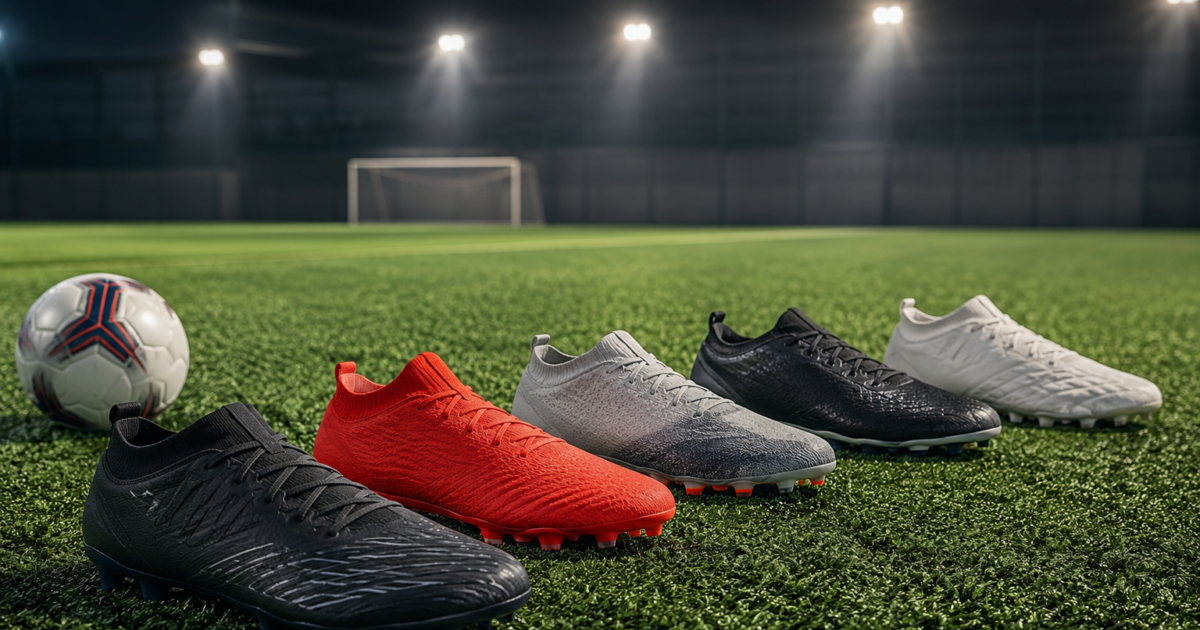
The guide compares seven football boots for artificial grass, focusing on 3G pitches, fit, traction and price. It explains why dedicated AG soleplates matter and distinguishes AG, MG, TF and FG boots for different surfaces.
The Nike Phantom 6 Low Pro AG is named best overall, with other picks for speed, wider feet, comfort and value. It also covers boot fitting, venue rules, pricing and basic maintenance for synthetic pitches.
Finding the best football boots for artificial grass is not simply a matter of choosing your favourite colour or copying a professional player.
The soleplate matters just as much as the upper. A boot designed for soft natural grass can feel awkward on a firm synthetic surface, while ordinary trainers may not provide enough grip for sharp turns and sudden stops.
For most players who regularly train or compete on a long-pile 3G pitch, a dedicated artificial-ground boot is the strongest starting point. AG boots normally use shorter and more numerous studs than traditional firm-ground models. Many also favour rounded or hollowed stud shapes that spread pressure across the foot.
This guide compares seven current options at different prices. It covers speed boots, control boots, wider-fitting models and affordable choices for weekly training.
Prices are official UK recommended retail prices checked on 21 July 2026. Retailers regularly reduce older colourways, so the price you pay may be lower.
For more equipment advice, visit the World in Sport sports guides hub or read our guide to the best football boots for wide feet.
Quick verdict: the best AG football boots
| Football boot | Best for | UK RRP |
|---|---|---|
| Nike Phantom 6 Low Pro AG | Best overall | £144.99 |
| adidas F50 Elite AG | Speed and acceleration | £220 |
| PUMA Future 9 Ultimate AG | Playmakers and wider feet | £220 |
| Nike Tiempo Maestro Elite AG | Comfort and ball touch | £229.99 |
| PUMA Ultra Nitro 7 Pro AG | Lightweight mid-range option | £130 |
| Nike Phantom 6 Low Academy AG | Best option under £100 | £79.99 |
| adidas F50 League 2G/3G AG | Affordable weekly training | £80 |
Our overall pick is the Nike Phantom 6 Low Pro AG. It balances a dedicated artificial-ground soleplate with a comfortable toe box, a textured upper and a price below the elite level.
Players who prioritise speed should compare the adidas F50 Elite AG and PUMA Ultra Nitro 7 Pro AG. Those who need more room through the forefoot should look closely at the PUMA Future 9 Ultimate AG.
Why artificial-ground boots matter
Artificial grass creates a different playing experience from natural turf.
A modern 3G pitch normally has a longer synthetic pile with infill beneath it. The studs enter that surface to provide grip, but the ground underneath remains firmer and less forgiving than soft soil.
Dedicated AG boots address this by spreading the studs more evenly across the soleplate. The studs are generally shorter than aggressive firm-ground blades and may be rounded or hollowed to support movement on the synthetic surface.
That does not mean every venue follows the same rules. Some facilities allow moulded plastic studs but ban blades and metal studs. Others have their own detailed footwear lists.
The FA’s 3G pitch footwear guide shows why players should check the policy before travelling. The Football Foundation also advises users to follow the surface manufacturer’s guidance and says boots with short plastic or rubber studs are generally encouraged.
Best overall: Nike Phantom 6 Low Pro AG
The Nike Phantom 6 Low Pro AG offers the most convincing balance of performance and price in this shortlist.
Nike has given the boot a more natural shape through the toe box than older Phantom generations. That makes it more accommodating than many narrow speed boots, although players with particularly wide feet should still try it before wearing it outdoors.
The VNMSkin striking area adds texture across the upper, while Flyknit helps the boot sit close to the foot. The result is a responsive feel when passing, dribbling and striking the ball.
Underneath, shorter studs with hollowed centres suit longer artificial-grass surfaces. The conical layout also supports quick changes of direction without feeling excessively aggressive.
At £144.99, the Pro version sits in a useful middle ground. It costs considerably less than an elite boot but retains more performance detail than most entry-level models.
Best for: Midfielders, forwards and all-round players who want one dependable AG boot.
Potential drawback: It still feels fairly close around the foot, so it will not suit every wide-footed player.
Best for speed: adidas F50 Elite AG
The adidas F50 remains one of football’s best-known speed-boot lines.
The original F50 became prominent during the 2000s, when lightweight synthetic boots began challenging heavier leather designs. The line later disappeared before adidas brought it back for a new generation.
Its modern Elite AG version follows the same basic idea. It provides a close fit, a lightweight Fibertouch upper and an artificial-ground frame built for fast movement.
The AG Traxion outsole uses conical studs to provide multidirectional grip rather than relying on long, aggressive blades. This makes the boot better suited to synthetic pitches than the firm-ground F50.
The F50 Elite AG feels most natural on players who like a direct, responsive boot. Wingers, attacking full-backs and forwards may appreciate how little material sits between the foot and the ball.
At £220, however, this is a premium purchase. Recreational players do not need to spend that much to find a safe and comfortable AG boot.
Best for: Quick players who value a lightweight, close-to-the-foot sensation.
Potential drawback: The streamlined shape may feel restrictive on broad feet.
Best for wider feet: PUMA Future 9 Ultimate AG
The PUMA Future 9 Ultimate AG is one of the most accommodating elite options in the current market.
PUMA lists it as having a regular-to-wide fit and a rounded toe. Its engineered knit upper adapts around the foot, while the midfoot structure aims to provide support without making the boot feel rigid.
That flexibility gives the Future a different character from a traditional speed boot. It suits players who twist, turn and receive the ball in crowded areas rather than relying only on straight-line acceleration.
The artificial-ground FLEXGILITY outsole uses a circular stud arrangement designed for pivots and movement in several directions. That makes sense for midfielders, number tens and forwards who frequently change their body position.
The £220 price places it firmly in the premium category. However, older colourways are often reduced once new collections arrive.
Best for: Playmakers, dribblers and players who need additional room through the forefoot.
Potential drawback: Some players may prefer the firmer, more structured feeling of a conventional low-cut boot.
For more fit advice, our football boots for wide feet guide explains why toe-box shape and midfoot pressure matter as much as the labelled size.
Best for comfort and touch: Nike Tiempo Maestro Elite AG
Tiempo has a long history as Nike’s comfort and touch-focused boot line.
Earlier generations became closely associated with soft leather uppers. The Tiempo Maestro Elite takes a more modern approach by using Nike’s Techleather material rather than traditional natural leather.
The upper is soft and designed to adapt around the foot. A split Maestro360 soleplate allows the upper to wrap more closely beneath the arch, creating a less rigid feeling than many one-piece speed plates.
Its AG version uses hollowed studs and additional forefoot traction points for harder synthetic surfaces.
At £229.99, the Tiempo Maestro Elite is one of the most expensive options here. It makes the most sense for players who already know they prefer a soft, padded touch rather than an ultra-thin upper.
Best for: Midfielders, defenders and experienced players who prioritise comfort and control.
Potential drawback: The price is difficult to justify for occasional five-a-side or once-a-week training.
Best lightweight mid-range option: PUMA Ultra Nitro 7 Pro AG
The PUMA Ultra Nitro 7 Pro AG targets players who want speed-boot characteristics without paying the full elite price.
PUMA describes the model as narrow, so it will suit slim and medium feet more readily than broad feet. The lightweight upper and responsive cushioning aim to create a quick, energetic feel during acceleration.
Its artificial-ground outsole combines speed-focused studs with rounder elements. That gives players traction for pushing off while retaining a layout intended for synthetic turf.
The £130 RRP places it below most elite AG boots but above basic academy models. That makes it an interesting option for regular players who want a lighter boot without moving beyond £200.
Best for: Wingers, strikers and full-backs with narrow or medium-width feet.
Potential drawback: Wide-footed players should start with the PUMA Future instead.
Best AG football boot under £100: Nike Phantom 6 Low Academy
The Nike Phantom 6 Low Academy AG brings the main shape of the Phantom range into a more affordable package.
It does not use the same premium upper construction as the Pro or Elite models. However, it retains a textured striking area, a comfortable low-cut shape and a soleplate specifically designed for artificial grass.
Its official £79.99 RRP makes it a sensible choice for grassroots players, students and anyone who trains on 3G several times each week.
This is also the level at which most players should begin. A secure £80 boot that suits the pitch is usually a better purchase than a £250 elite model with the wrong soleplate or shape.
Best for: Grassroots matches, regular training and players buying their first dedicated AG boot.
Potential drawback: The upper feels thicker and less refined than the Pro version.
Best affordable 2G and 3G option: adidas F50 League AG
The adidas F50 League 2G/3G AG is built for players who want a recognisable speed-boot shape at a far lower price.
Its £80 RRP matches the Nike Phantom Academy, although sale colourways can cost considerably less. The soleplate is designed with abrasion resistance in mind, which matters on hard synthetic surfaces.
The boot will not feel as light or precise as the £220 F50 Elite. However, that difference matters less to many recreational players than fit, durability and surface suitability.
This version is also clearly labelled for 2G and 3G use. That can help players who move between different artificial pitches, although they should still check each venue’s footwear rules.
Best for: Weekly training, five-a-side leagues and players seeking value.
Potential drawback: The materials and fit feel more basic than those of the Elite model.
AG, MG and TF boots serve different pitches
Football footwear labels can become confusing because brands do not always use exactly the same terminology.
AG means artificial ground. These boots normally have a larger number of shorter studs and suit long-pile synthetic football pitches.
MG means multi-ground. These soleplates aim to work on more than one surface, usually firm natural grass and some artificial pitches. They offer versatility, but a dedicated AG boot remains the more logical choice for someone who plays almost exclusively on 3G.
TF means turf. Turf shoes have many small rubber lugs and work best on short-pile, sand-based or particularly hard artificial surfaces. They should not automatically be treated as the ideal choice for every modern 3G pitch.
FG means firm ground. These boots primarily suit dry or moderately firm natural grass. Some moulded FG designs are permitted on artificial surfaces, but sharp blades and aggressive stud patterns may be restricted.
The safest rule is simple: buy for the surface on which you play most often, then check the facility’s policy.
How artificial-grass boots evolved
Synthetic football pitches have changed considerably since the early short-pile surfaces that became prominent during the 1970s and 1980s.
Those harder pitches helped make dimpled turf trainers a familiar sight. They provided rubber contact across a short synthetic carpet but offered a very different feel from traditional studded boots.
Longer-pile 3G surfaces later moved closer to the playing characteristics of natural grass. That change increased the need for studs that could enter the pile without using the long metal designs associated with muddy natural pitches.
Boot brands responded with dedicated AG plates. Modern versions often feature extra studs, rounded shapes, hollow centres and materials designed to withstand the abrasion created by synthetic fibres.
The biggest names have also carried their historic boot identities into the AG market. F50 and Mercurial still focus on speed. Tiempo and Copa favour touch and comfort. Phantom, Predator and Future concentrate more heavily on control, passing and multidirectional movement.
How should AG football boots fit?
An artificial-ground boot should feel secure but not painful.
Your heel should remain in place when you accelerate or stop. Your toes should have a small amount of room, but the foot should not slide forward inside the boot.
Pay particular attention to the width across the forefoot. Artificial pitches are unforgiving when a boot pinches, and a tight upper can become uncomfortable during a long training session.
Try boots while wearing your normal football socks. Lace both feet properly and make a few controlled turning movements indoors.
Do not assume a painfully tight boot will transform after several matches. Some uppers soften, but the underlying shape and soleplate will not suddenly become wider.
Can you wear firm-ground boots on artificial grass?
Some facilities allow moulded firm-ground boots, particularly when the studs are rounded and made from plastic. Others ban bladed designs or maintain much stricter footwear policies.
The Football Foundation’s 3G pitch guidance encourages short plastic or rubber studs while advising users to follow the surface manufacturer’s instructions.
Even where FG boots are allowed, a dedicated AG plate may feel more comfortable because it distributes pressure through a greater number of contact points.
Never assume metal studs, blades or ordinary trainers will be accepted. The venue has the final say.
How much should you spend?
Most recreational players can find a good AG football boot for between £60 and £150.
Below £60, choices become more limited, although end-of-season discounts can produce excellent value. Between £70 and £100, academy and league-level boots usually offer everything a casual or grassroots player needs.
The £120 to £160 range adds lighter materials, more refined uppers and improved fit. Above £200, buyers are paying for elite-level construction and the lightest available materials.
That premium may make sense for a serious player who trains several times a week. It is not essential for everyone else.
A well-fitting academy boot with the correct soleplate will usually perform better than an uncomfortable elite boot bought for its name.
How to make AG football boots last longer
Synthetic pitches can be abrasive, so basic maintenance matters.
Remove loose rubber infill after each session. Wipe the upper and soleplate with a damp cloth, then leave the boots to dry naturally at room temperature.
Do not place them directly against a radiator. Excessive heat can affect adhesives and make synthetic materials stiff.
Avoid leaving damp boots sealed inside a kit bag. Loosen the laces and allow air to move through the boot before the next session.
You should also inspect the sole regularly. Stop wearing the boots if the upper separates from the plate or if several studs become badly damaged.
Frequently asked questions
What boots are best for a 3G football pitch?
Dedicated artificial-ground boots with short plastic studs are the strongest general choice for long-pile 3G pitches. The Nike Phantom 6 Low Pro AG is our overall pick, while the Nike Phantom Academy AG and adidas F50 League AG offer better value.
Are AG boots better than Astro trainers on 3G?
AG boots usually provide greater stud penetration on long-pile 3G pitches. Astro or turf trainers are more commonly suited to shorter and harder artificial surfaces. Venue rules differ, so check before playing.
Are metal studs allowed on artificial grass?
Many facilities ban metal studs, although individual policies vary. Never wear them without checking the venue’s rules.
Can AG boots be worn on natural grass?
They can work on some dry and firm natural pitches, but they may not provide enough penetration when the ground becomes soft. Multi-ground boots offer more versatility for players who regularly switch surfaces.
Do expensive football boots improve performance?
Elite boots can feel lighter and use more sophisticated materials, but they cannot correct a poor fit or an unsuitable soleplate. Comfort, traction and surface compatibility should come first.
Final verdict
The Nike Phantom 6 Low Pro AG is the best all-round football boot for artificial grass in this comparison. It combines a dedicated AG plate, a natural toe-box shape and a textured upper without reaching elite-level prices.
The PUMA Future 9 Ultimate AG is the stronger choice for wider feet and agile playmakers. The adidas F50 Elite AG suits players who want a lightweight speed boot, while the Nike Tiempo Maestro Elite AG prioritises comfort and touch.
For most grassroots players, the Nike Phantom 6 Academy AG and adidas F50 League 2G/3G AG offer the best value.
Whichever model you choose, match the soleplate to the pitch rather than the player pictured in the advertising. The right boot should feel secure, comfortable and predictable every time you accelerate, turn or challenge for the ball.
Explore more football news, rules and match guides or start with our complete football rules explained guide.
