
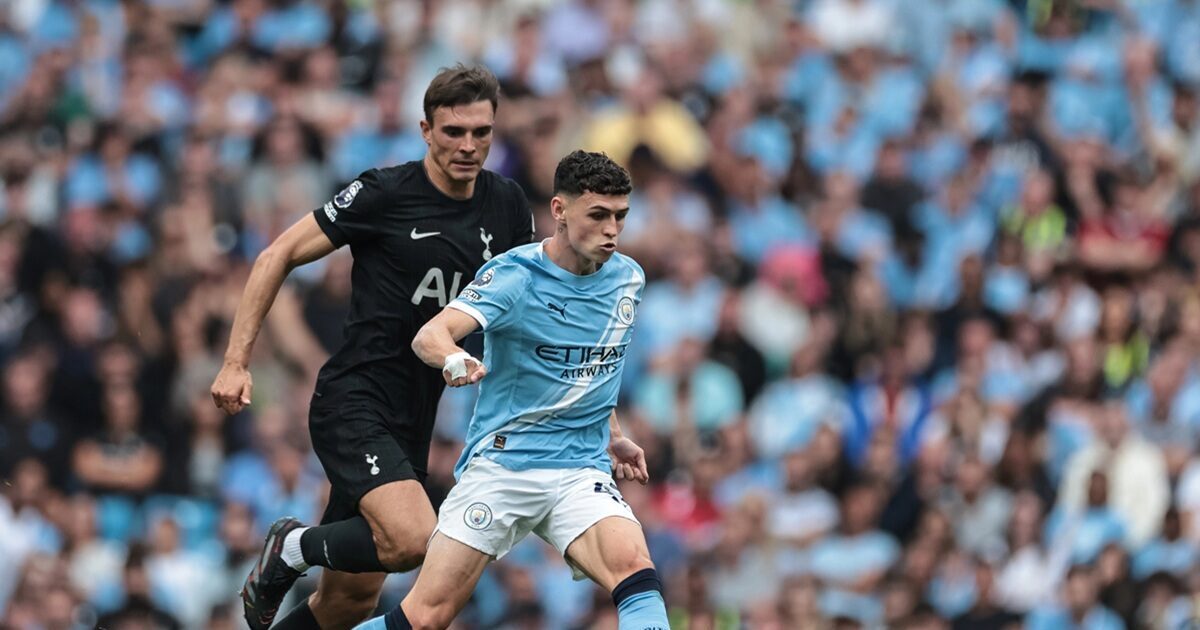
Phil Foden’s rise from Stockport supporter to Manchester City mainstay is traced through his academy path, his breakthrough under Pep Guardiola, and his role in the club’s most successful era. The profile covers his playing style, England career, records and major honours, including 369 appearances, 110 goals and a contract through 2030.
It also highlights how his best season in 2023/24 changed his status from promising academy graduate to decisive match-winner. With a new manager and greater responsibility ahead, Foden is presented as both a symbol of City’s identity and a senior figure in its next phase.
Phil Foden’s rise carries a meaning that statistics alone cannot capture.
Manchester City have assembled some of the finest players of the modern era, often through ambitious recruitment and enormous financial investment. Foden represents something different. He grew up supporting the club, entered its academy as a child and eventually became a defining player during its most successful period.
The boy from Stockport did not simply break into an elite team. He survived the intense competition, tactical demands and constant pressure that came with playing under Pep Guardiola.
He then became one of Manchester City’s leading match-winners.
Now entering the next phase of his career, Foden has signed a contract keeping him at the Etihad Stadium until 2030. The deal could take his relationship with the club beyond two decades and positions him as one of the senior figures charged with carrying City into a new era. Manchester City confirmed Foden’s new four-year contract on 22 July 2026.
Phil Foden’s career record
As of 22 July 2026, Foden has made 369 senior appearances for Manchester City, scoring 110 goals and providing 68 assists.
He has also collected 20 major honours, leaving him level with Bernardo Silva and John Stones as the most decorated players in the club’s history. His collection includes six Premier League titles, five League Cups, three FA Cups, three Community Shields, one Champions League, one UEFA Super Cup and one FIFA Club World Cup.
Those figures place Foden among the most productive academy graduates in modern English football. He is also one of only 20 men to have scored at least 100 goals for Manchester City.
Yet his importance goes beyond numbers. To many City supporters, Foden remains the clearest connection between the stands, the academy and the first team.
A Stockport childhood shaped his identity
Philip Walter Foden was born in Stockport on 28 May 2000 and grew up as a Manchester City supporter.
He played grassroots football for Reddish Vulcans before joining City’s academy at under-nine level. His technical ability stood out immediately, but his smaller frame meant that his pathway required patience as well as skill.
Foden regularly competed against older and physically stronger players. He learned to protect the ball, escape pressure and think before opponents could close him down. Those early challenges helped shape the close control and awareness that later became central to his senior game.
His connection to City was never manufactured for publicity. He had watched the club as a supporter, served as a ball boy and progressed through the youth system before training alongside players he had once admired.
That background gives his story an emotional weight few modern careers can match.
For more character-driven career stories from across sport, visit the World in Sport profiles section.
England’s Under-17 triumph announced his talent
Foden’s wider breakthrough arrived at the 2017 FIFA Under-17 World Cup in India.
England won the tournament after defeating Spain 5-2 in the final. Foden scored twice in that match and received the Golden Ball as the competition’s outstanding player.
The performance introduced him to supporters beyond Manchester and confirmed that City possessed one of England’s most gifted young footballers.
He carried himself with the confidence of a street player but rarely appeared interested in the attention surrounding him. His football did the talking. He wanted the ball in crowded areas, looked to move forward and played without fear.
England’s triumph also placed him at the centre of a highly rated generation. However, youth success offers no guarantee of senior opportunity. Foden still had to find a route into a Manchester City side filled with established internationals.
Guardiola made patience part of the plan
Pep Guardiola first included Foden in a senior Champions League squad against Celtic in December 2016, when the midfielder was only 16.
His competitive debut arrived against Feyenoord in November 2017. One month later, aged 17 years and 192 days, he became the youngest English player at the time to start a Champions League match when City faced Shakhtar Donetsk.
Many supporters wanted to see him play more regularly. Guardiola resisted the temptation to accelerate the process.
Foden had to compete with David Silva, Kevin De Bruyne, Bernardo Silva, İlkay Gündoğan and other established performers. Rather than leaving on loan, he remained inside City’s first-team environment and learned the positional details of Guardiola’s football.
That decision divided opinion at the time. In hindsight, the education proved invaluable.
Foden studied how elite midfielders received the ball, controlled space and chose when to increase the tempo. Guardiola gradually expanded his responsibilities instead of asking him to carry the side before he was ready.
World in Sport’s analysis of Guardiola’s possession-based philosophy explores the technical demands placed on creative players within such a structured system.
Foden turned promise into consistent production
The 2019/20 campaign marked an important change. Foden began to move beyond occasional appearances and became a reliable first-team option.
He followed that progress with 50 appearances, 16 goals and 12 assists during the 2020/21 season. City won the Premier League and League Cup while reaching their first Champions League final.
Foden no longer looked like a young player receiving protected minutes. He influenced major matches and delivered in several positions.
He could play from the left, start on the right, operate behind a striker or move into central midfield. That versatility helped him earn opportunities, although it also created a lasting debate over his best role.
His performances brought individual recognition. Foden won the PFA Young Player of the Year award and the Premier League Young Player of the Season prize in both 2020/21 and 2021/22.
However, his defining individual campaign was still to come.
The 2023/24 season changed his status
Foden entered the 2023/24 season as an outstanding member of an exceptional squad. He ended it as Manchester City’s driving attacking force.
Playing more regularly in central areas, he scored 27 goals across all competitions, including 19 in the Premier League. His strikes against Manchester United and West Ham became defining images of City’s fourth consecutive league title.
Foden received the Premier League Player of the Season award, the PFA Players’ Player of the Year prize and the Football Writers’ Association Footballer of the Year award.
Those honours represented more than recognition for a productive season. They answered a question that had followed him since his academy days.
Foden was no longer merely a talented player thriving inside Guardiola’s system. He had become the player capable of deciding City’s biggest matches.
He also scored two Premier League hat-tricks during the title run-in, against Brentford and Aston Villa. Those performances followed his first senior treble in the 6-3 Manchester derby victory in October 2022.
What makes Phil Foden’s playing style different?
Foden is a left-footed attacking midfielder who combines close control, acceleration and intelligent movement.
His first touch often takes him away from pressure rather than simply stopping the ball. He receives on the half-turn, shifts his weight quickly and attacks the space created by a defender’s hesitation.
He is particularly dangerous around the edge of the penalty area. When Foden moves inside from the right or receives between the lines, he can open his body and strike with limited backlift.
His low centre of gravity helps him change direction without losing control. Meanwhile, his awareness allows him to combine quickly with team-mates in crowded areas.
Foden’s most effective qualities include:
Close control under pressure
Quick changes of direction
Movement between midfield and defence
Accurate shooting from outside the penalty area
Fast combinations around the box
Intelligent pressing and counter-pressing
Late runs into scoring positions
Guardiola often encouraged Foden to trust his instinct to turn, move forward and attack the penalty area. He is not a controlling midfielder in the traditional sense. His greatest value comes when he accelerates an attack, breaks a line or arrives in a position to score.
His versatility brings freedom and frustration
Foden’s adaptability has helped him collect appearances, but it has also complicated the search for his permanent position.
On the wing, he can stretch a defence before cutting inside. As a number 10, he can receive closer to goal and combine with a striker. In a deeper role, his technique helps City move through pressure.
The central position appears to offer the clearest route to his full attacking influence. His finest season came when he received greater freedom between the lines and carried more responsibility for goals.
However, managers value his ability to solve several different problems. That often means moving him to suit the team rather than constructing the team around him.
The same debate has followed Foden at international level. World in Sport examined the challenge of fitting England’s creative players together in its analysis of Thomas Tuchel’s number 10 options.
Foden’s England career remains unfinished
Foden made his senior England debut against Iceland on 5 September 2020.
He scored his first two international goals against the same opponents in November that year and later represented England at Euro 2020, the 2022 World Cup and Euro 2024.
He scored against Wales at the 2022 World Cup and helped England reach consecutive European Championship finals. However, his club form has not always transferred smoothly to the international stage.
England’s shape, tempo and distribution of attacking roles have sometimes limited the spaces in which Foden excels. He has played from the left, through the middle and in deeper positions without consistently reproducing his most dominant Manchester City performances.
As of July 2026, England’s official player record lists Foden with 49 senior caps and four goals.
His international career should not be considered complete at 26. Nevertheless, the contrast between his club influence and England output remains one of the most interesting parts of his story.
Difficult periods tested his character
Foden’s career has included extraordinary success, but his development has not followed a perfectly smooth upward line.
After the personal high of 2023/24, he experienced periods in which illness, fitness problems, tactical changes and reduced form interrupted his rhythm.
That dip mattered because Foden had raised expectations so dramatically. Once a player has won the leading individual awards in English football, every quiet run becomes a talking point.
Guardiola continued to support him publicly. The manager urged Foden to rediscover the freedom and enjoyment that had always defined his best football, rather than trying to become a different type of player.
Those periods may ultimately strengthen his legacy. Great careers are rarely defined only by the climb. They are also shaped by how a player responds when confidence, form and certainty disappear.
A new Manchester City era changes his responsibility
Foden spent his entire senior club career under Guardiola before the managerial transition of 2026.
Enzo Maresca’s appointment changes the landscape. Foden is no longer the academy prospect learning from experienced champions. He is now one of the established players expected to protect standards, guide younger team-mates and help shape the next version of Manchester City.
World in Sport examined the scale of that transition when Manchester City appointed Maresca as Guardiola’s successor.
Maresca already knows Foden from his spell on City’s coaching staff during the treble-winning 2022/23 season. That familiarity should help, although the tactical demands and internal hierarchy will inevitably evolve.
The contract running to 2030 gives Foden security. It also brings responsibility.
He has already won more than many elite players achieve across an entire career. His next challenge is to lead rather than follow.
What records does Phil Foden hold?
Foden’s achievements include several notable landmarks.
He became the youngest English player to start a Champions League match when he faced Shakhtar Donetsk in December 2017.
He became the youngest Manchester City player to reach 200 Premier League appearances, achieving the landmark at 25 years and 158 days in November 2025.
He is one of only 20 men to score 100 competitive goals for Manchester City.
He has won six Premier League titles, with only five players having lifted the trophy more often.
Foden has also scored three hat-tricks for City and registered more than 100 Premier League goal contributions for the club.
What will define Phil Foden’s Manchester City legacy?
Foden’s place in Manchester City history is already secure.
He played an important role in the club’s first Champions League-winning campaign, contributed to the 2022/23 treble and became a leading figure during the first four-title sequence in English top-flight history.
He has also achieved something less measurable.
Foden gave City supporters a local hero during an era of global expansion. He showed academy players that a pathway into an elite first team remained possible, even when that squad contained some of the world’s best footballers.
His legacy will not depend solely on trophies or goals. It will rest on the connection between his beginnings and his achievements.
He was the child wearing oversized City shirts, the ball boy watching from the touchline and the teenager waiting behind celebrated internationals.
He eventually became the player deciding title races.
The next stage may prove the most revealing. Foden must now adapt to a new manager, recover his most decisive form and accept a greater leadership role.
Whatever follows, the central truth of his story will remain unchanged.
Phil Foden is not simply a star who plays for Manchester City. He is a product of the club, a supporter from its local community and one of the clearest symbols of its most successful era.
For the latest features, analysis and career stories, follow World in Sport’s wider football coverage.
