
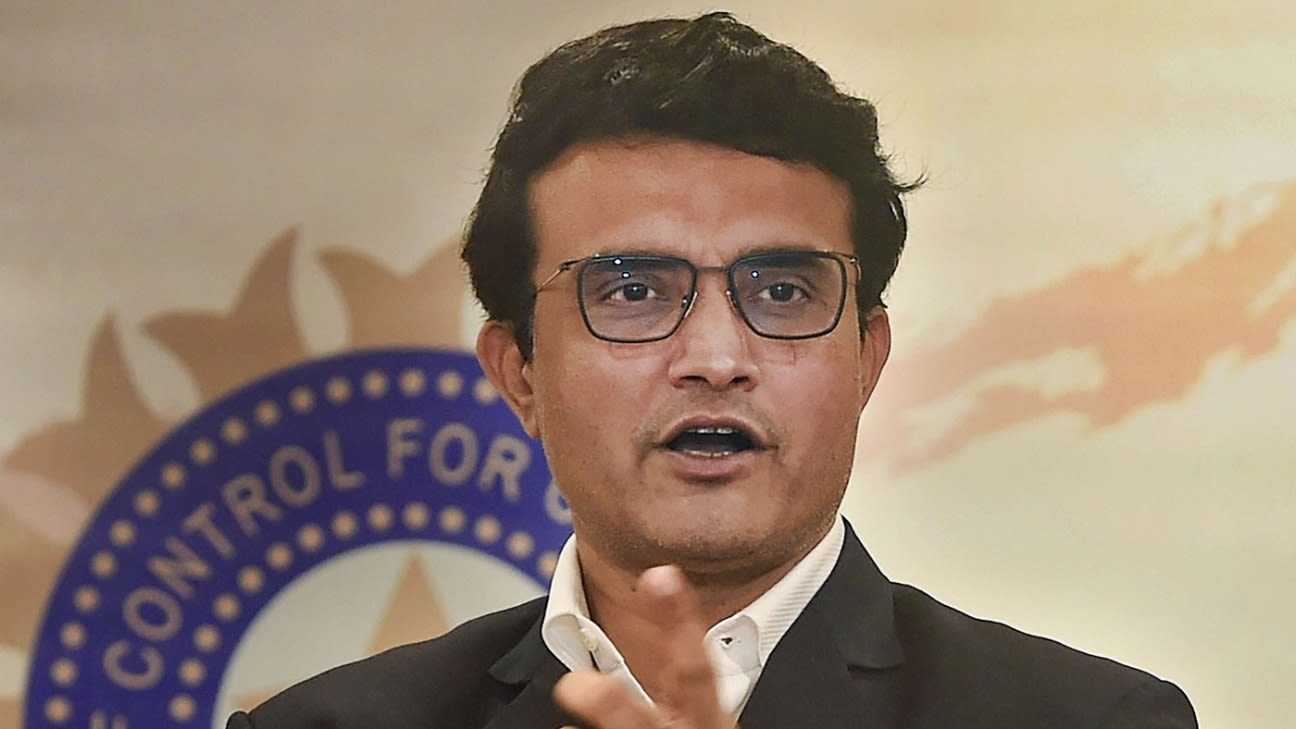
Ganguly, considered one of India’s best captains, played 113 Tests and 311 ODIs. He started his Test career against England in 1996 and made two hundreds in his first two Tests. In all, he scored 7212 runs at an average of 42.17 in Test cricket and 11,363 at 41.02 in ODIs. In white-ball cricket, he formed a prolific opening pair with Sachin Tendulkar. The two opened together 136 times, adding a record 6609 runs with 21 century stands.
Ganguly’s bigger contribution probably was as captain. He took over the side after the 2000 match-fixing saga and made India a formidable side outside India. Under his captaincy, India won the NatWest Series in England in 2002 and were the joint-winners of the Champions Trophy later that year. In 2003, he led the team to the final of the 2003 ODI World Cup, where they lost to Australia. In Test cricket, Ganguly’s side beat Australia 2-1 in the famous 2000-01 Border-Gavaskar Trophy at home before drawing 1-1 in Australia in 2003-04.
“To have my name included among cricket’s greatest players will remain one of my most cherished moments,” Ganguly said. “Representing India and playing along with several greats of the game has been a privilege, and to now be recognised in this way is truly special. This game has given me a lot, and I hope to continue to serve the game in the years to come.”
England’s Pietersen played 104 Tests, scoring 8181 runs at 47.28. In his very first Test series, the 2005 Ashes, he played a key role in England winning the urn after 17 years with a stroke-filled 158 at The Oval on the final day of the series. In 2012-13, he was also instrumental in England winning a Test series in India for the first time in 28 years.
Known for his flamboyant strokeplay, including the switch hit, Pietersen also scored 4440 runs in 136 ODIs, and was the Player of the Tournament in England’s 2010 T20 World Cup win.
“It is the highest recognition a cricketer can receive, and I know it will take some time for it to fully sink in,” Pietersen said. “I feel privileged to have played across all three formats of the game, and I look back on my career with immense pride and satisfaction.”
Chopra, a left-hand batter who captained India in all three formats, made her international debut in 1995. She was the first Indian woman to reach 1000 ODI runs and the first to play 100 ODIs. She also made notable contributions for India in the 2000 and 2005 ODI World Cups. Overall, she scored 2856 runs in 127 ODIs.
She played 12 Tests, scoring 548 runs with a best of 98 that came in the 2006 victory over England in Taunton. She also captained India to their overseas Test victory, in South Africa in 2002.
“As a kid growing up in a sporting household, I had heard stories of cricketing greats and momentous achievements,” Chopra said. “A dream to play for India got instilled very early on. I was encouraged to think big by my parents, teachers and coaches who have always been there to support me during tough times.
“I also got the timely support of administrators as I went on to wear the national colours with great pride. This honour – to be recognised amongst the game’s greatest – is an award for all those who have helped shape my career.”
Launched in January 2009 as part of the ICC’s centenary celebrations, the ICC Hall of Fame honours those whose achievements, skill and lasting influence have shaped the game. Players become eligible for induction only five years after their final international appearance.
