
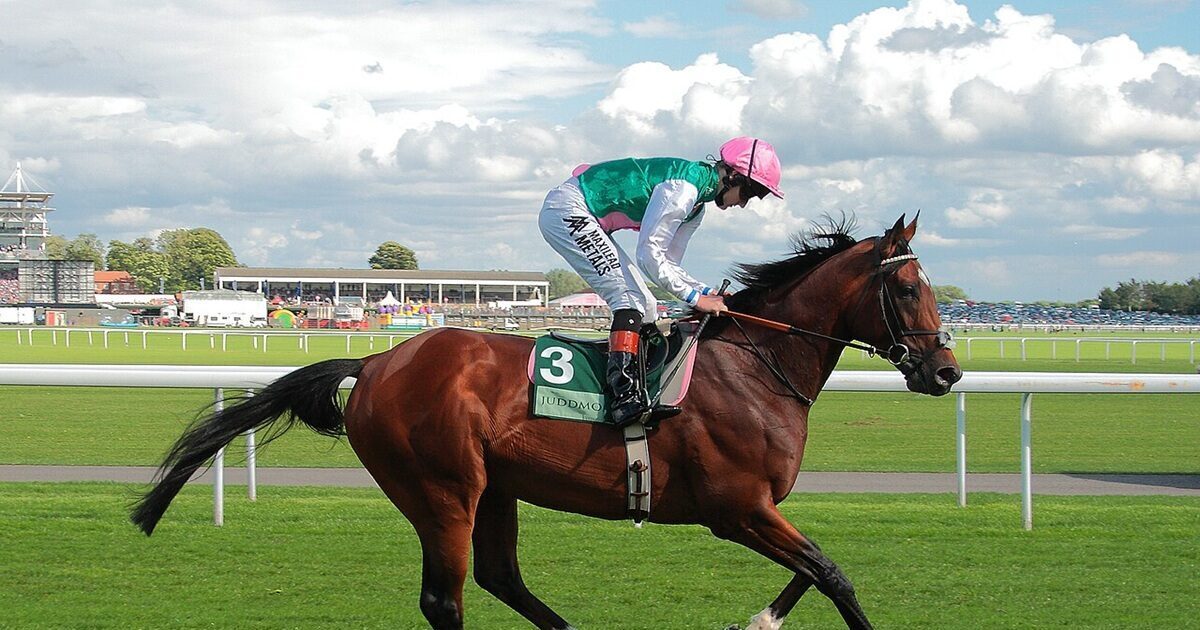
Frankel completed one of the most commanding careers in modern Flat racing without experiencing defeat. Fourteen races brought 14 victories, including ten at Group 1 level. As he progressed from an exciting two-year-old into a champion miler capable of carrying his brilliance beyond a mile.
Numbers alone do not explain why Frankel remains such an important figure. The margins of victory, quality of opposition and sustained standard of his performances separated him from other unbeaten horses. He won at the highest level from seven furlongs to ten and a half furlongs, earned an official rating of 140 and became champion at two, three and four.
His racing career lasted only 26 months, from August 2010 to October 2012, but it produced performances that changed the way a generation discussed equine greatness. His subsequent success as a stallion has extended that influence far beyond his final appearance at Ascot.
Bred for Success at Juddmonte
Frankel was foaled on 11 February 2008 at Banstead Manor Stud near Newmarket. A bay colt bred by Juddmonte Farms, he was by the Derby winner and exceptional stallion Galileo out of Kind, a six-time winner whose sire was the influential Danehill.
His pedigree combined Galileo’s middle-distance quality with significant speed on his dam’s side. However, even the strongest bloodlines cannot guarantee an elite racehorse. Frankel still had to develop the physical strength, balance and mental control required to use his natural ability effectively.
Prince Khalid Abdullah, Juddmonte’s founder, named the colt after Bobby Frankel, the American trainer who had handled many of the owner’s leading horses. Bobby Frankel died in November 2009 and never saw his equine namesake race. The colt was sent to Sir Henry Cecil at Warren Place in Newmarket, establishing a partnership that became central to the final chapter of Cecil’s career.
Cecil managed Frankel’s development carefully, while Tom Queally rode him in every race. The continuity between horse, trainer and jockey mattered. Frankel possessed extraordinary natural speed, but his exuberance needed to be directed rather than suppressed.
An Unbeaten Juvenile Campaign
Frankel made his debut over a mile at Newmarket on 13 August 2010. He defeated Nathaniel by half a length, a result that became increasingly significant as Nathaniel developed into a multiple Group 1 winner and later sired Enable.
The margin was the smallest of Frankel’s career, but the race revealed his ability before the wider racing public understood its scale. He returned at Doncaster and won by 13 lengths before moving into Group company.
His ten-length success in the Royal Lodge Stakes at Ascot demonstrated that he could maintain a strong gallop over a mile. Frankel then won the Dewhurst Stakes at Newmarket, beating a field that included Dream Ahead, winner of that season’s Middle Park Stakes.
Four victories from four starts secured his position as Europe’s champion two-year-old colt. More importantly, his performances suggested that he had the speed for the following season’s 2,000 Guineas without needing to sacrifice his ability to stay a mile.
The 2,000 Guineas Performance That Changed His Reputation
Frankel began his three-year-old campaign with victory in the Greenham Stakes at Newbury. That preparation took him to the 2,000 Guineas at Newmarket on 30 April 2011, where he delivered the performance that transformed him from leading prospect into a sporting attraction.
Queally allowed Frankel to establish his rhythm from the start. Rather than conserving energy behind the field, the colt accelerated away and opened a lead of approximately 15 lengths by halfway.
The expected challenge never came. Frankel remained clear and won by six lengths from Dubawi Gold, recording the race’s widest winning margin for 64 years. It was not merely the distance between first and second that impressed. Few Classic winners have placed an entire field under such pressure so early and maintained enough speed to remain dominant.
The performance established the central feature of Frankel’s racing style. His greatest weapon was not a brief finishing burst but a cruising speed that rivals struggled to match. Horses attempting to follow him risked using their energy too soon, while those held back could find the race beyond reach.
A Narrow Victory Exposed the Tactical Challenge
Frankel’s next appearance came in the St James’s Palace Stakes at Royal Ascot. Once again, he moved away from his rivals before the closing stages, but this time the early effort created a less comfortable finish.
Zoffany reduced the gap rapidly inside the final furlong, although Frankel retained a three-quarter-length advantage at the line. It was the closest any horse came to defeating him after his debut and prompted debate over whether Queally had committed for home too early.
The race did not expose a lack of ability. Instead, it demonstrated the difficulty of judging when to release a horse capable of reaching an unusually high cruising speed. Frankel had enough class to win despite the tactical questions, while Cecil and Queally adjusted how they used that speed in subsequent races.
His next start brought a widely anticipated meeting with Canford Cliffs in the Sussex Stakes at Goodwood. Canford Cliffs arrived as an established older champion with five consecutive Group 1 victories, but Frankel beat him by five lengths.
The result removed any suggestion that Frankel’s dominance had depended on facing only his own age group. He completed his three-year-old campaign by defeating Excelebration in the Queen Elizabeth II Stakes at Ascot, ending the season unbeaten in nine starts. And established as the world’s highest-rated racehorse.
Returning at Four After an Injury Scare
Frankel could have retired to stud after his three-year-old season. Instead, Prince Khalid kept him in training, giving racing supporters another year and allowing Cecil to test whether the colt could become even better.
Preparations were briefly interrupted in April 2012 when Frankel struck his off-fore leg during exercise. Swelling near the tendon area led to concern about his future, but scans found no serious damage. He returned to work and was able to begin his season in the Lockinge Stakes at Newbury.
Frankel won the Lockinge by five lengths from Excelebration. The victory was impressive, although it served mainly as preparation for his appearance in the Queen Anne Stakes at Royal Ascot.
Facing a strong field, Frankel moved smoothly through the race before accelerating clear. He defeated Excelebration by 11 lengths, producing one of the defining performances of his career.
The International Federation of Horseracing Authorities assessed the performance at 140. Timeform awarded Frankel a rating of 147, the highest figure the organisation had given to a racehorse. Different rating systems use different methods, but both indicated that the Queen Anne performance sat at the extreme upper limit of modern Flat racing.
Proving His Brilliance Beyond a Mile
Frankel returned to Goodwood for a second Sussex Stakes and became the first horse to win the race twice. Only three rivals opposed him, reflecting both his reputation and the limited number of connections willing to compete.
The remaining question concerned distance. Ten of his first 12 appearances had come over a mile. And some observers wondered whether his powerful, free-running style would be as effective over a mile and a quarter.
Cecil provided the answer in the Juddmonte International at York. Frankel travelled behind his pacemaker before moving forward with little apparent effort. Once Queally asked him to accelerate, he drew clear and beat Farhh by seven lengths.
The victory was his first beyond a mile and arguably his most complete performance. Frankel retained his speed but distributed his effort efficiently enough to dominate over ten and a half furlongs. More than 30,000 spectators attended the opening day of York’s Ebor Festival, an increase of 55 per cent from the corresponding day a year earlier.
His final race presented a different challenge. Heavy rain left testing ground for the Champion Stakes at Ascot, while Frankel was slowly away and raced further behind the leaders than usual.
He recovered his position, passed Nathaniel and then defeated the high-class French gelding Cirrus Des Aigles by one and three-quarter lengths. The margin was smaller than in his most spectacular victories, but the circumstances added to the performance. Frankel had overcome a poor start, soft ground and proven Group 1 opposition to complete his career unbeaten.
Frankel’s Career Record
| Career detail | Record |
|---|---|
| Foaled | 11 February 2008 |
| Breeder | Juddmonte Farms |
| Owner | Prince Khalid Abdullah |
| Trainer | Sir Henry Cecil |
| Jockey | Tom Queally |
| Career starts | 14 |
| Career wins | 14 |
| Group 1 wins | 10 |
| Winning distance range | Seven furlongs to ten and a half furlongs |
| Official peak rating | 140 |
| Timeform rating | 147 |
| Career prize money | £2,998,302 |
| Retired from racing | 2012 |
| Entered stud | 2013 |
Final racing statistics are complete to Frankel’s retirement in October 2012.
Readers unfamiliar with terms such as furlongs, Group races, pacemakers and going descriptions can find further context in World in Sport’s horse racing rules guide.
What Made Frankel Different?
Frankel combined stride length, balance and cardiovascular efficiency with the ability to sustain an exceptionally strong pace. Rivals were not simply required to produce a faster finish. They had to travel at an uncomfortable speed for longer than most horses could manage.
His racing style developed over the course of his career. The two-year-old Frankel could be forceful and eager, while his 2,000 Guineas victory came through almost unrestricted front-running. As he matured, Cecil and Queally became increasingly adept at settling him behind pacemakers before using his acceleration.
That adaptability mattered when Frankel moved beyond a mile. At York, he did not race as though Queally were attempting to preserve a doubtful stayer. He travelled naturally, relaxed behind the early pace and produced the same decisive change of speed seen over shorter distances.
There were still limits to what his record could prove. Frankel never raced outside Britain and did not contest the Derby, Prix de l’Arc de Triomphe or Breeders’ Cup. Most of his career centred on a mile, and comparisons with champions from different eras, distances and racing systems inevitably involve judgement.
Those omissions should form part of any balanced assessment. However, they do not diminish the level he repeatedly demonstrated against Group 1 winners. The official handicappers calculated that he posted a rating of at least 130 on eight occasions. And reached 135 or higher six times, showing that his reputation did not rest on a single exceptional afternoon.
Ratings, Honours and Place in Racing History
Frankel received an official rating of 140 at the end of 2012. The figure made him the highest-rated horse assessed under the revised international classification system at that time. Flightline subsequently received the same rating in 2022, meaning the pair share the benchmark under the modern system rather than Frankel holding it alone.
Ratings cannot conclusively settle arguments between horses who raced in different periods. Changes in competition, race planning, surfaces and handicapping methods prevent exact comparisons. Nevertheless, Frankel’s rating reflects both the quality and repeatability of his performances.
He was named Cartier Horse of the Year in 2011 and 2012. He was also recognised as Europe’s champion two-year-old colt, champion three-year-old colt. And champion older horse, becoming the first horse for more than 60 years to be champion at two, three and four.
In 2021, Frankel became the first horse inducted into the QIPCO British Champions Series Hall of Fame.
World in Sport readers can explore other careers that shaped the sport through the publication’s collection of sports profiles. And compare his impact with that of celebrated National Hunt figures such as Red Rum.
Extending His Legacy as a Stallion
Frankel retired to Banstead Manor Stud and began his stallion career in 2013. Great racehorses do not automatically become influential sires, but his offspring soon began succeeding at the highest level across Europe, Asia, Australia, North America and the Middle East.
His leading runners have included dual Champion Stakes winner Cracksman, Derby winner Adayar, Irish Derby. And St Leger winner Hurricane Lane, Prix de l’Arc de Triomphe winner Alpinista, multiple Group 1 winner Inspiral, 2,000 Guineas winner Chaldean and Oaks winner Soul Sister. That range has demonstrated his ability to sire elite performers with different racing styles and distance requirements.
Frankel became champion sire in Britain and Ireland in 2021 and regained the title in 2023. By the end of the 2025 season, Juddmonte credited him with 40 individual Group 1 winners and 12 Northern Hemisphere Classic winners. Lake Victoria and Minnie Hauk were among the horses who strengthened that record during 2025.
His advertised stud fee for the 2026 breeding season was £350,000. That figure reflects his commercial value as well as the racing record of his progeny, although stallion fees. And breeding statistics will continue to change as new crops reach the racecourse.
Frankel’s Lasting Racing Legacy
Frankel’s place in racing history rests on more than remaining unbeaten. Plenty of horses have retired without defeat after shorter or less demanding campaigns. His distinction came from maintaining that record through three seasons while repeatedly facing Group 1 opposition.
His 2,000 Guineas established the scale of his natural speed. The Queen Anne Stakes showed the devastating level he could reach at a mile. The Juddmonte International proved that the same ability could be carried into middle-distance company. At the same time, the Champion Stakes demonstrated that he could respond when the start, surface and race position were less than ideal.
Cecil’s decision to keep him in training at four gave Frankel’s career greater depth. It allowed him to improve his rating, expand his distance range and retire after defeating older international opposition rather than leaving unanswered questions after his three-year-old campaign.
There will never be a definitive way to decide whether Frankel was better than every champion who came before or after him. Different eras produce different challenges, and no rating system can eliminate that uncertainty.
What can be assessed is the evidence he left behind: 14 starts, 14 wins, ten Group 1 victories, an official rating of 140. And a body of performances that combined dominance with consistency.
His stallion career has ensured that his influence did not end at Ascot in October 2012. Frankel has become both a reference point for exceptional racecourse performance and an increasingly important source of elite Thoroughbred bloodlines.
That dual legacy makes his career unusually complete. He was unbeaten as a racehorse, tested successfully beyond his specialist distance and then developed into one of the most influential sires of his generation.
