
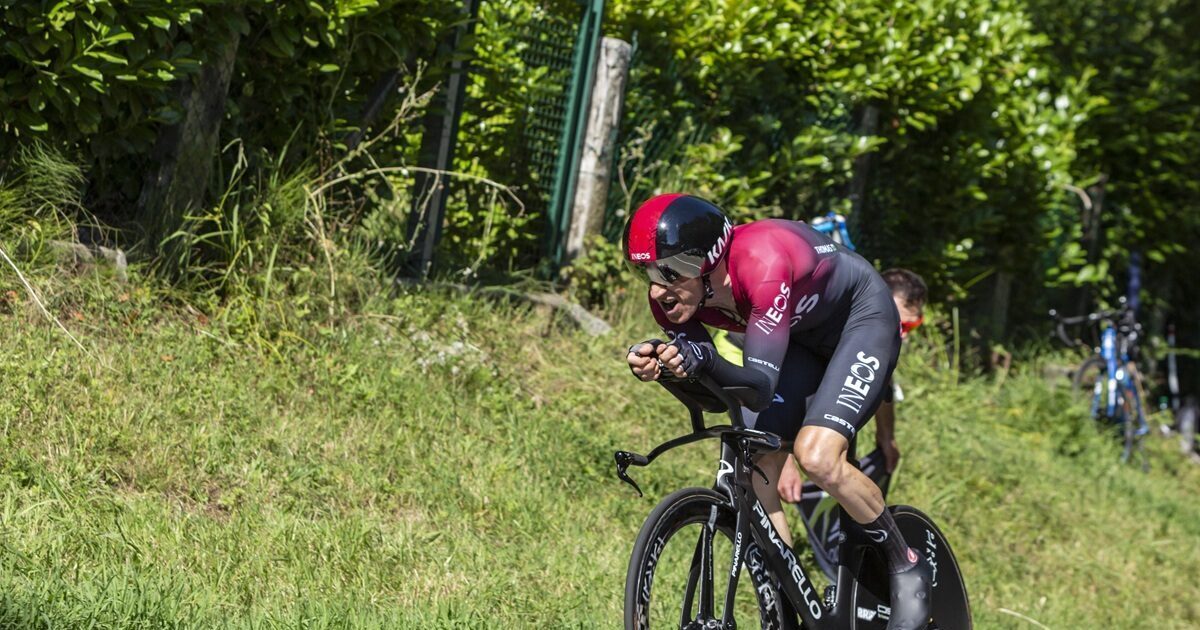
Geraint Thomas belongs to a select group of cyclists whose careers cannot be understood through one discipline alone.
He was an Olympic and world champion on the track before becoming a Classics winner. A trusted Grand Tour domestique and, eventually, the first Welshman to win the Tour de France. His career connected two important periods in British cycling: the track programme that dominated successive Olympic Games and the road-racing teams that transformed Britain into a Grand Tour force.
Thomas did not follow the usual path of an emerging Tour contender. He spent much of his early career riding for other leaders, suffered repeated injuries and did not win the yellow jersey until he was 32. His progress was gradual, occasionally interrupted and built on an unusual combination of power, endurance, tactical discipline and adaptability.
By the time he retired from professional racing in September 2025, Thomas had become one of the most accomplished British cyclists of his generation. His record included two Olympic gold medals, three senior world track titles, a Tour de France victory, and podium finishes in both the Tour de France and the Giro d’Italia.
For further race coverage, analysis and rider features, visit the World in Sport cycling section.
Early Life and the Maindy Flyers
Geraint Howell Thomas was born in Cardiff on 25 May 1986. He grew up in Birchgrove and attended Whitchurch High School. He began cycling at the age of 10 with Maindy Flyers, the Cardiff club based around the outdoor track at Maindy Stadium.
The club provided an accessible introduction to racing rather than a polished professional environment. Young riders learned how to handle a bike, compete on the track and understand the routines required to improve. Thomas developed alongside Luke Rowe, who would later become his teammate at Team Sky and INEOS Grenadiers.
His talent appeared early. Thomas won the scratch race at the 2004 UCI Junior Track World Championships and claimed silver in the points race at the European Junior Track Championships. He later entered British Cycling’s Olympic Academy, where coaches including Rod Ellingworth and Matt Parker helped guide his development.
That progress almost ended in February 2005.
While training with the Great Britain track squad in Australia, Thomas crashed after a piece of metal entered his wheel. He ruptured his spleen, suffered internal bleeding and required major surgery to remove the organ.
The injury caused complications beyond the immediate recovery period. The spleen plays an important role in fighting infection, meaning Thomas had to manage an increased health risk throughout the rest of his career. He nevertheless returned to competition and continued his development on both the road and track.
Track Success Provided the Foundation
Thomas’s early international reputation came through the team pursuit.
Four riders compete together over four kilometres, maintaining a tight formation while sharing the work at the front. Success depends on power, precise pacing, aerodynamic efficiency and complete trust between teammates. A poorly timed change or small gap can disrupt the entire effort.
Thomas helped Great Britain win senior team pursuit world titles in 2007, 2008 and 2012. At the Beijing Olympics in 2008, he joined Ed Clancy, Paul Manning and Bradley Wiggins as Britain broke the world record twice on their way to gold.
He retained the Olympic title at London 2012 alongside Clancy, Peter Kennaugh and Steven Burke. Once again, the British quartet set two world records during the competition.
Those victories established Thomas as an elite track rider, but they also shaped the cyclist he became on the road.
The team pursuit rewards sustained power rather than short acceleration. Riders must control their effort, remain efficient under pressure, and maintain a demanding pace as fatigue builds. Those qualities later became central to Thomas’s success as a time-trialist and Grand Tour rider.
His track background also taught him how to work within a structured team. Before he became a Tour leader, Thomas spent years protecting teammates, controlling races and accepting responsibilities that offered little individual recognition.
Learning the Professional Road Game
Thomas combined his track commitments with a developing road career.
After riding for Recycling.co.uk and spending a short period as a trainee with Saunier Duval-Prodir, he joined Barloworld. The team selected him for the 2007 Tour de France, making him the youngest rider in that year’s race and the first Welsh participant since Colin Lewis in 1967.
Thomas finished 140th out of 141 classified riders. The result was modest, but completing a first Tour at 21 gave him an early understanding of the physical and mental demands of a three-week race.
His development was interrupted again in 2009 when a crash at Tirreno–Adriatico left him with a fractured pelvis and broken nose. However, Team Sky recognised his versatility and signed him for the organisation’s first season in 2010.
Thomas won the British road race title that year and briefly led the Tour de France young rider classification. Over the following seasons, he became an important part of a squad constructed to win Grand Tours.
He worked for Bradley Wiggins during Britain’s first Tour victory in 2012 and later supported Chris Froome. In 2013, Thomas fractured his pelvis on the opening stage of the Tour but continued racing and helped Froome reach Paris in the yellow jersey.
The contrast with Thomas’s later career was striking. The future Tour winner initially built his reputation by carrying bottles, riding into the wind and setting the pace for somebody else.
Readers can explore that period further in the World in Sport profile of Chris Froome.
Becoming More than a Domestique
Thomas gradually proved that his abilities extended beyond support work.
Representing Wales at the 2014 Commonwealth Games in Glasgow, he won bronze in the individual time trial before taking gold in a difficult road race. A late puncture reduced his advantage, but he remained composed and completed a solo victory.
His success in the 2015 E3 Harelbeke provided another important breakthrough. Thomas became the first British rider to win the Belgian cobbled Classic after attacking with Zdeněk Štybar and Peter Sagan before riding away alone.
The victory demonstrated a different side of his skill set. He could survive rough roads, poor weather and repeated changes of pace, then make a decisive move after several hours of racing.
Thomas also developed into a successful one-week stage racer. He won the Volta ao Algarve in 2015 and 2016 before claiming Paris–Nice in 2016. These events combined climbing, time-trialling and tactical management, making them valuable tests for a future Grand Tour leader.
By then, Thomas had moved away from the track and focused entirely on road racing. He reduced his weight without losing the sustained power he had developed in the velodrome and became increasingly competitive on long climbs.
However, his path towards Grand Tour leadership remained difficult.
Thomas won the opening time trial of the 2017 Tour de France in Düsseldorf, becoming the first Welsh rider to wear the yellow jersey. His race ended on Stage 9 when he crashed on a descent while sitting near the top of the general classification.
It was another reminder that form alone could not guarantee a Grand Tour opportunity. Thomas had the physical level to contend, but staying upright and avoiding misfortune across three weeks remained just as important.
The 2018 Tour de France Changes Everything
Thomas entered the 2018 season as an established stage racer but not the clear leader of Team Sky.
Froome had won four Tours and arrived as the defending champion. Thomas strengthened his own case by winning the Critérium du Dauphiné, yet the expectation remained that he would provide support unless circumstances changed.
They changed in the Alps.
Thomas attacked near the finish of Stage 11 at La Rosière, caught the surviving breakaway riders and won the stage. The result placed him in the yellow jersey.
One day later, he won again at Alpe d’Huez. Thomas became the first British rider to take a Tour stage victory on the famous climb. And the first rider since Joop Zoetemelk in 1976 to win consecutive summit finishes at the race.
Those victories altered the team hierarchy. Thomas was no longer protecting a possible Tour winner; he had become the strongest rider in the race.
He defended his lead through the Pyrenees and completed the penultimate individual time trial without suffering the collapse his rivals required. Thomas reached Paris one minute and 51 seconds ahead of Tom Dumoulin, with Froome in third.
The result made him the first Welshman and third British rider to win the Tour de France. He had previously helped Wiggins and Froome claim the yellow jersey, but in 2018 the team worked to protect him.
The controlled racing associated with Team Sky often divided opinion. Critics viewed the team’s strength and mountain pacing as predictable, while supporters saw a difficult strategy executed with discipline.
Thomas certainly benefited from a powerful squad. However, his victory was not solely due to team strength. He arrived after winning the Dauphiné, claimed two decisive mountain stages and avoided the damaging bad day that ended the hopes of other contenders.
To understand how stage victories and the overall standings differ, read the World in Sport guide to cycling race rules, stages and classifications.
Grand Tour Longevity After the Yellow Jersey
Thomas did not repeat his Tour victory, but his later results strengthened rather than diminished his reputation.
He finished second to Egan Bernal at the 2019 Tour, giving Team INEOS the top two positions. Crashes and disrupted preparation then affected subsequent campaigns, including the 2020 Giro d’Italia, where a fall caused by a loose drinks bottle ended his challenge.
Thomas returned to win the Tour de Romandie in 2021. A year later, at 36, he won the Tour de Suisse and finished third at the Tour de France behind Jonas Vingegaard and Tadej Pogačar.
Thomas could not match the accelerations of the two leading riders, but he paced his effort intelligently and finished as the strongest of the remaining general classification contenders. The result placed him back on the Tour podium four years after his victory.
His narrow defeat at the 2023 Giro d’Italia became another defining performance.
Thomas wore the pink jersey during the final week and began the penultimate-stage mountain time trial with a 26-second lead over Primož Roglič. The Slovenian overturned that deficit on Monte Lussari and won the Giro by 14 seconds.
Thomas accepted second place after coming within one stage of completing a Tour–Giro double across his career. The defeat was painful in sporting terms, but his ability to challenge for a Grand Tour at 37 underlined his durability.
He returned to the Giro in 2024 and finished third behind Pogačar and Daniel Martínez. Thomas could not seriously threaten Pogačar’s dominant lead, but he remained consistent enough to reach another Grand Tour podium.
For comparison with the rider who controlled that race, read the World in Sport profile of Tadej Pogačar.
What Made Geraint Thomas Distinctive?
Thomas was difficult to categorise because his competitive role changed throughout his career.
He began as a pursuiter and powerful road rider suited to time trials and northern European Classics. He then became a domestique before developing into a stage-race leader capable of remaining with specialist climbers.
He was not usually the most explosive rider on steep gradients. Pure climbers could accelerate more sharply and create gaps over short distances.
Thomas instead relied on sustained power, measured pacing and the ability to maintain a demanding speed for long periods. He often climbed while seated, keeping his effort controlled rather than repeatedly changing rhythm.
His time-trial ability gave him another advantage. Grand Tour contenders who climbed at a similar level could still lose significant time to Thomas when racing alone against the clock.
Experience also improved his decision-making. Thomas understood where he needed to position himself, when to follow an attack and when chasing would waste energy. His years as a domestique gave him a clear understanding of what teammates required from a leader.
That adaptability became his defining quality. Few modern riders have won Olympic track titles, a cobbled Classic, a Commonwealth road race and the Tour de France.
Crashes and Missed Opportunities
Crashes formed a recurring part of Thomas’s career.
The ruptured spleen in 2005, broken pelvis in 2009, fractured pelvis at the 2013 Tour and abandonment from the 2017 Tour all came before his greatest victory. Later falls disrupted further attempts at the Giro and Tour.
Some incidents resulted from the ordinary risks of professional cycling. Others reinforced the perception that Thomas was unusually vulnerable to misfortune.
However, the setbacks also provide important context for his achievements. Thomas did not progress smoothly from junior champion to Grand Tour winner. He repeatedly had to regain fitness, rebuild confidence and wait for another leadership opportunity.
His career contained no defining personal controversy. Instead, much of the wider debate surrounding him came from his long association with Team Sky, whose resources and controlled style changed professional road racing.
A balanced assessment should acknowledge both sides. Thomas benefited from one of the strongest support structures in cycling, but he also spent years sacrificing his own ambitions for its leaders. When his opportunity arrived in 2018, he outperformed every teammate and rival.
Geraint Thomas’s Major Honours
The following summary covers Thomas’s principal track and road achievements through his retirement in September 2025.
| Competition | Achievement | Year |
|---|---|---|
| UCI Junior Track World Championships | Scratch race gold | 2004 |
| UCI Track World Championships | Team pursuit gold | 2007, 2008 and 2012 |
| Olympic Games | Team pursuit gold | 2008 and 2012 |
| British National Road Championships | Road race champion | 2010 |
| Commonwealth Games | Road race gold | 2014 |
| E3 Harelbeke | Winner | 2015 |
| Paris–Nice | Overall winner | 2016 |
| Critérium du Dauphiné | Overall winner | 2018 |
| Tour de France | Overall winner | 2018 |
| Tour de France | Second overall | 2019 |
| Tour de Romandie | Overall winner | 2021 |
| Tour de France | Third overall | 2022 |
| Giro d’Italia | Second overall | 2023 |
| Giro d’Italia | Third overall | 2024 |
Retirement and a New Role in Cycling
Thomas announced in February 2025 that the season would be his last as a professional rider.
He completed his final Tour de France in July before ending his career at the Tour of Britain on 7 September. The final stage began inside the Newport velodrome that bears his name and finished in Cardiff, allowing him to conclude his career in the area where it began.
Retirement did not take him away from elite cycling.
In November 2025, Thomas was appointed Director of Racing within the INEOS organisation. The leadership position includes involvement in race strategy, recruitment, rider development and preparation.
The appointment reflects the qualities that defined much of his riding career. Thomas understood how successful teams operated from several perspectives: young prospect, domestique, road captain, Grand Tour leader and veteran mentor.
Geraint Thomas’s Welsh and British Cycling Legacy
Thomas’s place in cycling history rests on more than one yellow jersey.
He formed part of Great Britain’s Olympic track success, supported the country’s first generation of Tour winners and then became a Grand Tour champion himself. His career demonstrated that a rider developed for the velodrome could adapt to cobbled Classics, mountain stages and three-week races.
His significance in Wales are especially clear.
Thomas progressed from a community cycling club in Cardiff to the top step of the Tour de France podium. The Wales National Velodrome in Newport was renamed the Geraint Thomas National Velodrome in 2018, while his Tour victory earned him the BBC Sports Personality of the Year award. And an OBE for services to cycling.
His influence is not based on an image of effortless dominance. Thomas crashed, served other leaders and waited longer than most Tour winners for an opportunity.
That is what gives his career its lasting shape.
He was not always the protected rider, the strongest climber or the obvious future champion. He became successful by expanding what he could do, surviving setbacks that might have halted his progress, and remaining ready when the race finally turned in his favour.
For more profiles covering major athletes and champions, visit the World in Sport Sports Profiles hub.
