
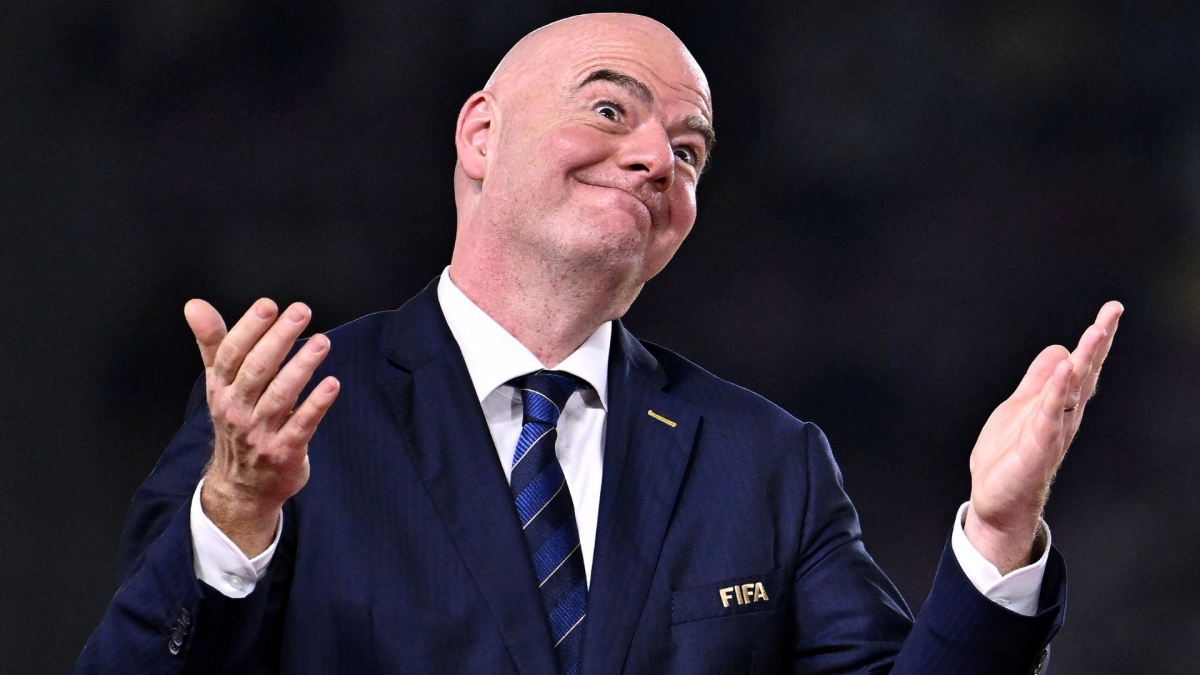
After a decade of nearly unquestioned authority, FIFA president Gianni Infantino has finally forced his critics to mount just enough opposition that he may be out of a job sooner rather than later. The most obvious question is who might follow him in the role, but there is another equally important query: what should the job actually entail?
For decades, the job has been interpreted as one that allows a central figure to assume as much control over the bureaucratic rhythms of the game as possible. FIFA has had just three presidents since 1974, all of whom have done what they can to increase the commercial rigor of the organization and, in particular, the men’s World Cup, sports’ most popular and valuable competition. The expressed motivation, at times, has been to increase investment in the parts of the world that need it the most, even if that line has often felt like window dressing. None of it has come without extreme levels of politicking along the way, meaning whoever becomes Infantino’s successor — if he is actually going to be unemployed, that is — will inherit a mess, an organization that is deeply flawed so much so that there is no pair of rose-colored glasses to look at FIFA through.
Infantino’s potential expulsion, either through a vote of no-confidence or simply March’s upcoming election, marks a chance at an actual reset, no matter how unlikely it might actually be. Meritocracy is not exactly a defining feature of FIFA’s succession plans. Joao Havelange, the president from 1974 to 1998, backed his general secretary Sepp Blatter to succeed him and Blatter ultimately won the votes to do just that. Blatter seemed poised to do the same with Michel Platini, the France legend turned UEFA president, before both were forced out of their jobs in the 2015 corruption scandal. Infantino billed himself as a breath of fresh air in a hotly contested election, but quickly put his own spin on FIFA’s usual order of business. Plus, he keeps such a tight circle — and might have tried to use FIFA Forward Enterprise, his failed proposal to privatize the World Cup, to offer him the chance to stay in charge as long as he wanted to — that he had not picked out an heir apparent.
The best case scenario for FIFA’s future, though, would actually involve a president who would not be lured away from the tasks at hand by backroom affairs that have made world soccer’s governing body a prevailing symbol of cynicism for decades on end. There are, after all, very real matters to discuss outside the inner machinations of world soccer.
Instituting — and following — checks and balances
FIFA can barely go a decade without forcing the game’s power-brokers, even the ones who are often resigned to the order of operations, to admit that governance is an issue that needs to be solved. The people at the top have changed, but they have only reinforced a longstanding problem — the FIFA president has a lot of unchecked power and plenty of authority to game the system in the hopes of staying in the job as long as possible.
Havelange and Blatter’s presidencies were ultimately defined by different corruption scandals, each using their positions to game the system as they saw fit. A report from Swiss prosecutors found that Havelange and his son-in-law Ricardo Teixeira received around $50 million in bribes relating to World Cup broadcasting rights, while Blatter was forced out in the 2015 corruption scandal that centered around a separate set of World Cup broadcast rights. Infantino’s style, though, has been keeping things to himself — FFE failed because he did not actually consult FIFA’s 211 member associations (MA) or the FIFA Council, while he also went around them and the sport’s official lawmakers to institute hydration breaks at this summer’s World Cup and to hand U.S. president Donald Trump the FIFA Peace Prize in December. Proper procedures were an afterthought, eventually to the detriment of all three FIFA presidents.
Whether Infantino’s successor likes it or not, their first responsibility should be ensuring that a system of checks and balances actually exists and cannot be overruled on a consistent basis. The fact that FFE required both sign-off from the 211 MAs and approval from the FIFA Council, the organization’s main decision-making body, is a good thing and those who complained that they were not consulted on a game-changing – and remarkably controversial – plan were right to do so. A democratic, transparent set of procedures will be the only ironclad way to ensure that the next president does not find a way to turn FIFA into a self-serving organization – and maybe, just maybe, a boring one that is actually focused on sporting matters.
Sporting merit comes first
Despite Infantino’s attempts to wrestle control of the World Cup away from the MAs and towards private equity with FFE, world soccer is mostly run by sports administration types who are qualified for their jobs but have a lousy way of showing it. A proper system of checks and balances would be foundational, then, to ensure that FIFA’s main role is not to uplift the president but rather make sporting decisions that are in the best interest of the sport at large.
Fair processes would allow 211 MAs with understandably different priorities to actually advocate for the resources and opportunities they need and get in the way of things that actually offer few benefits to anyone. That would apply to ideas big and small, like the hydration breaks that disrupted the flow of World Cup games and were met with boos in just about all 16 stadiums across North America this summer, or the halftime show that dragged out the halftime break as Spain and Argentina duked it out for sports’ most prestigious title and did not hype up the 80,000-plus inside MetLife Stadium in any real way.
The next FIFA president also could break a streak of World Cup expansion, a carrot that each of Havelange, Blatter and Infantino has dangled in front of low revenue-generating MAs in the hopes of currying favor in elections later on, the tournament now arguably too big for its own good. Next summer’s Women’s World Cup in Brazil will mark the final 32 team edition of the competition, a perfect format – big enough to include a wide variety of teams, all without the headache of figuring out which third-place teams would advance to the knockouts and ensuring a few dead rubber-like games would close out the group stage. The 48 team format, which was on display at this summer’s World Cup and will be the norm in the women’s game starting in 2031, is already testing the limits and the jury is still out on whether or not it is a set-up that actually works. A further expansion to 64 teams, which is now Infantino’s next move to stay in charge, runs a serious risk of diluting sports’ most valuable product.
Reasonable outside investment
The most savory part of the job to just about every realistic candidate is the fact that the FIFA president has to ensure the revenue streams run as effortlessly as possible, in large part because money is essentially the only way to realize its actual mission – doing what it can to ensure soccer is operational in just about every part of the world.
FIFA’s recent presidents have mostly used those earnings as a reason to win votes, adopt a white savior complex and ultimately justify their attempts to maximize profits at the expense of player welfare and entertainment value. FFE is as cynical version as it gets and one that offered incredible influence to private investors in a deal that did not make sense for MAs – FIFA made $15 billion on this summer’s World Cup alone but was set to offer a right in the men’s and women’s World Cups, plus the respective club World Cups, for just $4 billion or so. It is no wonder, then, that Concacaf implored FIFA to use its existing reserves to offer more support to MAs in need of financial assistance – the organization is not exactly strapped for cash, nor has it been for years. Refusing to kowtow to private equity is also a surefire way to ensure the new FIFA president will not try to influence disciplinary proceedings to impress new investors, as the Times of London reported regarding FIFA’s decision to make Folarin Balogun available for the U.S.’ round of 16 game against Belgium at this summer’s World Cup, especially when your new investor’s brother’s father-in-law takes credit for it.
The funny thing about Infantino’s failed attempt to privatize the World Cup is that traditional commercial avenues have worked well for FIFA, this summer’s a perfect example. FIFA generated revenue the old-fashioned way for the most part, their controversial ticket sale scheme working and commercial partners lining up in big numbers to be part of the World Cup. There is no reason they cannot do so again, especially since other commercial opportunities await in the near future. Broadcast rights for the men’s World Cup are now up for grabs in the U.S. and then there’s a most valuable asset FIFA has yet to maximize – the Women’s World Cup.
A focus on women’s soccer
Reforming FIFA’s various processes would be of benefit to all but transparent, democratic governance would lay the pathway for women’s soccer to finally flourish, especially if the new president puts a real effort into growing the sport.
Several levels of dedicated leadership to the women’s game specifically would be of benefit to FIFA, with processes in place to ensure those departments have equal access to organizational resources and representation in governance. Professional standards still lag behind the men’s game in many parts of the world, and the list of improvements is long – players continue to deal with low salaries and inadequate sporting resources, while some MAs do not even schedule competitive games at a regular cadence for their women’s national teams. FIFA, quite frankly, should be at the forefront of improving players’ working conditions; it is one of the few tasks in front of the FIFA president that has some genuine, straightforward answers.
Dedicated leaders for women’s soccer, though, would also include a commercial team dedicated to FIFA’s women’s soccer properties, chief among them the Women’s World Cup. Women’s sports currently boasts a potential for exponential growth in a way few other parts of the sports industry do, while the Women’s World Cup is a uniquely valuable property. The men’s World Cup perhaps only competes with the Olympic Games for global relevance and if FIFA can add another equally compelling competition to the mix, it will be better for it.
Who’s in the mix?
The usual suspects
The next FIFA president is likely to come from a list of power players who already travel in some of the same circles that Infantino does, minus the current president’s habit of clinging to U.S. president Donald Trump. These are some of the names floating around, though no one has formally announced a bid to challenge Infantino in March’s election.
- Victor Montagliani: The Concacaf president reportedly has backers if he throws his hat in the ring for the FIFA post, in part because he steered the North American confederation to a level of stability after the FIFA corruption scandal of 2015 also threw that organization into disarray. He played a part in ensuring Canada would be a co-host of this summer’s World Cup, and the women’s game has seen further professionalization in recent years, chiefly with the introduction of the Concacaf W Champions Cup. Montagliani, though, faced calls to resign from his current position in 2021 by former players of the Vancouver Whitecaps’ women’s teams, who criticized how he handled allegations of sexual misconduct by ex-Canada U-20 women’s coach Bob Birarda when Montagliani was the director of Canada soccer’s national teams.
- Nasser Al-Khelaifi: The Paris Saint-Germain president has become a popular figure in Europe and is reportedly UEFA’s pick for the presidential election, though he insists he has no interest in the job.
- Aleksandar Ceferin: The UEFA president has been Infantino’s most constant critic for years and led the charge in the rejection of FFE. His opposition to the European Super League in 2021 makes him a fascinating figure, especially so after the FFE debacle, but Ceferin has not stated an interest in campaigning for the FIFA role.
- Mattias Grafstrom: It is probably too early to speculate on Grafstrom’s interest in the job, but the FIFA secretary general is, at the very least, well-positioned to make a bid. He reportedly broke ranks with Infantino over FFE and is another person who was not consulted on the plans, plus has the institutional knowledge to promise a smooth transition if he does eventually throw his hat in the ring. There is also a notable former No. 2 at FIFA who rose to the top job – Blatter. Then again, the picture of him and Infantino each giving a thumbs up the day after he privately denounced FFE is perhaps a sign that he’s not gunning for the top job. Or, at least, is only doing so if Infantino isn’t.
- Luis Figo: The Ballon d’Or winner is arguably the most likely of any so-called outsider candidates to mount a bid after doing so in 2016, his recent op-ed calling on Infantino to resign may be the first sign of his interest in the job. He pledged to expand the World Cup to 48 teams during his campaign a decade ago and boasted endorsements from Jose Mourinho and David Beckham but star power did not help all that much in the end, with Figo dropping out before election day.
The wishlist
Whoever’s on the ballot in March, potential candidates will likely pitch themselves as a new type of president, no matter how true that claim ends up being. Few people outside the familiar batch of sports administrators, if any, are actually poised to run – but it does not mean that spitballing about what types of candidates might be a good fit, even if mounting a bid is incredibly unlikely, is off the table.
- Lise Klaveness, the outspoken sportocrat: Most high-ranking soccer executives seemed ready to accept Infantino’s re-election bid until they heard about FFE, so much so that Infantino had more than 200 letters of support before the World Cup final. There are a few notable exceptions, though, Norway Football Federation president Lise Klaveness chief among them. She has consistently denounced Infantino in recent years, from his late arrival to the 2025 FIFA Congress to attend Trump’s meetings in the Middle East to the creation of the FIFA Peace Prize. Klaveness also announced plans to file an ethics complaint about the Balogun affair, which continues to loom large as Infantino battles to keep his job and was also among the key players in UEFA’s decision to boycott FIFA events over FFE. Klaveness, a former national team player, has only been able to make so much change on a global level with her current role but it would be fascinating to see what she or someone like her could manage with more power.
- Pep Guardiola, the big-picture manager: There is a reasonable argument to be made that FIFA could use someone with sporting experience at the helm, and they could potentially pick from FIFA employees like ex-Arsenal boss Arsene Wenger and former U.S. women’s national team coach Jill Ellis. Neither would be a good fit for a variety of reasons — outside of denouncing FFE, Wenger has mostly just regurgitated FIFA talking points while Ellis’ stint in charge of the NWSL’s San Diego Wave ended with allegations of a toxic workplace, which she has denied. There are coaches who have succeeded in taking a big-picture view, though, including the currently unemployed Pep Guardiola. He has been a fierce critic of fixture congestion and would likely oppose measures that only add to the issue, like a further expansion of the World Cup. He will also likely command respect in just about every room he walks into, which may help sway his colleagues who often put athlete welfare to the side. New Germany head coach Jurgen Klopp and USWNT counterpart Emma Hayes would also be good alternatives, the latter especially so since she built Chelsea from the ground up and kept player welfare front and center of her plans.
- Alex Morgan, the ambitious former player: Much like coaches, players with a wide view of the game could also offer some real insight, but that comes with the caveat that they generally lack genuine governance experience, which could prove tricky. Alex Morgan, a two-time World Cup winner with the USWNT, has a compelling, wide-ranging skillset. She’s already leveraged her star power and become an accomplished advocate for her teammates – she was a key player in the equal pay settlement, assisted her teammates as the NWSL faced a reckoning on abuse and successfully convinced Tottenham Hotspur to improve standards for the women’s team during a brief spell at the club. As someone who slipped into an entrepreneurial role after retirement, Morgan has more business savvy than many of her counterparts. Other names that logically come to mind are France’s Thierry Henry as a reasonable alternative and one who would likely push against further fixture congestion, while the legendary George Weah has literal governance experience as a one-term president in Liberia, in addition to being one of the greats of the game.
