


























Defector Wuthers Some Heights

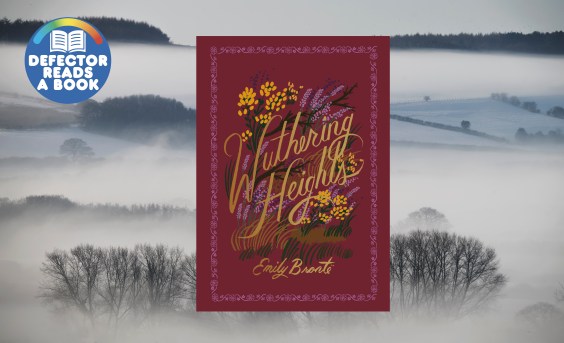
Wuthering Heights is always a stranger book than you remember. This holds true whether you last read it in high school, or a month ago. There is always some weird detail, some brutality, some incomprehensible human interaction that you overlooked. Everyone remembers the ghost of Catherine Linton at the window, pleading to be let in, but do you also recall how our gentleman narrator “pulled its wrist on to the broken pane, and rubbed it to and fro till the blood ran down and soaked the bed-clothes”? Catherine’s famous declaration about Heathcliff—“Whatever our souls are made of, his and mine are the same”—sticks in the mind, of course, though years and Instagram quotes have a habit of turning it into an expression of romantic sympathy, instead of what it actually is: a description of the total obliteration of sovereign selfhood. You might have held on to a vague sense that there are a lot of dogs in this book, but do you remember that one of the dogs is named Skulker? Or that Skulker the dog has a son, named Throttler?
One of the things I hadn’t remembered was how little we are told about the environment around Wuthering Heights and Thrushcross Grange. This is particularly strange given I always think of it as a novel deeply concerned with setting. If you had asked me a week ago how much of the book is dedicated to long and detailed descriptions of the West Yorkshire countryside I would have answered “quite a lot” and I would have been wrong. We get a bit about Penistone Craggs (“bare masses of stone, with hardly enough earth in their clefts to nourish a stunted tree”), some river sounds, a lot of fog, but not a whole lot else. We think about Wuthering Heights as a novel about place, but it is better described as a novel about not knowing your place. Foundlings rise, sons are brought low, servants are hilariously emboldened, and the path between one house and the other is sometimes obstructed. Lockwood, our narrator, is out of place—you get the sense that he was meant to appear in a comedy of manners but got lost along the way. The reader is often equally confounded, between the multiple Catherines and Lintons and general sense that everyone in this book is stark raving mad.
Wuthering Heights is always a stranger book than you remember because it actively resists your comprehension. It is, in fundamental ways, a book about things we do not and cannot know. This goes back to the inciting event—we are never told why Mr. Earnshaw brings an unnamed orphan back from Liverpool. We are never given a clue as to Heathcliff’s origins, or how he makes his fortune during his three-year absence.
What's Your Reaction?
 Like
0
Like
0
 Dislike
0
Dislike
0
 Love
0
Love
0
 Funny
0
Funny
0
 Angry
0
Angry
0
 Sad
0
Sad
0
 Wow
0
Wow
0