























F1 news: Pre-season testing, explained for 2026



Formula 1 is going to look a little different here in 2026.
That includes the annual pre-season testing.
This year the sport ushers in a host of new technical regulations, aimed at improving the on-track spectacle. The changes are the biggest F1 has seen in years, which means the teams have a lot to learn about how their new designs will perform under racing conditions.
But that is not the only big change.
This season, the grid grows by one, as Cadillac joins F1 as the sport’s newest team. Sports fans may have been introduced to Cadillac during Super Bowl LX, when the team launched their livery for the upcoming season during a commercial.
So ahead of the first open pre-season testing session of the 2026 season — more on that in a second — let’s dive into the big questions facing the grid as it gets underway.
What is F1 pre-season testing?
Let’s start with a basic question.
What is pre-season testing?
Pre-season testing is a three-day event at the Bahrain International Circuit, site of the Bahrain Grand Prix which follows later this season, that sees all 11 teams put their challengers for the upcoming F1 season to the test. This is the first time each team will have extended sessions with their 2025 cars, beyond minimal filming or promotional days that are allowed for under the F1 Sporting Regulations.
Over three days this week (Wednesday, Thursday, and Friday) teams are allowed to put their cars on the track with minimal restrictions, to get a sense of how their setups, power, weight, aerodynamics, and more will look for the season ahead.
Each day is broken up into two sessions, a morning session which starts at 10:00 a.m. local time and an afternoon session which starts at 3:00 p.m. local time. The importance of that afternoon session is that it will last beyond sunset, allowing teams to get a feel for how the cars will run during night-time conditions.
Teams can approach these sessions in a number of different ways, but the main goal is to iron out any major issues, hone setups, and make adjustments as necessary. Teams can also isolate what areas of their cars need to be upgraded ahead of the season, which begins a few weeks later in Australia.
When is it being held?
This is one of many changes from last year.
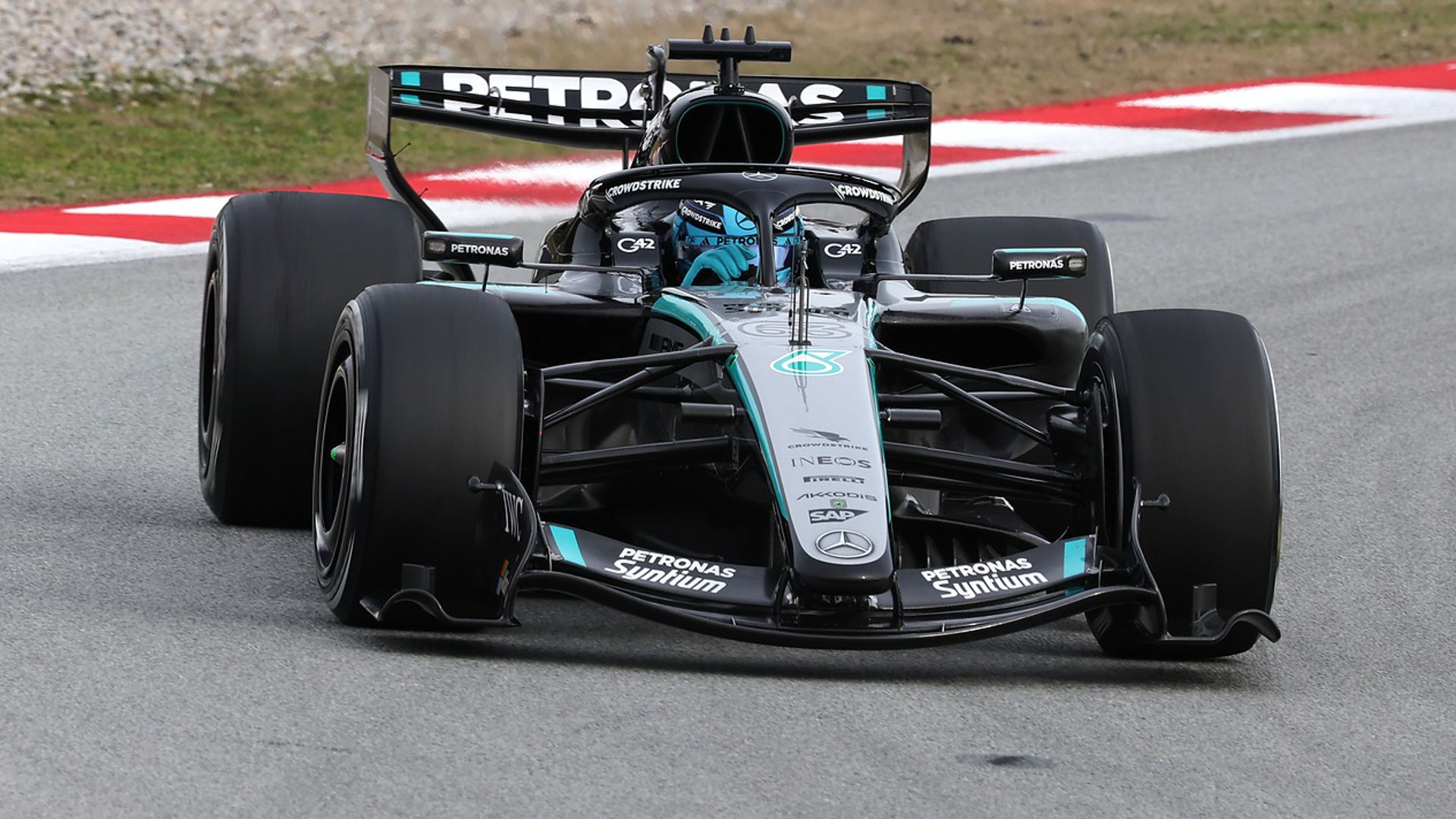
As noted above, this season F1 ushers in a host of new technical regulations. We will dive into those in more detail in a moment, but the basis premise is that the cars are going to be smaller, lighter, and more agile, hopefully to improve the on-track spectacle. In addition, this year will see a 50/50 split between battery power and the Internal Combustion Engine (ICE), as the sport continues a push towards sustainability.
To that end, this is actually the second of three pre-season testing sessions that F1 is holding this year. The sport held the first testing session behind closed doors in Barcelona during the last week of January, billed as the “Barcelona Shakedown.” Five days of testing were held, but teams could only test on three of those five days.
Now the testing goes public with the first of two sessions that we will get to see.
The third and final pre-season testing session runs later in February, from February 18 through February 20.
The first pre-season testing session is set to begin on Wednesday, February 11, and will run three days as noted above. Each day consists of two sessions, a morning session that begins at 10:00 a.m. local time, and an afternoon session that begins at 3:00 p.m. local time.
Wednesday
Morning session: 10:00 a.m. local time / 2:00 a.m. Eastern
Afternoon session: 3:00 p.m. local time / 7:00 a.m. Eastern
Thursday
Morning session: 10:00 a.m. local time / 2:00 a.m. Eastern
Afternoon session: 3:00 p.m. local time / 7:00 a.m. Eastern
Friday
Morning session: 10:00 a.m. local time / 2:00 a.m. Eastern
Afternoon session: 3:00 p.m. local time / 7:00 a.m. Eastern
Why is it held in Bahrain?
Some seasons, a reason for holding testing in Bahrain was logistical. With the schedule beginning with the Bahrain Grand Prix, it cut down on travel and freight as the teams could simply roll things over for the start of the season.
But with the season beginning with the Australian Grand Prix this year logistics are not at play.
That leads us to another reason Bahrain is the host: The configuration of the track. Here is the layout of the Bahrain International Circuit, which you can see here in a diagram from F1.com:

The design of Bahrain International Circuit allows teams to test their cars under a few different conditions. There are some long straights — including the very long straight coming out of Sector 3, through the start/finish line and into Sector 1 — and some tight corners, most notably in Sector 2.
This layout means teams will be able to test out how their cars handle both long straights, as well as tight corners.
How are tires handled at F1 pre-season testing?
Pirelli, the tire provider for F1, provides all teams an equal number of each tire compound. This allows the teams to complete as many laps as they wish with each tire compound. This allows teams to get a sense of pit strategy for when the season begins.
Ahead of testing, Pirelli announced that during the first of the two sessions in Bahrain, the teams can only run the hardest sets of tires: The C1, the C2, and the C3. Teams are allowed to use up to 28 sets of dry weather tires, while one set of the Intermediate tires, for use in damp conditions, will be available.
During the final pre-season testing session later this month all five tires in Pirelli’s range will be available, meaning the C4 and the C5 compounds will be added.
Here are the teams’ tire selections for the first session in Bahrain:
The track surface in Bahrain is one of the tougher on the F1 grid, which is why the hardest compounds are usually selected for the Bahrain Grand Prix. That is why many teams are opting to load up on the harder compounds. In addition, the reason team are loading up on the C3 compound is that it will be the most frequently used over the course of the season.

Are there specific things teams can or cannot do during testing?
Testing is not held under grand prix conditions, and while normal safety requirements must be followed, teams are permitted to design their own testing programs. That includes selecting which drivers are going to participate, including reserve and/or testing drivers who are not slated to compete in the upcoming season.
I am seeing neon paint on some of the cars. What is that?
In F1, aerodynamics is everything. How well air flows — or does not flow — over the car can mean the difference between a podium finish, and a finish outside the points.
So finding out how the air is flowing over the cars is a huge part of the process, including during testing.
To get a clearer picture of how air is flowing over different parts of the car, teams will use what is called “flow-vis” paint. This is a paint composed of a fluorescent powder mixed with a light oil, applied to the front of the car before it takes to the track. As the car works through the circuit, the paint flows over the car, following the air.
Here is a closeup photograph of Oscar Piastri and his MCL38 from a previous pre-season testing year:

Here is a better look at how the flow-vis paint can disperse over an entire car:

In the above photograph taken from pre-season testing ahead of the 2022 season, you can see the flow-vis paint on the Williams Racing car driven by Nicholas Latifi.
Do not be surprised if, when watching pre-season testing, teams try and hide the results of a run using flow-vis paint. Often when the cars return to the garage after a run with flow-vis paint, teams cover the car so their competitors cannot get a sense of what is working … and what is not.
Did someone just drive through a fence?
The flow-vis paint discussed above is not the only method teams use to gather data on the track during testing.
Allow us to introduce “aero rakes.”
Aerodynamic rakes, or “aero rakes” for short, are another means of gathering data on the cars in near real-time. These devices include “pitot tubes,” which are sensors designed to measure off-body air flow. These can be placed on various parts of the car, to measure how air is flowing over various parts.
For example, if you wanted to see how the air was flowing over the front wing, you can place the aero rake behind the front tires. If you wanted to see how air was flowing over the entire car, you can place the aero rake on the rear of the car, as you can see in this example from Alpine:

This image from testing in 2022, with a massive aero rake fitted to the AlphaTauri of Pierre Gasly, gives you a sense of how big the aero rakes can be:

So if you see these on the track this week, do not worry. Someone has not taken a wild wrong turn, instead it is another means of their teams gathering data on the car.
Are these the final cars that teams will use this season?
Adapt or die is part of life in F1. Teams are constantly looking to upgrade their cars, looking to squeeze every last bit of power out of them, and shave of every possible millisecond.
To that end, while the cars we will see this week are close to the final product, the results of testing often force some upgrades. A prime example comes to us from McLaren three seasons ago. During pre-season testing in 2023, it became clear that the MCL60 needed some upgrades.
The team rolled those out over the course of the season, and while they were fighting for points at the start of the year — as Lando Norris explained to me ahead of the 2023 Azerbaijan Grand Prix — they were fighting for podiums and wins by season’s end.
There, there is Alpine during the 2024 season. They arrived in Bahrain and quickly learned that the A524 was overweight, and focused on upgrades throughout the season.
The team brought a substantial upgrade package to Austin for the 2024 United States Grand Prix, as both Pierre Gasly and Team Principal Oliver Oakes describe to me last October. While Alpine was at the back of the grid to start the year, they ended up finishing sixth in the Constructors’ Championship thanks in large parts to those mid-season upgrades.
How much should we read into the lap times this week?
In reality? Not much. Given the number of variables at work — teams are trying different programs, with different tyre compounds and different fuel loads — it is usually hard to get a clear sense of how the grid stacks up before the season begins. Remember, while all the tyre compounds are available during the third and final testing session, once the season begins, Pirelli allocates just three of the five different dry-weather tyre compounds for each Grand Prix. So we might see a team this week put down a fast lap time on a tyre compound that is not going to be in use later this season at the actual Bahrain Grand Prix.
Also, teams do try and hide just how strong they are during testing, saving their full performance capability during the first qualifying session of the season. This is a tactic referred to as “sandbagging.”
Still, in recent history we have seen teams strong during testing come out and secure the pole position at the same track during the season. In 2021 Max Verstappen of Red Bull posted the fastest lap time during testing, and secured the pole at the Bahrain Grand Prix later in the season. In 2020 Valtteri Bottas of Mercedes posted the fastest lap time during testing, and his teammate Lewis Hamilton qualified on pole at the Spanish Grand Prix later that year. That season testing was held in Barcelona.
What we can mainly ascertain is what teams are going to start the season on the front foot, and what teams will begin the year with some work to do. Take the 2023 campaign. During pre-season testing that season it was clear that Red Bull’s RB19 was going to be strong, and that proved to be true as Red Bull won all but one grand prix in 2023, and Max Verstappen lapped the field in the Drivers’ Championship.
But we also learned that Aston Martin had something cooking with the AMR23, and they began the year on the front foot and were in second place behind Red Bull during the early going. We also got our first glimpses of what Williams was going to bring to the table, as they delivered a promising seventh-place finish in the Constructors’ Championship.
We also learned that McLaren had some work to do with the MCL60. They left Bahrain promising some future upgrades to their challenger, which they slowly rolled out over the course of the 2023 season. While they indeed started on their heels, they made a mid-season charge up the table, to finish in a stunning P4 in the Constructors’ Championship.
So in many ways, pre-season testing will tell us who is on solid footing to begin the year, and who has some work ahead of them.
Is there a winner of F1 pre-season testing?
As with anything in F1, times will be kept.
But you should, as noted, take them with a pinch of salt.
Teams will be running different programs, using different setups and tire compounds, and using reserve drivers as well. So while each session will see a driver post the fastest lap time, you cannot immediately assume that that team/driver pairing will see that success continue into the season-opening Bahrain Grand Prix.
(Although, the past few years have seen Verstappen top the timing sheets so maybe there will be some truth in the numbers).
In addition, just because a team completes a lot of laps (or conversely the fewest amount of laps) does not mean that they are either going to be consistent over the season, or struggle with reliability issues on the other end of the scale. In 2023 for example McLaren posted the fewest laps during pre-season testing.
Still, McLaren found a way to charge through the field over the second half of the season for a fourth-place finish in the Constructors’ Championship.
That trend continued into 2024. Last year McLaren posted the second-fewest laps in Bahrain, ahead of only Williams.
But when the dust settled at the end of 2024, McLaren stood atop the F1 world as Constructors’ Champions.
What are the major storylines for F1 2026 pre-season testing?
New regulations
As noted above, the biggest storyline headed into the 2026 season will unfold starting this week.
One of the more fascinating aspects about Formula 1 is that it is as much an engineering problem to be solved, as it is a race to be won. The sport constantly changes the technical regulations, pushing teams and designers to deliver technological advancements on the track.
This year brings a massive new set of regulations to the sport, as F1 is looking to improve the racing spectacle. The cars are going to be smaller, lighter, and more agile, and that is not all. Not only is the chassis being updated, but so too are the power units, in what F1 is calling the “biggest overhaul of regulations in the sport’s history.”
According to a presentation by F1 given to the media, including SB Nation, here are some of the major points:
- Smaller and lighter: The wheelbase has been reduced by 200 millimeters, the width of the cars has been reduced by 100 millimeters, the floor width has been reduced by 150 millimeters, and the minimum weight was cut down by 30 kilograms (to 770 kilograms) to make the cars more “agile and responsive.”
- Reduced downforce and drag: Not only has downforce been reduced by up to 30% due to F1 removing ground-effect “floor tunnels,” but draft has been reduced by up to 40%.
- Active aerodynamics: The Drag Reduction System (DRS) has been removed, replaced by movable front- and rear-wings. This allows drivers to gain extra grip. According to F1 this means “adjustable angles of the front and rear wing elements in specific high-speed sections, designed for Corner and Straight modes. It enables strategic adaptability and maximises full usage of the car’s power through greater on track grip.”
- Narrower tires: Front tires are 25 millimeters narrower, while rear tires are 30 millimeters narrower, which cuts down on both drag and weight.
- Power unit: F1 has also introduced changes to the power units. There is an approximate 50/50 split between electrical power and the Internal Combustion Engine (ICE). In addition, F1 has simplified the hybrid setup, removing the MGU-H and increasing the power to the MGU-K “significantly” to allow for “enhanced overtaking and straight-line speed.” The cars will also run on advanced, sustainable fuel.
- Overtake mode: With the removal of DRS, drivers can now use overtake mode. When they are within one second of a car in front, they can “deploy extra power to instigate an overtake.“
- Boost mode: In addition to overtake mode, drivers can also deploy extra energy from the engine and battery at the push of a button, no matter where they are on the track. This can be used offensively, or defensively.
- Recharge: Drivers can also recharge their battery with recovered energy from braking, via lifting the throttle at the end of a straight, or even in corners where they do not use the full throttle.
New team
Then there is the new team on the grid.
While technically there are two new teams — Audi joins F1 as a new works operation in place of Sauber — the size of the grid has expanded by one, as Cadillac arrives for this season.
Cadillac opted for a pair of veteran drivers, Valtteri Bottas and Sergio Pérez, to begin their F1 journey. Both drivers have championships on their resume, Bottas as part of the Mercedes operation alongside Lewis Hamilton, and Pérez during his time at Red Bull with Max Verstappen.
How will the new kids on the block fare in their inaugural season? We’re about to find out.
Early drama
Then there is the “compression ratio” saga.
Under the new regulations the “compression ratio” of the V6 combustion engines — a measurement of how much the air-fuel mixture inside a cylinder can be compressed — has been reduced to 16:1 for this generation of power units. This was done to make the sport more accessible for new engine partners such as Audi.
However, some teams believe that Mercedes has found a workaround for this issue. F1 tests the compression ratio when the power units are cold, but teams such as Audi and Ferrari believe that Mercedes has found a way to expand the compression ration when the power units are running hot, giving them a potential advantage on the track.
McLaren CEO Zak Brown addressed the issue at the team’s launch, a notable point for him as McLaren is a customer of Mercedes and uses their power units.
“It’s typical politics of Formula 1. The engine has been designed and totally compliant within the rules,” he said at the launch of McLaren’s 2026. “That’s what the sport is about. No different than things like double diffusers that we’ve seen in the past where they’re compliant within the rules.
“I don’t believe there’s a significant advantage as being represented by the competition, but of course their job is any perceived advantage, they’ll make a story out of it. But the reality is the engine is completely compliant [and] passed all its tests. And I think [Mercedes] HPP has done a good job.”
What drivers are testing, and when?
We will update this list as confirmations are released by the teams.
F1 pre-season testing driver schedule by day
We will update this list as confirmations are released by the teams.
F1 pre-season testing driver schedule by team
We will update this list as confirmations are released by the teams.
Can I watch pre-season testing?
That depends on where you are reading this from, dear reader.
For those joining us from the United Kingdom and Ireland, Sky Sports F1 will provide coverage, including airing the final hour of each day.
Here in the United States, F1 is moving to Apple TV for the 2026 season. As of the time of publication Apple TV has not announced any live coverage of pre-season testing.
This post will be updated as driver and team schedules are announced.
What's Your Reaction?
 Like
0
Like
0
 Dislike
0
Dislike
0
 Love
0
Love
0
 Funny
0
Funny
0
 Angry
0
Angry
0
 Sad
0
Sad
0
 Wow
0
Wow
0