















Natan Last Has Thought A Lot About Crosswords

It may seem like they’ve been around forever, but the crossword as we know it is barely a century old. They started in the New York World in 1913, where it was originally called a “word-cross.” Going on to obsess writers like T.S. Eliot and Vladimir Nabokov, who reportedly wrote the first Russian-language puzzle as a teenager, the crossword settled into a kind of urbane normalcy over the course of the 20th century, a feature of newspapers and cheap jumbo packs dominated by the editor Will Shortz. More recently, puzzle games, particularly those created and owned by the New York Times, exploded in popularity during the COVID-19 lockdowns, forming an unlikely bedrock alongside other mobile games for the financial vitality of papers of record.
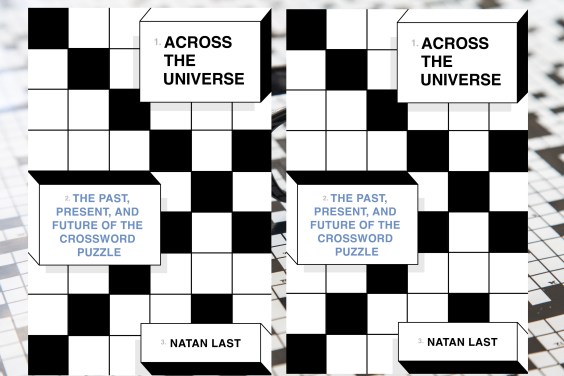
Cruciverbalist and crossword constructor Natan Last’s recent book Across the Universe: The Past, Present, and Future of the Crossword Puzzle supplies a history of the game, but also compelling perspectives on its evolution: From an unlikely early 20th-century American craze the New York Times once compared to disease, to a thriving and idiosyncratic subculture, a point of artistic inspiration, and a forum for politics and social mores. After all, the vocabulary treated as common enough for millions of players to grasp, written in an increasingly globally dominant language, is chosen by a group of biased individuals, each of whom bring their own worldview to the form. As Last writes, “There are puzzle-makers who invest their political essences into the grid; there are those who reject the notion the grid should be anything more than a zone of play, Huizinga’s magic circle become square. The crossword traffics in at least two distinct registers of language: the pun clue’s dad joke, and the trivia clue’s prodding for erudition.”
Recently, Last and I discussed the crossword’s democratization, the labor of both editing and solving, the limits to which the puzzle can be a political tool, and whether we’re playing through a boom-and-bust cycle of digital gaming.
What's Your Reaction?
 Like
0
Like
0
 Dislike
0
Dislike
0
 Love
0
Love
0
 Funny
0
Funny
0
 Angry
0
Angry
0
 Sad
0
Sad
0
 Wow
0
Wow
0