
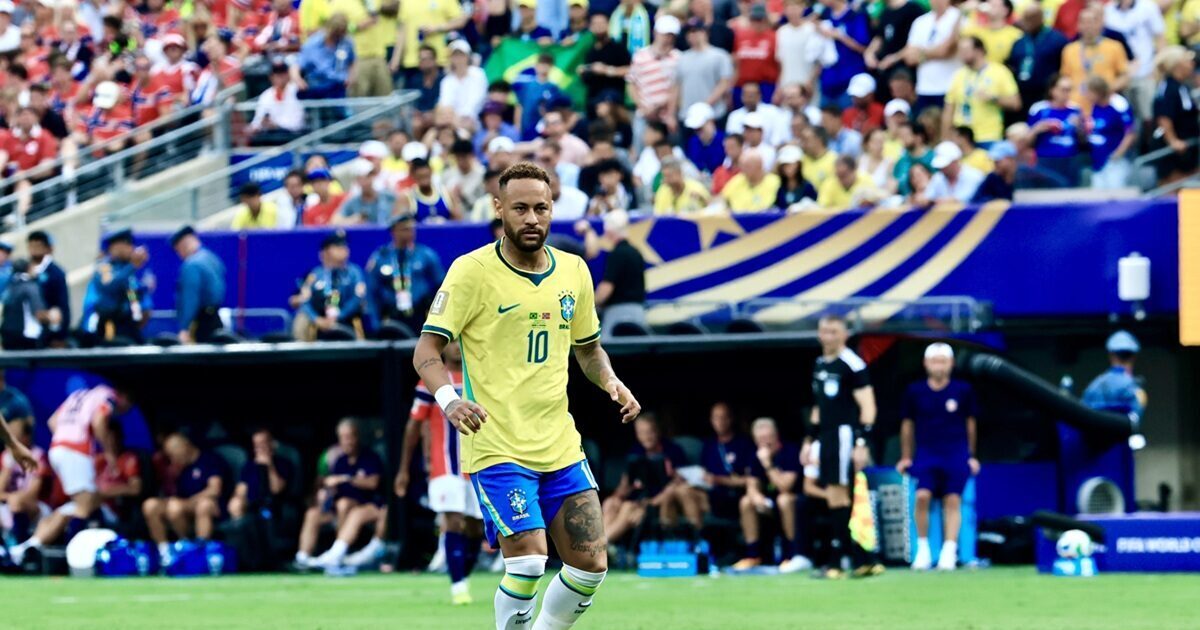
Football is constantly evolving, and iconic matches and World Cups have historically been milestones for innovations that shaped the future of attacking football.
Hungary invented the False Nine in the 1950s. The historic “Match of the Century” in 1953, when Hungary defeated England 6-3 at Wembley Stadium, is widely regarded as the birth of modern football tactics. Hungary’s striker, Nándor Hidegkuti, unlocked the English defensive marking system.
Hidegkuti positioned himself deep into midfield, and when the English defence followed his movements, Hungary’s legendary player Puskás waited to exploit the space. If Hidegkuti was left unmarked in midfield, he had time to initiate the progression and act as a playmaker, creating momentum with numerical overload around the penalty area.
Brazil won the World Cup in 1958 and became world-famous for Jogo Bonito. The style of play was a mix of ginga, Afro-Brazilian dance culture. It also included the martial art Capoeira, along with improvisation that grew naturally from playing street football and indoor futsal. There was an attempt to systematically Europeanise the Brazilian style of play ahead of the 1954 World Cup.
But the 1954 failure led to a dramatic shift, with visionary coaches like Vicente Feola Argued that the solution was not to suppress Brazilian flair, but rather to build a modern tactical framework around it. Brazil proved that Jogo Bonito could be successful and that playing with joy and improvisation was truly possible if implemented into a flexible tactical system.
If Hungary introduced positional flexibility and Brazil added individual flair, the Netherlands in the 1970s developed attacking football even further with an organised tactical framework.
Under manager Rinus Michels and later Johan Cruyff, the Dutch created Total Football, a system built on continuous positional rotation. By maximising the pitch dimensions in possession and reducing space through collective pressing when defending, Total Football established a balance between tactical discipline and fluid movement.
In the late 1980s, the Italian manager Arrigo Sacchi was influenced by Total Football and built on fundamentals such as aggressive defending and pressing. Sacchi elevated the defensive system by introducing a highly aggressive, compact 4-4-2 zonal pressing system. Instead of being reactive, his team was active and often played with a high defensive line. His players kept only 25 metres between defence and attack and mastered the offside trap, shifting the defence’s focus from “marking the man” to “controlling the space.”
The early 2000s were defined offensively by Spanish Tiki-Taka, a possession-oriented, short-passing style of football. Defensively, German football introduced Gegenpressing.
Instead of retreating after a transition, teams immediately hunted the ball, making high-intensity counter-pressing, which was famously called the ”best playmaker” by Jürgen Klopp. It was two fundamentally different systems. The Spanish Tiki Taka relied on a playmaker like Xavi who controlled the game. Gegenpressing focused on winning the ball back immediately after losing it, thereby replacing the ”playmaker” with immediate goal-scoring opportunities.
While the 2000s saw football evolve toward high-intensity attacking football and counter-pressing, Italy won the 2006 World Cup by blending its traditional defensive heritage with modern tactical organisation influenced by Arrigo Sacchi. Modernising Catenaccio football meant that manager Marcello Lippi focused on a compact, zonal defence led by Fabio Cannavaro.
Italy often defended with a low defensive block around the penalty area, locking down the centre of the final third. Italy also balanced controlled possession with counter-attacks featuring technically brilliant players such as Francesco Totti and Andrea Pirlo. Conceding only two goals throughout the tournament, Italy proved that defensive organisation remained crucial to winning the championship in the modern era.
Modern football has entered an era of pragmatism, trying to control space both offensively and defensively. Teams on the elite level often combine a disciplined, dynamic low-block defence – reminiscent of Italy 2006 – and, offensively, are influenced by the Spanish possession-based passing networks. Teams are structured in basic formations, which is the setting for collective tactics. Simultaneously, modern football has become highly disruptive, with a match functioning as a 90-minute chess game of constant countermoves. Individually, players are increasingly assigned highly specialised, dual-purpose tactical roles.
This could be understood as micro-tactics; for example, a fullback may overlap to make crosses on the flank as well as invert into midfield during possession. An attacking winger might initiate a high press before dropping back to man-mark the opponent’s overlapping fullback. The match is not static but rather disruptive, with tactical instructions changing multiple times during a game.
What did the 2026 World Cup teach us about modern attacking football, and what are the latest innovations shaping the game?
Comparative Analysis: World Cups 2014-2026
The World Cup 2026 will be remembered for extraordinary athletes and tactically sophisticated teams that were organised defensively to such a degree that even the former legendary Italian Catenaccio-oriented manager Fabio Capello, following the tournament from the stands, seemed impressed.
The two superstars, Lionel Messi and Cristiano Ronaldo, who, despite their technical brilliance and experience, struggled to score goals and rarely found pockets of space between well-organised defensive lines. Vinicius Jr., Dembele, and Mbappe had several magical moments but could not fully excel either on the flank or in central attacking zones, where defenders effectively squeezed space.
The Brazilian Jogo Bonito and Dutch Total Football were unrecognisable, focusing on controlling possession instead of a more attacking style of play with improvisation and flair. Despite playing with a low defensive block and zero shots on goal in the final, Argentina’s 19 goals in 2026 set a national team record and are the third-highest in World Cup history. Hungary is first with 27 goals in 1954, and the 2026 bronze final, where England’s 6-4 victory over France left both teams with a total of 20 goals each.
Argentina had planned solutions regarding how to unlock low defensive blocks – shots from distance and crosses into the box. This was part of Argentina’s game plan, especially in the knockout phase. When Argentina faced Egypt in the round of 16 and were down 2-0, defender Cristian Romero scored on a header inside the penalty area. Before Messi scored the second goal with an excellent shot inside the box, he constantly moved away from the penalty area towards the right flank, where he crossed the ball into the penalty area several times.
The third goal was a cross from the right flank, where Lautaro Martinez found Enzo Fernandez, who finished with a great header. The game plan with headers and shots from distance was successfully used against Switzerland in the quarter-final. Alexis Mac Allister scored with a header on a corner kick. Before Julian Alvarez scored with a magnificent curved shot from the edge of the box, Argentina had plenty of shots from distance almost resulting in goals.
Interestingly, in the semi-final against England, the first goal came after a cross from Morgan Rogers on the right flank, where Anthony Gordon finished on the far post. Messi once again created plenty of chances with key passes from the right flank, assisting Enzo Fernandez, who scored the equaliser with a long-distance shot. The final goal that brought Argentina to the final came through Messi’s cross on the flank, where Lautaro Martinez scored on a header.
What separated Argentina in the last World Cup 2022 was the Messi factor. He was the centre of all attacking play, often involved in passing combinations and part of fluid attacking movements around the penalty area. With a less dynamic Messi in 2026, Argentina had to rely on different attacking strategies and other players. To break down low defensive blocks, Argentina focused more on vertical variations in attack – direct crosses into the box or shots on goal – which were executed successfully.
Compared to previous World Cups, in 2026 Argentina had similar possession around 60%, but the differences were in goal attempts, shots on target, and goals scored. All the numbers are significantly higher in the 2026 tournament. In the 2014 World Cup, Germany scored 18 goals and, in subsequent tournaments, reduced their attacking output significantly. Brazil scored 18 goals in 2002 and followed the same pattern with lower attacking numbers.
Spain have significantly increased goal attempts and shots on goal in 2026, with a total of 14 goals scored. France won the World Cup in 2018 with 14 goals and followed up with more goal attempts and goals in 2026.
Historically, the World Cup winner averages around 100 goal attempts, 50 on-target attempts, and 15-20 goals scored. While it is important to be tactically sophisticated and well organised defensively, what separates the winner from the rest is eventually the ability to create chances and score goals.
Utilising key performance indicators for attacking football. Specifically, possession, goal attempts, attempts on target, and total goals – the following section provides a comparative statistical analysis of Argentina, Spain, Germany, Brazil, and France across the World Cup cycles from 2014 to 2026.
Table 1. Argentina
World Cup Possession Goal Attempts Attempts on Target Goals
2018 65,8 % 58 36 6
2022 57,4 % 104 48 15
Table 2. Spain
World Cup Possession Goal Attempts Attempts on Target Goals
2018 74,0 % 70 53 7
2026 64,1 % 140 54 14
Table 3. Germany
World Cup Possession Goal Attempts Attempts on Target Goals
2014 57,9 % 100 47 18
2022 59,3 % 67 24 6
2026 65,0 % 74 28 11
Table 5. Brazil
World Cup Possession Goal Attempts Attempts on Target Goals
2014 53,4 % 111 48 11
2018 58,4 % 106 81 8
2022 56,2 % 90 41 8
2026 60,9 % 73 29 10
Table 4. France
World Cup Possession Goal Attempts Attempts on Target Goals
2014 53,0 % 91 34 10
2018 48,0 % 79 68 14
2022 51,3 % 40 16 10
2026 60,9 % 139 59 20
The Future of Attacking Football: From Dynamic Possession to Tactical Creativity
The World Cup 2026 winners, Spain, held a masterclass in attacking football. Over the years, Spain stood firm in its national identity and built on the Tiki Taka possession-oriented football that once brought attacking football to new heights. The core principles of Spanish football that players learn from a young age and up to first team level are different types of superiority;
Numerical Superiority – Creating an overload through more players than the opponent in specific zones on the pitch, e.g. 3v2 in the final third.
Positional Superiority – Players position themselves in pockets of space and half-spaces between the defensive lines that allow them to receive and progress towards goal.
Qualitative Superiority – Create 1v1 situations where a player’s technical strengths outperform the opponent, e.g. a winger attacks a fullback trying to dribble past.
Dynamic Superiority – Gaining a spatial advantage through movement, momentum, and collective timing, regarding how and at what speed players come into space.
Even if Spain had several players that elevated the attacking game through positional superiority, such as Rodri in the build-up and Olmo in the final third, as well as qualitative superiority when Lamine Yamal dribbled on the flank, it was the numerical and dynamic superiorities that stood out.
Spain’s strength was in collectively creating numerical superiority, especially in the final third, where both fullbacks, Porro and Cucurella, advanced on the flanks. And the centre-back Cubarsi created chances with both progressive passes and long-distance shots. The X performance factor was the dynamic superiority which Spain completely dominates in world football.
As already mentioned, modern football has evolved around micro-tactical strategies, a dimension of the game where Spanish players have a key strength. Spain gained dynamic superiority through positional rotations, e.g. Oyarzabal dropped into midfield, Baena positioned as a striker and Olmo as a winger, as well as fluid interchanges between e.g. fullbacks and wingers – where the crucial part was the timing of the motion, which manipulated the opponent’s defensive lines to create openings. This dynamic process relies not only on the strategic utilisation of space, but also on successfully synchronising players’ movement and game tempo.
When Lamine Yamal attacked Lucas Digne, who committed a foul that resulted in a penalty kick, and Oyarzabal scored the first goal, Spain had already identified France’s weakness. The left fullback Digne and the central midfielder Rabiot were consistently overloaded on the wing due to the French attackers’ minimal defensive contribution. Spain exploited this weakness again for Pedro Porro’s goal. Olmo and Oyarzabal created depth and occupied the French centre-backs, while Yamal created width by positioning himself wide on the flank.
The Spanish central midfielders overloaded the right side of the pitch, creating a moment of hesitation among the French players. Porro utilised the uncoordinated press and created momentum by moving forward. Having already heavily influenced the build-up by inverting centrally and combining with deep-lying pivot Rodri, Porro expanded his attacking movement, combining with Olmo in the final third. Eventually, Porro could attack explosively behind the last defensive line with speed, timing, and scoring.
This reflects how micro-tactical flexibility on an individual level could turn focus from Cucurella and Cubarsi – who were the primary build-up options – to Porro, who initiated the progression from build-up as well as the passing combination with Olmo. That resulted in scoring a goal.
Against a defensively oriented Argentina in the final, Spain had to play with the absolutely best attacking players to score goals. At the end of the game, 7 of 11 players were from FC Barcelona: Eric, Cubarsi and Cucurella (who was raised in La Masia), Pedri, Olmo, Yamal and Ferran.
This reflects how important FC Barcelona is regarding the future of attacking football. Insights from Barça Innovation Hub, an official scientific research facility operated by FC Barcelona, highlight the evolution of possession. The change of direction in ball circulation is crucial. Instead of looking only at how long a team keeps the ball, focus should be on how often and how a team moves the ball between different zones on the pitch, before creating an attacking opportunity or a shot on goal.
This approach, dynamic multidirectional attacking football, is important because it shows movement patterns, creates unpredictability, and helps open up the opponent’s defence. The research indicates that more changes of direction are linked to longer possession sequences and more offensive actions, including shots and goal chances. This adds a new tactical dimension to possession analysis, as clubs can now measure not just how much of the ball they have, but how purposefully they move it around the pitch.
Understanding the flow of possession in these terms also helps address some of the limitations of older data models. For example, long possession without variation can become predictable and easy to defend against, especially against low or compact defensive blocks. By adding this new variable to performance analysis and coaching practices, teams can better evaluate not just whether they are dominating the ball, but also how they are using it to create advantages—a key step forward in modern tactics.
Barça Innovation Hub also highlights that creativity is crucial – not just to add extra flair in the game, but also a core component of effective possession as well as player development. It shows that when players are encouraged to explore, improvise, and try varied actions in training, they build the confidence and cognitive flexibility needed to make unique, valuable decisions in real games.
The future of attacking football is not only about dynamic possession but most likely even more about creativity.
In the research paper ”Good, better, creative: the influence of creativity on goal scoring in elite football”, Professor Daniel Memmert analysed 311 goals in World Cup tournaments to evaluate how crucial creativity was when scoring goals in elite football. According to this research, attacking football consists of tactical intelligence and tactical creativity. Creativity was defined as an action that is surprising, original, and flexibly executed, e.g., no-look passes, dribbling, or movements to break free from opponents. To evaluate the level of creativity, the eight actions before a goal were analysed.
The research suggests that tactical creativity intensifies when actions were closer to the goal – 86% of the goals contained a minimum of one creative action, with 44% registering a very high creativity rating. Analysing the 2010 and 2014 World Cup tournaments showed that the knockout phase had a significantly higher creativity value in pre-assist passes. These are passes before the assist to goal.
Ultimately, creativity is what allowed Jogo Bonito to conquer the world – a rare convergence of passion, improvisation, and Brazilian flair that challenged conventional imagination. In modern football, dynamic defensive blocks are the new standard, and offensive tactics must adapt. The future of attacking football belongs to teams that balance dynamic possession with creativity. The ultimate difference between football ideas that shape the future will always be the unpredictable spark of human genius.
Will Ancelotti revitalise the Brazilian Jogo Bonito? Can Spain hold on to their dominance over world football? Can Zidane’s France or Klopp’s Germany win the next World Cup?
