















Finally! An Ancient Fish That Understood Life’s Terrors

The Cambrian period is most famously remembered as an era of biological experimentation, with bizarre creatures such as Hallucigenia, whose body resembled anti-bird spikes, and Wiwaxia, which looked like a medieval flail come to life. But the Cambrian should also be remembered as a time when shit got extremely real for fish. If life in the oceans seems scary now for anything small and soft-bodied, they were undoubtedly scarier 518 million years ago in the Cambrian period. For eons, the oceans belonged to filter feeders, which raked in plankton and other animalcules rather peacefully (for everyone except for the plankton, of course.) But over time, the oceans gave rise to large, carnivorous predators, which meant little fish needed to adapt if they were going to make it out of the Paleozoic period alive.
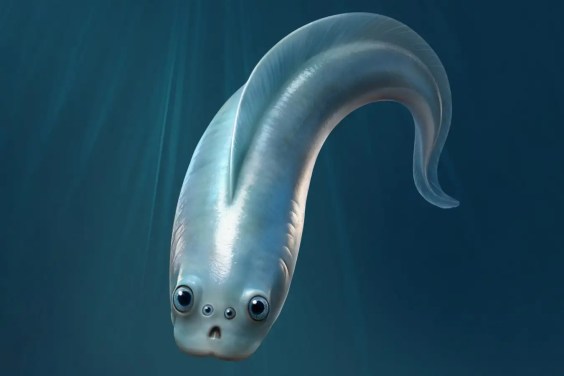
Myllokunmingiids, the earliest fossils that look anything like fish, were discovered in China and hail from around 518 to 530 million years ago. One species of myllokunmingiid called Haikouichthys was, scientifically speaking, just a little guy, topping out at about an inch long. Like a modern fish, Haikouichthys had a head, a modest array of slits that looked like gills, and a distinct muscle-bound spine. Unlike modern fish, it lacked a jaw. Instead of a modern fish mouth, it had a conical opening like that of a lamprey or hagfish. It didn't have much in the way of fins, either.
Now, a new paper in Nature suggests that Haikouichthys diverges from modern fish in another key way: Instead of two eyes, Haikouichthys had four. The authors, a team of researchers from China and the United Kingdom, examined some exquisitely preserved fossils and found Haikouichthys and another myllokunmingid had two larger eyes outside their heads and two smaller eyes in the middle of their heads. All four eyes contained melanosomes, organelles that produce and store melanin and control coloration and light absorption in eyes.
What's Your Reaction?
 Like
0
Like
0
 Dislike
0
Dislike
0
 Love
0
Love
0
 Funny
0
Funny
0
 Angry
0
Angry
0
 Sad
0
Sad
0
 Wow
0
Wow
0