
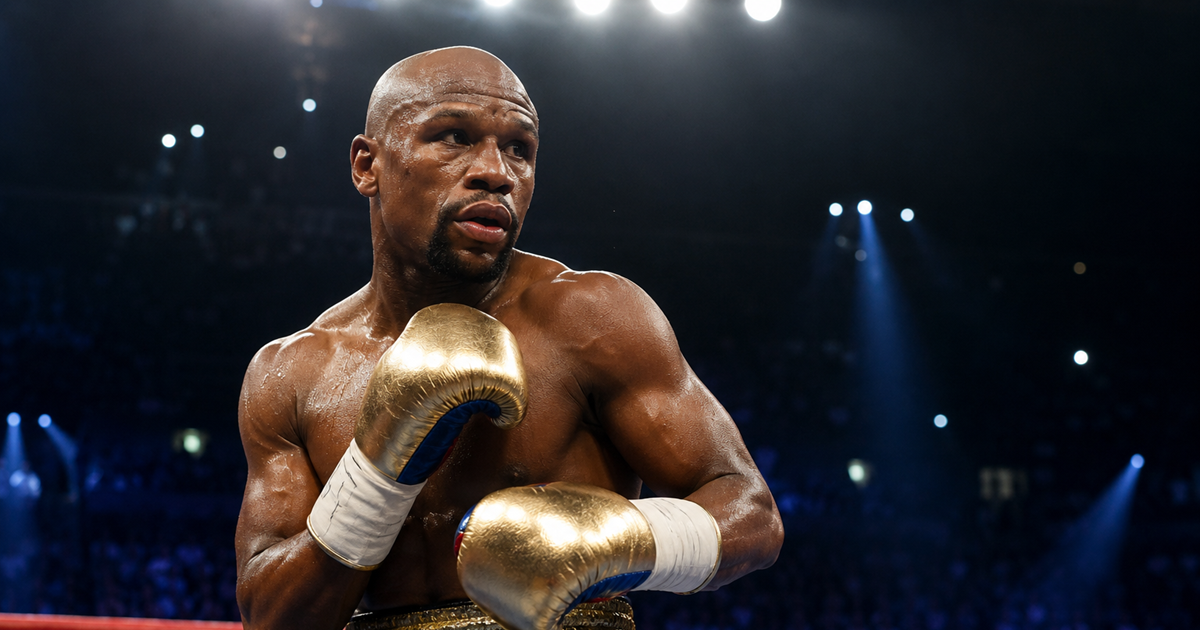
Floyd Mayweather Jr built an unbeaten professional boxing career around defensive control, timing and adaptation. He won 50 of 50 fights, captured world titles in five weight divisions and became a defining figure of modern boxing.
The profile traces his path from Olympic bronze and an early aggressive style to major wins over champions including De La Hoya, Cotto, Pacquiao and McGregor. It also examines the debate around his legacy and his influence on how undefeated records are valued.
Floyd Mayweather Jr did not simply complete an unbeaten professional boxing career. He turned avoiding defeat into an art form, a business model and one of the defining stories of the modern fight game.
Across 50 professional bouts, Mayweather won 50 times. He stopped 27 opponents, collected major world titles in five weight divisions and defeated a long list of champions, future Hall of Famers and leading pound-for-pound fighters.
His style often divided opinion. Some supporters admired every feint, shoulder roll and counter right hand. Others wanted more exchanges, more risk and more drama.
However, very few opponents found a reliable way to beat him.
Mayweather could control a contest without appearing hurried. He read distance, recognised patterns and forced aggressive fighters to operate at his preferred pace. Once he understood an opponent’s timing, he usually removed their strongest weapon.
That ability made him the defensive standard of his generation.
For more profiles of the athletes who shaped their sports, visit the World in Sport Sports Icons hub.
Floyd Mayweather Jr’s career record
| Category | Record | Career context |
|---|---|---|
| Professional bouts | 50 | Competed professionally between 1996 and 2017 |
| Professional wins | 50 | Retired from professional boxing without a defeat or draw |
| Knockout wins | 27 | Combined early-career aggression with later tactical control |
| Weight divisions won | Five | Super-featherweight to light-middleweight |
| Olympic appearances | One | Won featherweight bronze at Atlanta 1996 |
| Olympic medals | One bronze | Lost a disputed semi-final decision to Serafim Todorov |
| Hall of Fame | Class of 2021 | Inducted into the International Boxing Hall of Fame |
His full professional fight record on BoxRec also shows the range of champions and contenders he faced during more than two decades in the sport.
The numbers matter, but they do not explain everything. Mayweather’s real achievement came through the consistency behind them. He rarely lost control of a fight, even when an opponent hurt him, crowded him or forced him towards the ropes.
Boxing shaped Mayweather from childhood
Floyd Joy Mayweather Jr was born in Grand Rapids, Michigan, on 24 February 1977. Boxing surrounded him from an early age.
His father, Floyd Mayweather Sr, fought professionally and later became a trainer. His uncle Roger Mayweather won world titles in two divisions before playing a central role in his nephew’s corner. Another uncle, Jeff Mayweather, also boxed professionally.
That family background gave Mayweather an unusually detailed education. He learnt how to stand, move, defend and recognise danger long before most young fighters developed those instincts.
His childhood was not always stable away from the gym. Boxing offered structure and a clear direction. The sport demanded repetition, concentration and discipline, qualities that later became central to his professional success.
Mayweather developed a strong amateur career and won three National Golden Gloves titles. His speed and sharp defensive reactions made him one of America’s leading hopes before the Atlanta Olympic Games.
Olympic disappointment drove his professional career
Mayweather represented the United States in the featherweight division at Atlanta 1996.
He defeated Bakhtiyar Tileganov, Artur Gevorgyan and Lorenzo Aragón before meeting Bulgaria’s Serafim Todorov in the semi-final. The judges awarded Todorov a narrow points victory in a decision that the American camp disputed.
Mayweather received a bronze medal. More importantly for his future, he left Atlanta with a lasting dislike of allowing judges to control his fate.
Todorov became the final opponent to defeat Mayweather in a competitive boxing contest. Within months, the American entered the professional ranks and began building the record that would define him.
‘Pretty Boy’ Mayweather attacked with speed and accuracy
The later version of Mayweather became famous for patience, defence and calculated risk. The younger fighter carried a more aggressive edge.
Mayweather made his professional debut against Roberto Apodaca in October 1996 and won by second-round stoppage. His hand speed, combination punching and accuracy immediately stood out.
He moved quickly through the super-featherweight division. In October 1998, in only his 18th professional contest, Mayweather stopped Genaro Hernández to win the WBC title.
Hernández had experience, composure and championship pedigree. Mayweather still controlled him. The victory announced the arrival of an elite young fighter rather than simply another promising prospect.
The nickname “Pretty Boy” suited this stage of his career. He remained difficult to hit cleanly, but he also pursued stoppages and committed to combinations.
His 2001 performance against Diego Corrales remains one of the clearest examples. Corrales entered unbeaten and carried serious punching power. Mayweather dropped him five times before Corrales’ corner ended the contest in the 10th round.
It was not a cautious points victory. It was a dismantling.
José Luis Castillo forced Mayweather to adapt
José Luis Castillo gave Mayweather one of the most difficult nights of his career in April 2002.
Mayweather moved up to lightweight and challenged for the WBC title, but Castillo refused to give him comfortable space. He pressed forward, attacked the body and tried to turn the contest into a physical inside fight.
Mayweather received a unanimous decision, although many observers believed Castillo had done enough to win. The result has remained one of the most debated verdicts on Mayweather’s record.
Rather than avoid the argument, Mayweather accepted an immediate rematch.
Eight months later, he produced a clearer performance. He managed the distance more effectively, limited Castillo’s sustained pressure and won another unanimous decision.
The two fights showed an important part of his greatness. Mayweather did not rely on one fixed approach. He studied what had gone wrong, made adjustments and returned with a better plan.
Mayweather climbed through five weight divisions
Mayweather continued moving through the divisions as his body developed and bigger opportunities appeared.
He overwhelmed Arturo Gatti in 2005 to win the WBC light-welterweight title. The fight became a breakthrough commercial moment, but the contest itself proved painfully one-sided. Mayweather’s speed and accuracy forced Gatti’s corner to stop the fight after six rounds.
Victories over Zab Judah and Carlos Baldomir then established Mayweather at welterweight.
By this stage, the fighter and the public persona were changing. “Pretty Boy” gradually became “Money” Mayweather. He understood that boxing success depended on more than winning. Promotion, negotiation and control over an event also shaped a fighter’s earning power.
Mayweather embraced the villain’s role. Fans often bought his fights because they admired his ability. Others paid because they wanted to see somebody defeat him.
Either way, they watched.
Oscar De La Hoya turned Mayweather into a global attraction
Mayweather’s 2007 meeting with Oscar De La Hoya transformed his career.
De La Hoya was the established attraction, the bigger man and the defending light-middleweight champion. Mayweather entered a new division and accepted the largest stage of his career.
The contest remained competitive, particularly when De La Hoya used his jab and tried to force Mayweather towards the ropes. However, Mayweather landed the cleaner punches and won by split decision.
The victory gave him a world title in a fifth weight division.
More significantly, it established Mayweather as boxing’s leading commercial figure. He no longer needed to stand on the other side of somebody else’s promotion. He could build major events around his own name.
Later that year, he stopped the previously unbeaten Ricky Hatton in the 10th round. Hatton brought relentless pressure and a huge travelling support, but Mayweather gradually found his timing before ending the fight with a perfectly judged counter left hook and follow-up attack.
Why Mayweather’s defence worked
Mayweather’s defence involved far more than standing sideways and rolling his shoulder.
He controlled range with small movements. He moved his lead foot, adjusted his upper body and positioned opponents where their attacks became predictable. He often remained close enough to invite a punch but far enough away to avoid its full impact.
The shoulder roll helped him deflect right hands while keeping his own counter ready. His raised lead shoulder protected his chin, while his rear hand remained close enough to catch hooks.
However, reducing his style to the shoulder roll misses much of the detail.
Mayweather also used a high guard when circumstances demanded it. He blocked body punches with his elbows, tied opponents up at close range and used subtle forearm positioning to prevent clean combinations.
His lead right hand became one of his most effective attacking weapons. He threw it before opponents expected an attack, then stepped away before they could answer.
Mayweather rarely wasted punches. He valued accuracy over volume and understood that one clean counter could discourage an opponent from launching the next attack.
World in Sport previously examined those qualities when comparing his style with Amir Khan in the Mayweather fight that never happened.
Mosley proved Mayweather could survive danger
Shane Mosley came closer than most fighters to breaking Mayweather’s control.
In the second round of their 2010 welterweight contest, Mosley landed a powerful right hand that visibly hurt him. Moments later, another attack forced Mayweather to hold.
It was the type of crisis that could destroy an unbeaten record.
Mayweather remained composed. He recovered, moved forward and began taking control rather than simply trying to survive. From the third round onwards, he dominated Mosley with his jab, timing and right hand.
The performance highlighted an overlooked part of his career. Mayweather did not possess an untouchable chin because nobody ever landed. He absorbed occasional heavy punches and responded without losing tactical discipline.
Cotto and Maidana tested him physically
Miguel Cotto forced Mayweather into a demanding light-middleweight contest in 2012.
Cotto attacked the body, worked behind a disciplined jab and enjoyed success when he trapped Mayweather near the ropes. Mayweather still won clearly, but he finished the fight with visible signs of the punishment he had absorbed.
The bout offered a reminder that Mayweather could win difficult, physical contests as well as technical ones.
Readers can revisit Cotto’s side of that rivalry in our Miguel Cotto career profile.
Marcos Maidana created another uncomfortable challenge in 2014. His awkward attacks, physical pressure and willingness to throw from unusual positions disrupted Mayweather’s rhythm during their first meeting.
Mayweather won by majority decision and then accepted a rematch four months later. As he had done against Castillo, he returned with clearer answers and claimed a more controlled unanimous decision.
Mayweather outclassed Canelo before the Mexican reached his peak
Saúl “Canelo” Álvarez entered his 2013 fight with Mayweather as an unbeaten young champion.
Canelo held advantages in youth, natural size and punching power. Mayweather held the advantages that mattered most on the night: timing, positioning and experience.
He repeatedly landed his right hand before slipping away from Canelo’s counters. When Canelo waited, Mayweather led. When he attacked, Mayweather made him miss.
The official result went down as a majority decision because one judge scored the contest level. The performance itself left little doubt. Mayweather had controlled one of the most talented fighters of the next generation.
Canelo later became a multi-weight champion and one of boxing’s biggest names, which only strengthened the historical value of Mayweather’s victory.
The Pacquiao fight finally happened
For several years, Floyd Mayweather against Manny Pacquiao stood as the fight boxing could not make.
Negotiations failed, arguments continued and supporters blamed both camps. By the time the contest finally took place in May 2015, many believed it had arrived several years too late.
Even so, it remained the defining event of the era.
Pacquiao tried to close the distance with quick attacks and sharp changes of angle. Mayweather controlled the range, disrupted his rhythm and landed the cleaner punches.
The fight did not produce the sustained action many viewers expected. However, it produced another clear Mayweather victory.
He won by unanimous decision and added Pacquiao to a record already filled with championship names.
Mayweather’s position among boxing’s most famous undefeated champions rests on more than the final number. The quality and variety of his leading opponents strengthened the 50–0 record.
McGregor became the final official victory
Mayweather defeated Andre Berto in September 2015 and announced his retirement with a record of 49–0.
He returned to professional competition in August 2017 for a crossover contest with UFC champion Conor McGregor.
McGregor started energetically and used his size and unconventional rhythm to make the early rounds competitive. Mayweather remained patient, allowed his opponent to expend energy and gradually increased the pressure.
The referee stopped the contest in the 10th round after Mayweather trapped a tiring McGregor with a sustained attack.
The victory moved his professional record to 50–0, taking him one win beyond Rocky Marciano’s famous 49–0 heavyweight record.
Mayweather later participated in exhibition contests. Those appearances generated attention and substantial commercial interest, but they did not alter his official professional record.
Mayweather’s appearances extended beyond boxing
Mayweather’s fame carried him into mainstream entertainment.
He competed on Dancing with the Stars in 2007 and appeared in one of WWE’s most memorable celebrity storylines the following year. At WrestleMania XXIV, he defeated Big Show in a no-disqualification contest built around the dramatic size difference between them.
Those appearances reflected his understanding of promotion. Mayweather knew how to attract viewers who did not follow boxing every week.
His later exhibition career followed a similar principle. The opponent, audience and spectacle could change, but Mayweather remained the central attraction.
Did Mayweather protect his unbeaten record?
Critics often argue that Mayweather chose the right moment to face certain opponents.
Pacquiao was no longer at his physical peak in 2015. Canelo remained young in 2013. De La Hoya had already entered the later stages of his career by 2007.
Those arguments form a legitimate part of any discussion about Mayweather’s legacy. Boxing matchmaking always involves timing, leverage and negotiation.
However, the criticism can also overlook the depth of his record.
Mayweather defeated experienced champions, unbeaten contenders, aggressive pressure fighters, powerful counter-punchers and opponents who outweighed him naturally. He fought across five divisions and remained at world-title level for well over a decade.
He did not face every possible opponent. No fighter does. Nevertheless, the opponents he did face rarely came close to solving him.
The 50–0 record changed modern boxing
Mayweather made an unbeaten record feel like a championship in its own right.
Before his rise, boxing supporters understood the value of a perfect record. After Mayweather, promoters increasingly built entire campaigns around protecting the zero beside a fighter’s name.
That influence brought benefits and problems.
An unbeaten record can create tension and attract interest. However, it can also encourage cautious matchmaking and make fighters fear a defeat that might otherwise improve them.
Mayweather had already developed into an elite champion before his record became a marketing tool. The danger comes when younger fighters copy the protection without possessing the same skill, discipline or championship victories.
For wider coverage of the sport’s champions, rankings and major fights, visit the World in Sport boxing section.
Where does Mayweather rank among the greatest boxers?
Ranking fighters from different generations will always involve personal judgement.
Sugar Ray Robinson displayed extraordinary brilliance across a vast career. Muhammad Ali fought defining heavyweight battles against dangerous rivals. Roberto Durán combined skill, aggression and longevity across several divisions. Sugar Ray Leonard defeated elite opponents during one of boxing’s strongest eras.
Mayweather’s argument rests on control.
Few fighters maintained such a high standard for so long while conceding so few clear rounds. He adapted as his speed declined, changed his approach as he moved through the weights and prevented opponents from imposing their preferred style.
He was not the most destructive puncher. He did not produce relentless action in every contest. He did not need to.
Mayweather built his career around winning each decision within a fight: where to stand, when to punch, when to hold, when to move and when to take control.
That intelligence carried him from Olympic disappointment to five-weight world titles and an unbeaten professional record.
Floyd Mayweather Jr remains the modern defensive benchmark
Floyd Mayweather Jr retired from professional boxing with a record that demands attention: 50 fights, 50 victories and 27 stoppages.
Yet the numbers only form part of his story.
His greatest skill was not simply avoiding punches. It was making elite opponents doubt their own decisions. Fighters who normally attacked with confidence began hesitating. Pressure fighters found themselves falling short. Counter-punchers waited for openings that never arrived.
Mayweather understood the rhythm of a contest as well as any fighter of his generation.
His personality divided supporters. His matchmaking still fuels debate. His fights did not always deliver the drama audiences expected.
However, when the bell rang, he solved every professional opponent placed in front of him.
That is why the discussion continues. Mayweather did not merely retire unbeaten. He created the defensive standard against which modern fighters are still judged.
