
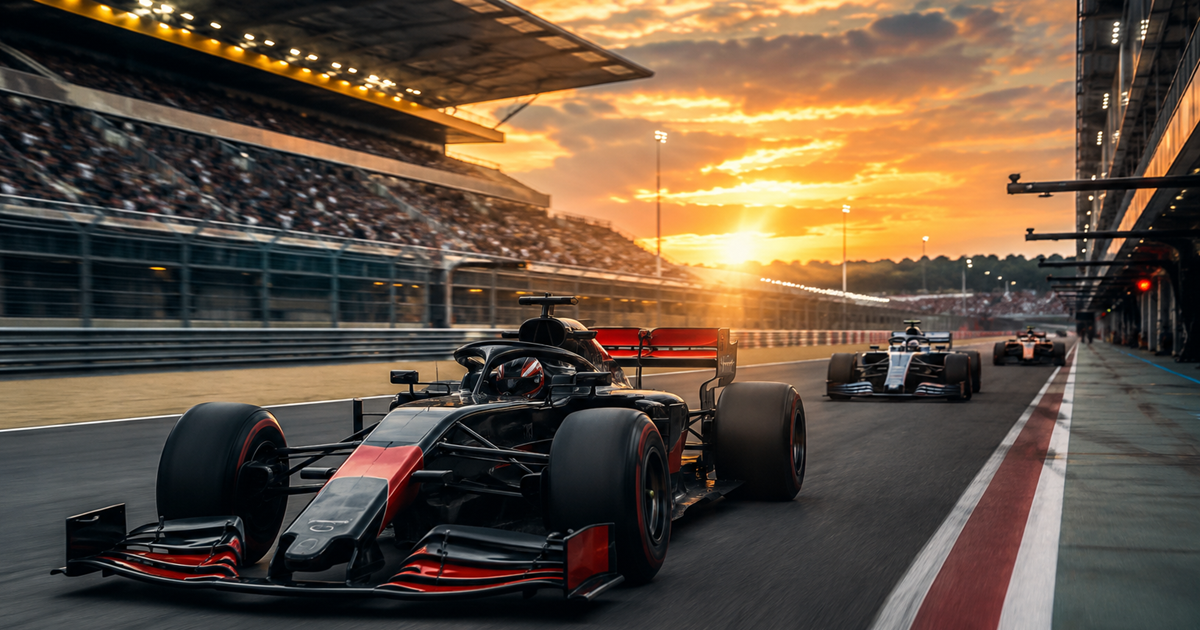
Formula 1 qualifying uses three knockout sessions, Q1, Q2 and Q3, to set the starting grid. Drivers must deliver clean, fast laps while managing tyres, traffic, track evolution and weather, with deleted laps and penalties often changing the final order.
The guide also explains parc fermé rules, Sprint qualifying, and how qualifying has evolved over time. It notes that pole position helps but does not guarantee victory, and that the official grid can differ from the qualifying classification because of penalties or technical issues.
Formula 1 qualifying compresses an entire weekend of preparation into a handful of flat-out laps.
Drivers spend practice refining their cars, understanding the tyres and searching for the right set-up. However, when qualifying begins, only their fastest lap in each part of the session matters.
The result normally determines the starting order for the Grand Prix. The fastest driver earns pole position, while those eliminated in Q1 and Q2 fill the lower places.
The basic idea is simple, but traffic, track evolution, tyre preparation, weather and grid penalties can make the final order far more complicated.
For more background on race weekends, penalties and championship rules, visit the World in Sport Formula 1 hub and our complete guide to Formula 1 rules.
How does Formula 1 qualifying work?
The standard Formula 1 qualifying format has three knockout stages: Q1, Q2 and Q3.
Every driver takes part in Q1. The slowest six drivers are eliminated, while the remaining 16 advance to Q2. Six more are knocked out in Q2, leaving 10 drivers to fight for pole position in Q3.
The 2026 format reflects the expansion of the grid to 22 cars. Before the grid grew, five drivers were usually eliminated in each of the opening two sessions.
The current format lasts 18 minutes in Q1, 15 minutes in Q2 and 13 minutes in Q3. There is a seven-minute break between each stage.
| Session | Drivers | Duration | What it decides |
|---|---|---|---|
| Q1 | 22 | 18 minutes | The slowest six fill positions 17 to 22 |
| Q2 | 16 | 15 minutes | The slowest six fill positions 11 to 16 |
| Q3 | 10 | 13 minutes | The top 10 fight for pole position |
The number of eliminations can change when fewer or more cars are eligible to compete. Under the 2026 regulations, five drivers would leave after Q1 and Q2 if 20 cars entered qualifying. Seven would be eliminated from each stage if 24 cars were eligible.
Readers who want the precise regulatory wording can consult the FIA’s Formula 1 Sporting Regulations.
What happens in Q1?
Q1 is the busiest and often the most unpredictable part of qualifying.
All 22 cars can use the circuit, so drivers must find enough space to complete a clean lap. A faster car can still suffer an early exit if its driver meets traffic, makes a mistake or loses a lap because of track limits.
Teams usually aim to record an early representative time rather than leave everything until the final seconds. That first effort provides a safety net, although improving track conditions can quickly push an apparently secure driver towards the elimination zone.
As the circuit gains grip, later laps often become faster. This creates the familiar end-of-Q1 rush, with drivers leaving the garages together and trying to begin their final attempt before time expires.
The six slowest drivers take no further part. Their Q1 times determine positions 17 to 22 in the qualifying classification. The remaining drivers lose their Q1 times and begin Q2 with a clean timing screen.
A driver can also become unclassified by failing to record a valid Q1 time or by finishing outside 107 per cent of the fastest Q1 lap. The 107 per cent restriction does not automatically apply when the race director has declared the track wet. And the stewards can permit an unclassified driver to race after considering the circumstances.
What happens in Q2?
Q2 reduces the field from 16 cars to 10.
Times from Q1 do not carry over. Every driver must therefore produce another valid lap, even if they topped the opening session.
Traffic usually becomes less severe because six cars have already dropped out. However, the margins can become smaller as the slower cars disappear and the leading midfield teams challenge for places in Q3.
The slowest six drivers are eliminated and fill positions 11 to 16. The driver in 11th narrowly misses the final shootout, while the 10 fastest advance.
Once again, the surviving drivers lose their previous lap times before the next session begins. A driver who leads Q2 receives no lasting advantage beyond the confidence and information gained from that lap.
What happens in Q3?
Q3 is the battle for pole position.
The remaining 10 drivers have 13 minutes to set their fastest laps. Their Q2 times have been deleted, so only laps completed during Q3 determine the first five rows of the provisional grid.
Teams often plan two separate runs. A driver records an initial time, returns to the pits for another set of tyres and then attacks again during the closing minutes.
Some teams may delay their first run or complete only one serious attempt when tyre availability, weather or session timing makes that approach worthwhile. However, a red flag or late yellow flag can leave a driver without another opportunity.
The fastest driver in Q3 takes first place in the qualifying classification and earns pole position. The other nine drivers are ordered by their best valid Q3 times.
When two drivers record identical times, the driver who completed the lap first receives the higher position. That rule famously decided the 1997 European Grand Prix at Jerez, where Jacques Villeneuve, Michael Schumacher and Heinz-Harald Frentzen all recorded a lap of 1m 21.072s. Villeneuve took pole because he set the time first.
How does an F1 qualifying lap work?
A qualifying attempt normally consists of three different laps.
The out-lap takes the driver from the pits to the start of the timed attempt. It may appear slow, but it is a crucial part of the process. The driver must bring the tyres and brakes into the correct temperature window without using too much energy or damaging the tyres.
The flying lap begins when the car crosses the timing line. Every corner, braking point and gear change matters. A small slide can cost several tenths of a second, while one locked wheel can ruin the entire attempt.
The in-lap follows the timed effort and brings the car back to the pits. Drivers must still follow flag instructions, speed limits and minimum-time requirements where applicable.
Although the driver delivers the lap, the wider team plays a major role. Engineers choose when to send the car out, estimate traffic, monitor weather and decide which tyres to use.
Why do drivers wait until the final seconds?
Track conditions often improve throughout qualifying.
As cars complete more laps, their tyres lay rubber onto the racing line. This can increase grip and make the circuit faster, particularly on a dry track.
Waiting can therefore produce a quicker lap. However, it also carries significant risk.
A driver can become trapped in a queue, encounter a slow car during the preparation lap or fail to begin the timed attempt before the session closes. An accident elsewhere can also produce yellow or red flags and prevent anyone from improving.
Teams must balance the potential advantage of a better track against the security of setting a time early. That tactical choice helps make the final minutes of Q1, Q2 and Q3 so tense.
What are track limits and deleted lap times?
Drivers must keep their cars within the defined limits of the circuit.
When a driver exceeds track limits, race control can delete the lap time. That decision can move a driver down the order or eliminate them from the session entirely.
Deleted laps become particularly costly near the end of Q1 or Q2. A driver may have no time to complete another attempt.
Times can also disappear after a technical investigation. If a car fails a legality check, the stewards can disqualify it from qualifying even after the driver has appeared to secure a strong position.
The official qualifying result should therefore remain provisional until the stewards have completed any investigations.
Does qualifying always decide the final starting grid?
Qualifying creates the initial classification, but it does not always produce the final grid.
Drivers can receive grid-place penalties for changing restricted power-unit components, causing incidents or committing other offences. A driver may qualify third but start eighth after receiving a five-place penalty.
When several drivers have penalties, the FIA applies them through a defined allocation process rather than simply moving every driver backwards one at a time. Unpenalised drivers then move into the available positions.
Drivers can also start from the pit lane when their teams make certain changes under parc fermé conditions or when another regulation requires it.
The FIA publishes a provisional grid before the race and issues the final starting grid one hour before the formation lap. A late withdrawal can either close the grid or leave a vacant space, depending on when it occurs.
That distinction explains why television graphics may show both a qualifying result and a separate starting grid.
What is parc fermé?
Parc fermé restricts the work teams can perform on their cars once competitive running reaches a defined point.
For a standard weekend, a car enters parc fermé conditions when it leaves the pit lane for the first time during qualifying. If a car never leaves the pit lane, the regulations still place it under parc fermé at the end of Q1.
Teams can carry out permitted safety checks and limited adjustments, but they cannot freely rebuild the car with a completely different race set-up.
This forces teams to consider both qualifying and the Grand Prix when choosing ride height, suspension settings, wing levels and cooling arrangements.
A highly aggressive qualifying set-up might deliver one excellent lap but harm tyre wear or straight-line speed during the race.
The broader effect of the new cars and sporting structure is covered in our guide to the 2026 Formula 1 rule changes.
How is Sprint qualifying different?
Sprint weekends contain two separate qualifying sessions.
Sprint Qualifying sets the grid for the short Saturday Sprint. It uses SQ1, SQ2 and SQ3 rather than Q1, Q2 and Q3.
In 2026, SQ1 lasts 12 minutes, SQ2 runs for 10 minutes, and SQ3 lasts eight minutes. Six drivers are eliminated after each of the first two stages, leaving 10 to contest the final session.
The Sprint itself takes place on Saturday. Traditional Grand Prix qualifying then follows later that day and sets the grid for Sunday’s main race.
A strong result in Sprint Qualifying does not determine where a driver starts the Grand Prix. The two classifications remain separate.
Our complete guide to how the F1 Sprint works explains the schedule, format and points system in greater detail.
How has F1 qualifying changed through history?
Formula 1 has used several qualifying systems since the World Championship began in 1950.
From 1950 until 1996, drivers generally had two one-hour sessions in which to set their fastest time. One took place on Friday and the other on Saturday.
In 1996, Formula 1 moved to a single one-hour Saturday session and limited each driver to 12 laps.
One-lap qualifying arrived in 2003. Drivers appeared individually, meaning every car had the circuit to itself for its timed attempt. However, changing weather could heavily favour one part of the running order.
The sport experimented with aggregate times in 2005 before introducing the foundations of the present knockout system in 2006. Drivers were gradually eliminated until the fastest 10 remained for the final section.
Qualifying initially contained fuel-related complications because drivers carried fuel for the race. The ban on in-race refuelling in 2010 restored the spectacle of lighter cars attacking on low fuel throughout qualifying.
Formula 1 briefly tried a rolling-elimination variation in 2016, but the sport returned to the familiar three-part knockout approach.
The next significant numerical change came in 2026. Cadillac’s arrival created an 11-team, 22-car grid, increasing the number eliminated from five to six in both Q1 and Q2. Q3 remained a 10-car contest.
What are the major F1 qualifying records?
Lewis Hamilton holds the Formula 1 record for career pole positions. His official total stood at 104 in July 2026, placing him comfortably ahead of Michael Schumacher’s previous record of 68.
Hamilton also holds the record for the most poles at one circuit. He secured his ninth Hungaroring pole at the 2023 Hungarian Grand Prix.
Valtteri Bottas owns the record for the most consecutive Q3 appearances. He reached the final stage at 103 successive Grand Prix weekends between the 2017 Australian Grand Prix and the 2022 Saudi Arabian Grand Prix.
Max Verstappen recorded the fastest pole lap by average speed at Monza in 2025. His 1m 18.792s lap averaged 264.682km/h, or 164.466mph, and replaced Hamilton’s previous Monza benchmark.
These records show that qualifying rewards more than outright speed. Drivers must repeatedly deliver clean laps under pressure while responding to different cars, circuits and weather conditions.
Does pole position guarantee a race victory?
Pole position provides an advantage, but it does not guarantee the win.
The polesitter starts at the front and avoids much of the traffic behind. That can reduce the risk of first-lap contact and allow the driver to control the approach to the opening corner.
However, the value of pole varies from circuit to circuit. It carries enormous importance at narrow tracks where overtaking is difficult. At circuits with long straights, several passing opportunities and high tyre degradation, race pace can matter more.
Starts, pit-stop strategy, tyre wear, reliability, weather and safety cars can all overturn the qualifying order.
A driver can therefore dominate Q3 and still lose the race. Equally, someone starting outside the top 10 can recover through strategy, overtaking and changing conditions.
Qualifying decides where the contest begins. It does not decide where it ends.
What should fans compare when choosing qualifying coverage?
Qualifying rewards close attention, so the quality of the coverage matters.
Before choosing a television package, streaming service or timing subscription, check whether it provides the complete live session rather than highlights alone.
Live timing adds valuable context because the main broadcast cannot show every driver. Sector times reveal who is improving, while tyre information and interval screens show which drivers face elimination.
Onboard cameras and team-radio feeds offer another layer. They allow viewers to follow an entire preparation lap, flying lap and return to the pits without the director changing cars.
Other useful features include session replays, multi-device support, downloadable viewing, pre-session analysis and a clear archive of previous qualifying results.
Broadcast rights and available services differ between countries. Fans should confirm local live coverage, replay restrictions and device compatibility before paying for a subscription.
Formula 1 also provides an official beginner’s guide to the race weekend, covering practice, qualifying, Sprints and the Grand Prix schedule.
Formula 1 qualifying: quick answers
How long does F1 qualifying last?
The scheduled running time is 46 minutes: 18 minutes for Q1, 15 for Q2 and 13 for Q3. Two seven-minute intervals bring the planned overall duration to one hour, although red flags and delays can make it longer.
How many drivers reach Q3?
Ten drivers progress to Q3 and compete for the first 10 positions in the qualifying classification.
Do Q1 times carry over to Q2?
No. The times of the advancing drivers are deleted after Q1. The same process happens after Q2, so every Q3 driver starts the final session without a recorded time.
Can a driver top Q1 but start outside the top 10?
Yes. Leading Q1 does not protect a driver in Q2. A mistake, deleted lap or mechanical problem in the next session can still leave them outside the top 10.
Can a driver take pole but start further back?
Yes. A driver can finish qualifying fastest but move down the grid because of a sporting, technical or power-unit penalty.
Does F1 award championship points for pole position?
No championship point is awarded simply for taking pole position. Points come from the Grand Prix and the Sprint, where one is held. The full allocation is available in our F1 points system guide.
Why qualifying remains essential viewing
Qualifying strips Formula 1 back to its fastest and most unforgiving form.
There are no pit-stop strategies to rescue a slow lap and no long race distance in which to recover. Drivers must prepare the tyres, judge the traffic and push the car to its limit without crossing it.
Q1 brings jeopardy, Q2 exposes the true midfield order, and Q3 delivers the final contest for pole.
The format has changed repeatedly since 1950, but its central purpose remains the same: find the fastest driver and car over one decisive lap.
