
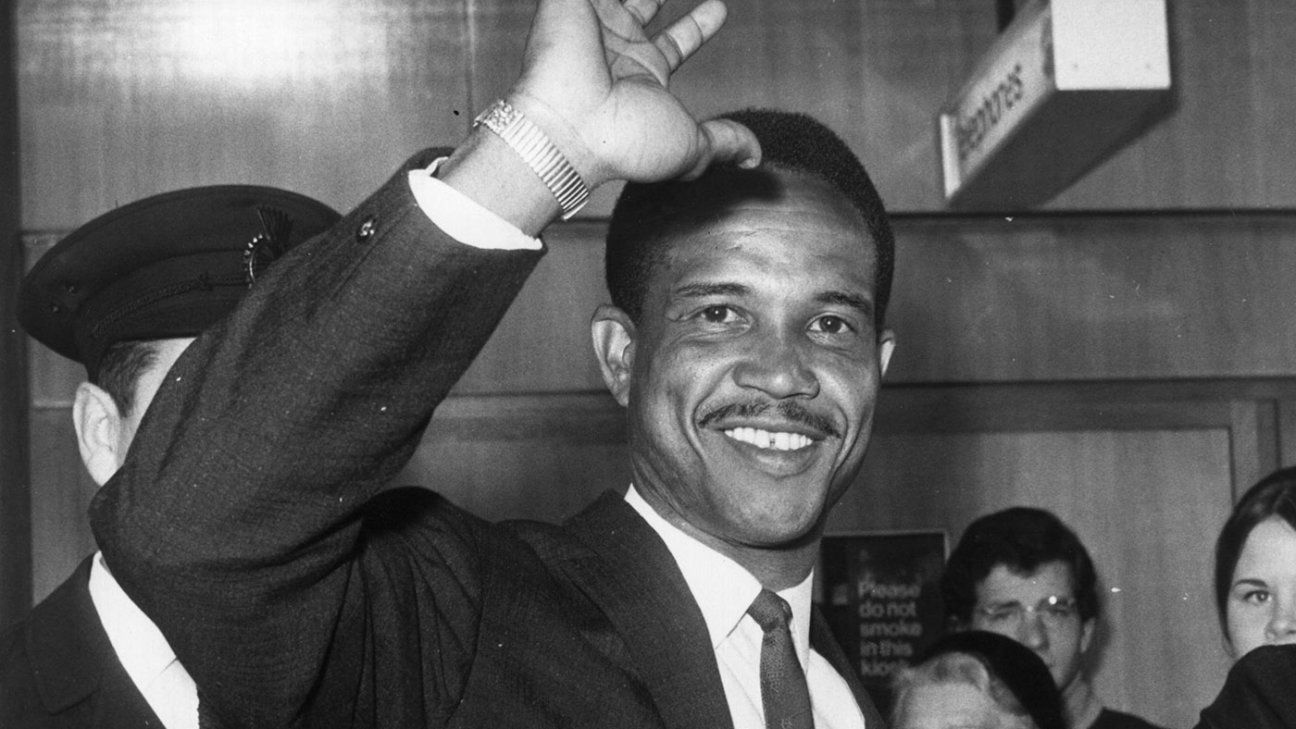
Widely regarded by many as the greatest allrounder and most gifted cricketer to have played the game, Sobers excelled as Test batter, could bowl left-arm pace as well as orthodox and wrist-spin, and he was an exceptional fielder and close-in catcher – attributes that once led his fellow all-timer, Sir Donald Bradman, to describe him as a “five-in-one cricketer”.
Sobers played 93 Test matches for West Indies between 1954 and 1974, scoring 8032 runs at an average of 57.78 and took 235 wickets at an average of 34.03. The ICC’s premier annual award in men’s cricket – the Sir Garfield Sobers Award – is named in his honour and recognises the most outstanding overall performer in men’s international cricket across all formats.
“A great innings has come to an end. In our hearts, now and forever, Sir Garfield Sobers,” Cricket West Indies said in a post on X.
Sobers made his first-class cricket debut at the age of 16, against the touring India team in January 1953, and excelled with four first-innings wickets to help his side enforce the follow-on. His Test debut followed a year later, against England in Jamaica, where he scored 14 and 26 from No.9 and took 4 for 75 in England’s first innings.
A decade after that record-breaking innings, Sobers became the first cricketer to hit six sixes in an over in first-class cricket – off Glamorgan’s Malcolm Nash – while playing for Nottinghamshire in Swansea. His first-class career comprised 383 matches for West Indies, Barbados, Nottinghamshire and South Australia and he amassed 28,314 runs at an average of 54.87 and took 1043 wickets at an average of 27.74.
While Sobers played 95 List A games, his international career had wound down by the advent of ODIs and he played only one international in that format – against England at Headingley in 1973. He was knighted for his services to cricket in 1975, and in 2000, he was named as one of Five Cricketers of the Century by Wisden Cricketers’ Almanack, alongside Bradman, Sir Jack Hobbs, Sir Viv Richards and Shane Warne.
Born in Barbados in 1936, Sobers was the fifth of six children, and was raised primarily by his mother after his merchant-seaman father died during the Second World War in 1942. He was born with six fingers on each hand – the extra digits were removed in his childhood – and he excelled in all sports, including basketball, football and golf.
In a statement on behalf of Cricket West Indies, the board president, Dr. The Hon. Kishore Shallow, described Sobers as the “greatest cricketer the world has ever seen”, and offered his “heartfelt condolences to his family, the Government and people of Barbados and all those across the world who mourn his passing.
“There are moments in the story of a people when the life of one individual becomes woven into the hopes, dreams, and identity of generations,” Swallow added. “Today, the Caribbean mourns the passing of such an individual … His mastery of batting, bowling and fielding was unparalleled, but his true significance reached far beyond the boundary ropes.
“He emerged from the Caribbean at a time when our region was finding its voice and asserting its place on the world stage. Through his excellence, he gave millions across our islands and in the diaspora, a renewed belief in what was possible. He showed that greatness was not confined by the size of our nations, the geography of our islands or the circumstances of our beginnings.
“Sir Garfield Sobers became more than a sporting icon. He became a symbol of Caribbean excellence, resilience, and possibility. His achievements brought pride to Barbados, inspiration to the West Indies and admiration from every corner of the cricketing world.”
