
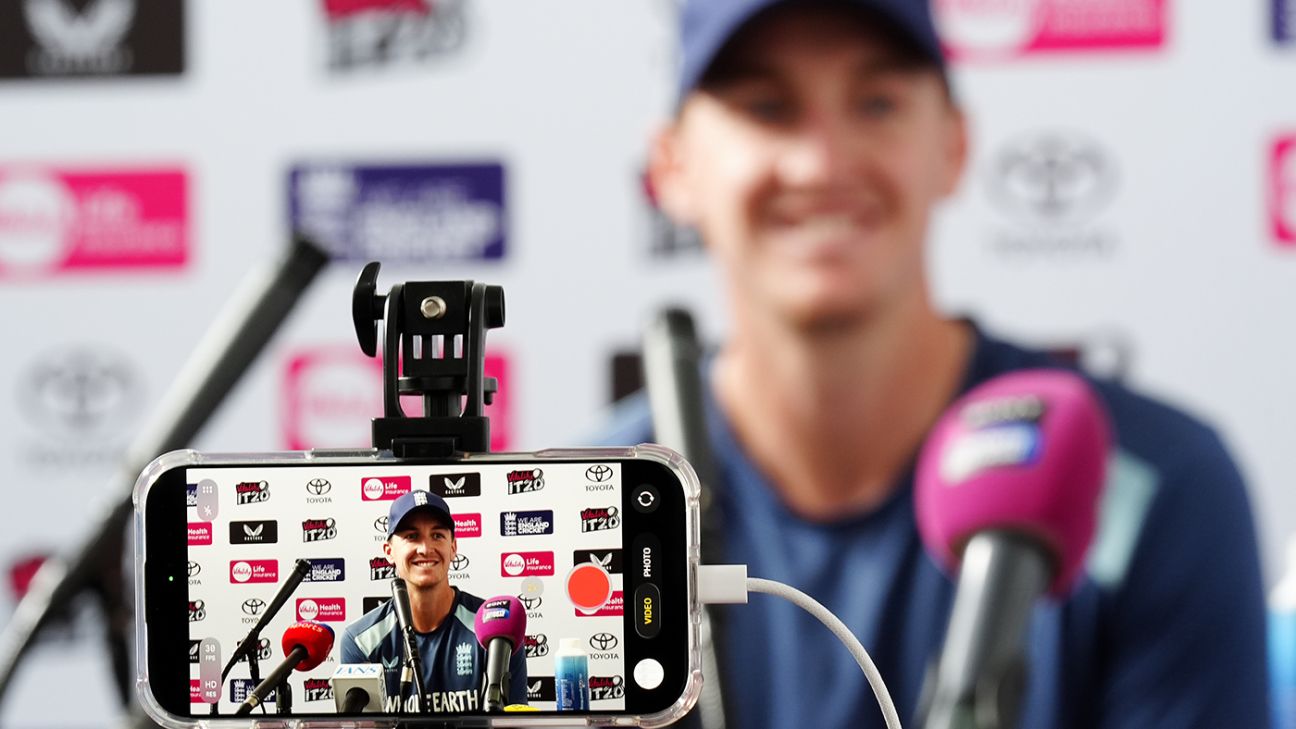
Brook was described as “a bit dumb” by Stokes when he first broke into the England set-up but has proved himself to be a smart, pragmatic captain in T20 cricket. He has won 17 out of 20 completed matches in charge – England’s run is 19 out of 22, with Jacob Bethell deputising in Ireland last year – and can take them to No. 1 in the ICC’s rankings with a win on Saturday.
The rankings only carry so much relevance in a format where teams often rotate in bilateral series and England’s semi-final defeat to India – falling just short chasing 254 in Mumbai – will not be avenged even by a 4-0 win. But they remain a useful gauge of a team’s progress, and England’s has been obvious in this format since Brook took over from Jos Buttler last year.
Brook has an innate feel for the format, rather than always following predetermined plans: he often gives Jofra Archer a third over with the new ball if he is on a roll, and uses his spinners both in the powerplay and at the death. But nor is he dogmatically anti-data, praising his team for consistently running more twos than India and crediting “all the analytic work and stats”.
Their preparation and planning relies more on pitches and dimensions than on their opposition. “We haven’t tried to focus on India too much; we’re tried to look at the conditions as much as we can,” Brook explained, as well as repeatedly praising England’s in-game communication between coaches and players throughout this series.
There are shades of England’s Test team in the early days of McCullum’s tenure in this T20 side. It is filled with vastly experienced players who have been backed and liberated by simple, clear messaging that shows trust in both their talent and their ability to adjust to conditions, just as England were for the first 18 months of Stokes’ Test captaincy.
But transferring that formula across to Test cricket would not be straightforward. The two formats are inherently very different, and England’s experience as a short-form side – Josh Tongue is the only player used in this series without at least 100 career T20 appearances – is not reflected in their Test team, where Joe Root is the only player to have won even 50 caps.
Brook is clearly aligned with McCullum in a way that Stokes was not by the end of the Ashes. “Me and Baz get on really well,” he said. “We have a lot of conversations around cricket, and away from cricket. He’s a great lad. We think in the same way, and we’re always striving to be the best team in the world… Everyone’s buying into what me and Baz are asking of them.”
But England must work out whether that alignment risks turning into groupthink in a different setting. Brook has never known a Test coach other than McCullum and while he has batted on a separate plane to anyone else on either side in this T20 series, it is nearly a year since he last scored a Test hundred and his red-ball game is in stasis.
Stokes found captaining the Test team draining enough while playing in one format; how would Brook cope while leading in all three?
Rob Key, England’s managing director, has always pushed for a close alliance between coach and captain – “It’s imperative they’re on the same page,” he wrote in his autobiography Oi, Key – but there is no guarantee that he will be the man making a call on Stokes’ successor in any case, with speculation over his own future still rife.
England are still paying the price for Key’s ill-fated decision to extend McCullum’s brief to include white-ball cricket two years ago and to make the same call with Brook would carry the same risk of confusing his focus and spreading him so thin that he is diluted across formats. Stokes found captaining the Test team draining enough while playing in one format; how would Brook cope while leading in all three?
Matt Roller is a senior correspondent at Cricinfo. @mroller98
