
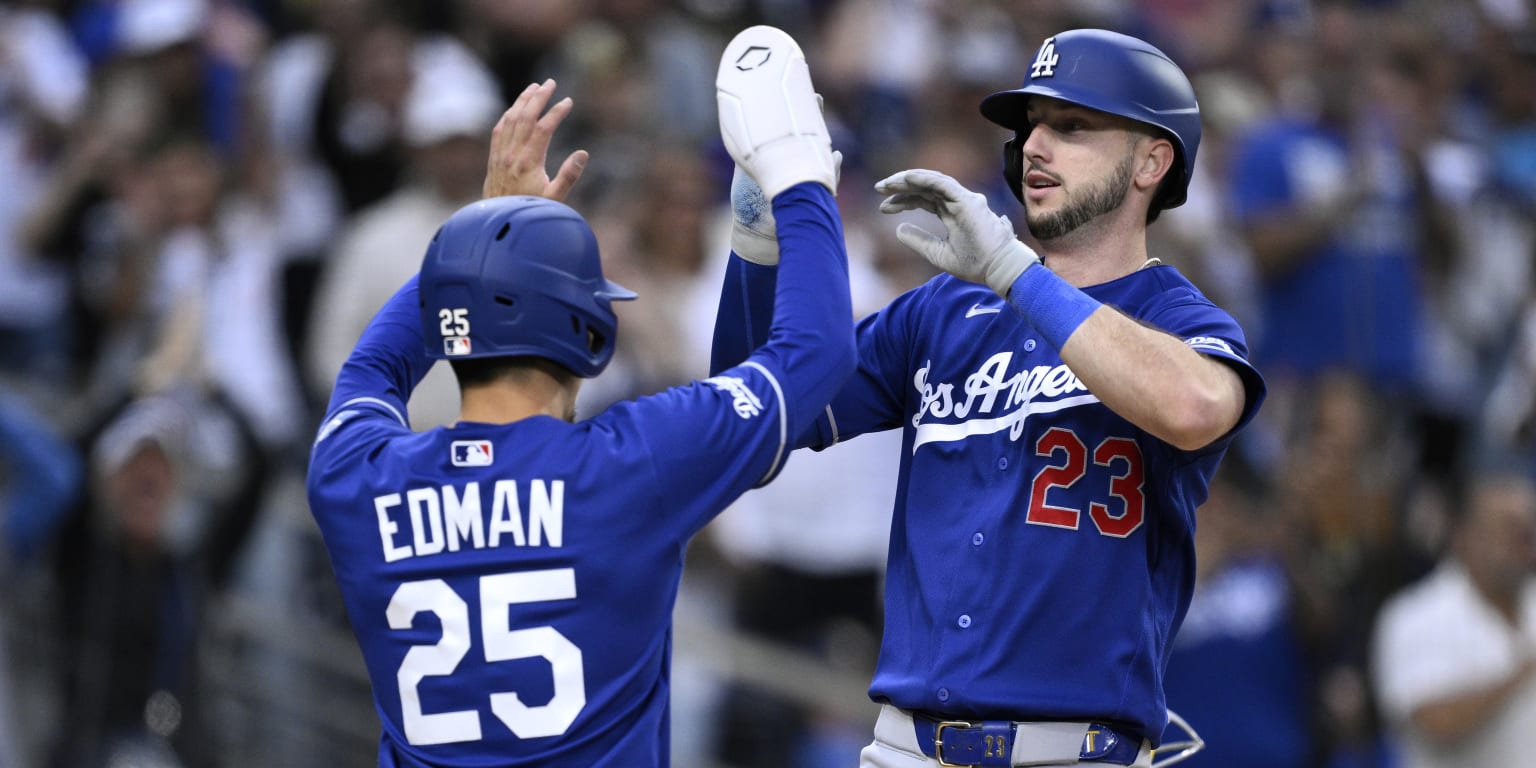
The Dodgers made two big splashes last winter, signing outfielder Kyle Tucker and reliever Edwin Díaz as free agents, and so far they haven’t gotten a whole lot out of either one. (Not that it’s stopped them, as they’re easily cruising to yet another NL West title.) Díaz pitched only six unimpressive innings early before undergoing elbow surgery, though there’s time enough to make a second first impression should things go better when he returns – which could be any day now.
Tucker, however, represents a different issue altogether. A red-hot first half with the Cubs last year turned into a disappointing second half, though that was easy enough to look past once it became clear he’d been playing through a hand fracture before suffering a calf injury. That was particularly true given that he’d been an All-Star each season from 2022-25. But four months into his first season with Los Angeles, he’s hitting only .239/.334/.376 with nine homers.
Among 170 players with at least 300 plate appearances entering Monday’s games, his 99 wRC+ ranked 114th. He’s hitting like Bryson Stott, not Bryce Harper. His once-strong defense has declined, too. It all looked a lot worse before a pair of homers over the weekend at Citi Field, his first dingers in nearly a month.
This is not the player who was a top-10 hitter in the sport over the previous four seasons. And Tucker hasn’t even turned 30 yet, so this shouldn’t be about age. He’s started 97 of the team’s 106 games, so it shouldn’t be about health either (occasional back spasms aside). So: What happened here? What can be salvaged down the stretch?
We’re going to tell you, but we’re going to warn you, too: This is going to be frustrating. There’s not one big flashing reason. There’s just minor declines in many ways, which all add up to something like a league-average hitter – hardly the star the Dodgers thought they were getting.
Unless, of course, the pair of homers against the Mets are the start of a turnaround.
It’s been everything without being anything, really. He’s striking out (19%) more than he did last year (15%), yet that’s still less than the Major League average. He’s walking less (12%) than he did last year (15%), but also still better than Major League average. There’s small ticks up in ground-ball rate and down in hard-hit rate and bat speed, though again nothing catastrophic. While he’s actually chasing a lot more, that’s just dropped him from the 98th percentile to 81st – which is, again, “still better than the Major League average.”
It’s all these small things that add up to a greater whole, and it’s down across all pitch types, not any one in particular. Where this is really going to lead is, “He’s missing out on the best-quality contact,” because those small changes in “more grounders” and “less hard-hit” have turned into a barrel rate cut down from 11% of his batted balls to just 7%. That’s a big deal because the slugging percentage on a barrel is about 3.5 times higher as it is on a non-barrel. (A barrel is a hard-hit ball in the air, the perfect combination of exit velocity and launch angle.)
That, finally, gets us to something worse than average. The previous few years, he was near the 70th percentile in turning batted balls into barrels. This year, that’s merely 37th percentile. It’s not that Tucker is getting less out of his barrels, it’s just that he’s not doing it as often.
Really, that’s almost all of what this is. Look at Tucker’s performance on non-barreled balls last year and this year, and you’ll find basically no difference. Remember, if a barrel is the perfect combination of exit velocity and launch angle, then a non-barrel is everything else – weakly hit balls or crushed grounders or popups, etc. It’s all the “everything else that’s not the best thing you can do.”
Tucker, non-barreled balls
The outcomes are more or less the same, right? That’s actually been true in four of the last five years, around the injury-shortened 2024 that looked like it’d be a career year before he hurt his shin. Whatever the problem is, it’s not this.
Now look at the really, really high-quality batted balls, those barrels.
Still excellent, and still in the range of previous years. There, again, is the feeling of “This isn’t it, keep looking.”
So all this comes down to, really, are the small handful of missing barrels – instead of the roughly 32 he would usually have through the end of July, he’s sitting on only 19.
If merely that – a dozen-or-so missing high-value hits – doesn’t seem like enough to account for this, it tells you a little about the margins we’re talking about here, and also about how valuable those hits really are. (And, also, for as disappointing as Tucker’s season has been, it’s more about failing to meet expectations than it is being an outright disaster, as he’s still essentially a league-average hitter right now, as his 97 OPS+ shows.)
But it really does matter, though. If we take his usual outcomes on barrels over the last half-decade (so 70% extra-base hits, and half of all his barrels become homers) and give him simply a dozen more back, he’d have added six more homers and two doubles, along with four outs. That alone would take his line from this …
That, conveniently, is relatively similar to what Andy Pages has done – and would make him about 20 percent above average. If not up to his peak years, it would alleviate a lot of concern, too.
Tucker had, in fact, gone two entire weeks without a single barreled ball, leading up to the Mets series.
“There’s some times where I like to see the ball coming in, put a swing on it, and I can visualize the ball coming off the bat and doing what I want with it, but it doesn’t really go that way,” Tucker said to reporters in New York. “Which is a little frustrating. … That happens at times, but it’s seemed to happen a lot more this year. I’ve just got to battle for the next pitch and just continue on with the at-bat.”
After the game on Saturday, Tucker spoke to the FOX broadcast about what he was feeling in his big weekend.
“I feel a lot better,” he said. “Taking some good pitches, and swinging at the ones I want to, is the biggest thing, and then just trying to put a good swing on it when I get something over the plate. I felt a lot better today, and yesterday, and hopefully I just keep going off that.”
That mirrors, to some extent, what Dodgers manager Dave Roberts had said to the OC Register two months ago.
“I do think that the swing rate is higher than it has been in his career, whether it’s the first pitch, just in total,” Roberts said. “I think that speaks to not being selective enough, because he is a guy that by nature can run deep counts and still be fine getting to two strikes, but it just seems like he’s much more hyper-aggressive than I recall.”
That all comes down to swing decisions, which are a notoriously tricky thing to evaluate. Generally, you’d like to swing at strikes and not at balls, but it’s also more complicated than that, since sometimes there’s a strike that’s not a great pitch for you to hit. That can likely be seen somewhat, we think, in what happened to his bat speed. This is probably not, “He decided to swing harder,” so much as it is, “He was swinging at better pitches.” And by better, we mean the kind that allow him to make better contact. Bat speed is, after all, as much a timing metric as anything else.
If it really is just that worse swing decisions led to missing out on the best-value contact and those swing decisions are improving, then maybe what we saw in Queens over the weekend was the start of a turnaround. And maybe the early struggles will turn out to be no more than that, the umpteenth example of a player taking some time to find comfort in his new home.
But there’s a few simply odd things happening, too.
For one thing, there’s his strikeout rate. Tucker struck out 27% of the time in June, which was the second-highest mark of his entire career, at least in months when he took at least 50 plate appearances. Yet in July, so far, that’s dropped all the way down to 11%, the third-lowest of his career, and that was for a month that was, ahead of the New York weekend, one of the weakest he’s ever had.
For another thing, he’s been oddly ineffective at Dodger Stadium, where he’s homered just twice, and we say “oddly ineffective” because while it still has a long-ago reputation as a pitcher’s park, the fact is that it’s been one of the best home run parks in the Majors for years now. Tucker, however, now has an excellent OPS of .804 on the road as compared to a brutally weak .607 OPS mark at home. He’s been a top-50 hitter on the road, better than Harper or Nick Kurtz. He’s been one of the dozen weakest at home. (That’s after posting a 1.200 OPS in eight games as a Dodger Stadium visitor from 2021-25.)
We think, most likely, that’s a weird fluke. Then again, pretty much everything about Tucker’s first year in Los Angeles has been kind of weird. Like Díaz, he has the benefit of knowing that this rough introduction won’t prevent his team from making the playoffs. Like Díaz, no one will remember any of this should he get back to normal in October. The pair of homers at Citi Field might just be the start.
