
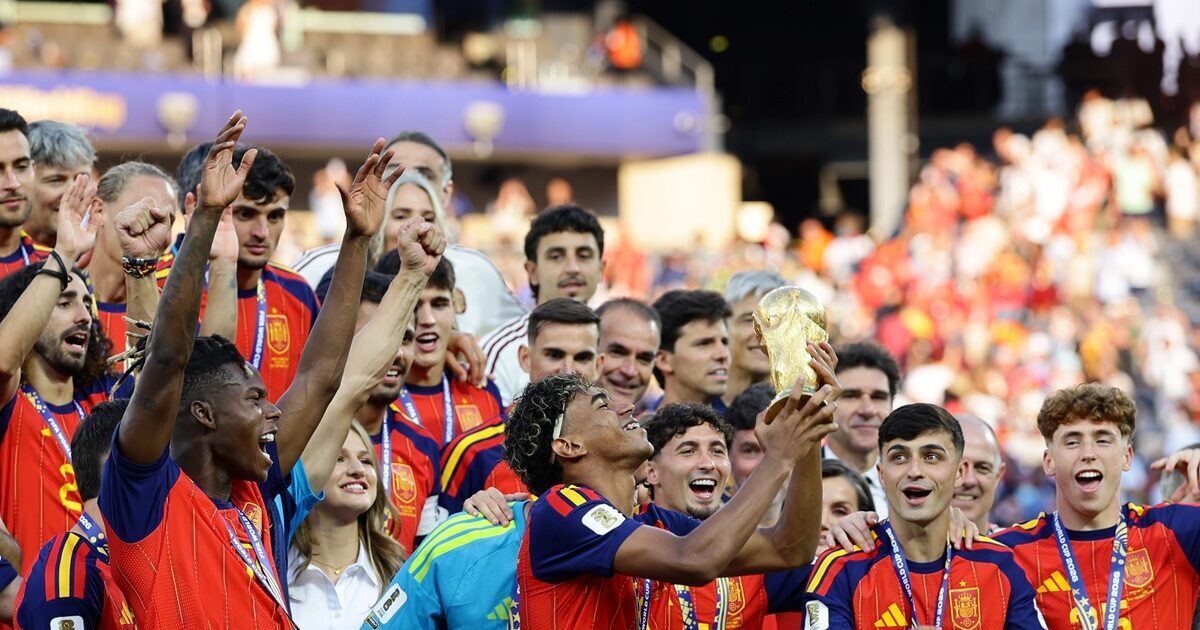
Spain outplayed Argentina to lift the second World Cup title in their history on Sunday in East Rutherford. It was Ferran Torres’ magic moment in the 106th minute that gave La Roja the defining goal at MetLife. Spain were by far the dominant side throughout the game and completely outclassed the opponent. Argentina did not register a single shot on target in the entire match, with their first shot coming in at the 117th-minute mark.
Spain entered the match with the same lineup that beat France in Arlington. On the other hand, Lionel Scaloni made three changes to his team that started the game against England. Gonzalo Montiel, Rodrigo De Paul and Nicolás González replaced Nahuel Molina, Giuliano Simeone and Leandro Paredes.
The Gameplan
Spain pressed Argentina high up the pitch with their traditional 4-4-2 diamond pressing structure. They made Argentina play the ball on the left side of the field, then blocked all passing options, forcing Lisandro Martínez to go long. La Albiceleste did not force the issue and played into Spain’s hands. Scaloni was aware of Spain’s pressing ability beforehand, and that is why he started Nicolas Gonzalez. Nico provided an aerial and run-in-behind threat to Spain’s back line and was the target man for those long balls.
Spain’s centre-backs dealt with the threat from Nico Gonzalez exceptionally well. Once Spain had recovered the ball, they tried to break Argentina’s 4-4-2 mid block by quick counter movements and one-twos. Argentina dealt with it well enough by not letting Spain create any clear-cut chances in the first half.
When the Spanish centre-backs had the ball, Argentina pressed high up the pitch and marked Spain’s midfield. Rodri often dropped deep between the centre-backs to get away from his marker. Argentina’s centre-backs also were not afraid to step out of the back line and put pressure on Olmo and Oyarzabal, not letting them have much time on the ball. Thus, both sides dealt with what the other side threw at them, and the game remained in a gridlock until half-time.
Where Things Went Wrong for Argentina
Lisandro Martinez’s injury in the 44th minute changed the game completely. The left-footed Manchester United defender was the outlet for Argentina to provide long balls to beat Spain’s intense pressing. In his 44 minutes on the pitch, he attempted 8 long balls. Scaloni replaced him with Nicolas Otamendi, who is a right-footed defender. He could not execute the plan and did not complete a single long ball in his 76 minutes on the pitch.
After half-time, Scaloni tried to bring control to Argentina by replacing Nicolas Gonzalez with Leandro Paredes. The midfielder brought some control, but Argentina lost their only attacking threat from the first half. Spain’s organised press did not let Argentina get through to the final third. Cristian Romero’s injury in the 70th minute also did not help Argentina’s case. Enzo Fernández’s red card in stoppage time proved to be the final blow to Argentina’s plans, and as the clock ticked, La Scaloneta dropped further and further into their own half.
As the game progressed, it seemed only a matter of time until Spain scored. The breathtaking moment came in the 106th minute when Ferran Torres put a volley through the roof of the net, initially headed down by Nico Williams. Argentina, with Messi at the helm, then tried to conjure up something and created a couple of chances as well, but it was too little, too late. Spain held on for the rest of extra time and etched their names in history.
Spain’s dominance in the World Cup was undeniable. They were unquestionably the best team in the tournament. Their control of possession was unmatched; they conceded a single goal throughout and managed to limit formidable attacks like France and Argentina to a combined expected goals (xG) of just 0.5.
In recognition of their exceptional midfield and defensive contributions, Rodri Hernandez and Pau Cubarsi earned the Golden Ball and Young Player of the Tournament awards, respectively. Furthermore, Unai Simón secured the Golden Glove for his outstanding goalkeeping record. However, it’s crucial to understand that Spain’s World Cup triumph is not because of these individual displays, but rather the result of their exceptional teamwork and collective spirit that ultimately led them to glory.
