
Before he hit the game-winning shot in the 1982 NCAA Men’s Basketball championship game, before he was drafted third overall in the 1984 NBA Draft, before the Rookie of the Year Award, the 14 All-Star selections, the 10 scoring titles, the five MVP Awards and the six NBA titles …
Before he became widely regarded as the greatest basketball player of all time, another sport held Michael Jordan’s focus and attention: baseball.
The American pastime was Jordan’s first love when it came to sports. And it was the same for his father, James, who was one of the primary motivators that drove him to athletic greatness.
During All-Star festivities in Philadelphia on Tuesday, a unique piece of memorabilia was sold at auction for $35,250. It is quite possibly the first sports-related autograph Jordan ever signed, and it came on a page of the 1975 North Carolina Dixie Youth Baseball State Tournament program.
The item — and the story behind it — gives us a window into the baseball exploits of a 12-year-old Jordan, who participated in that tournament and nearly led his team to a DYB World Series championship.
It’s that “nearly” part that might have played a role in steering Jordan toward the sport in which he would eventually become an unrivaled superstar.
Match ’em with the Mitchems
Reggie Murrill was 10 years old when he and his family moved into a home on Gordon Road in Wilmington, North Carolina, in 1974.
When they found out who the previous owners of the home had been, it led to a friendship between Reggie and one of the boys who had lived there before moving down the street.
That boy was Mike Jordan.
“We would go back and forth to each other’s house to play and stuff like that,” Murrill said. “We’d be in his yard playing basketball all day. It was him and his brother against me and my brother.”
Murrill and Jordan became close friends, and when they were each 12 years old, they were selected to participate in North Carolina’s Dixie Youth Baseball State Tournament, which was to be held in Kings Mountain.
Kings Mountain was about a four-hour drive west of Wilmington, on the outskirts of Charlotte. The kids from around the state who were selected to participate stayed with host families for the duration of the tournament.
Frank and Nina Mitchem volunteered to host a player, and they were assigned Jordan. Jordan asked if Murrill could also be assigned to the same family, and the Mitchems agreed to have both boys stay with them.
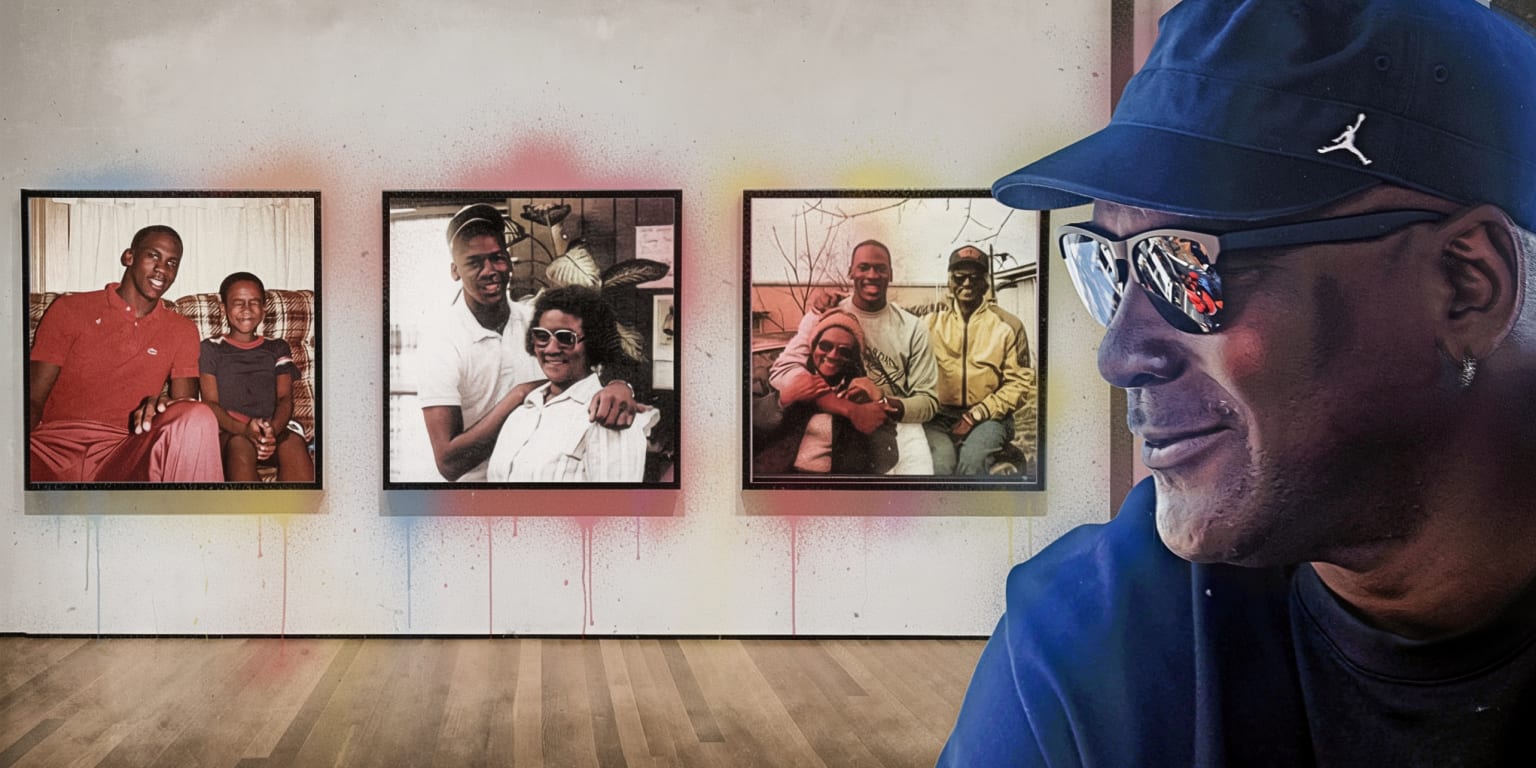
So began a special relationship between the Mitchems and Jordan, one that brought him back to their home every summer for more than a decade after that — even after he had become one of the most recognizable people in the country.
“My grandfather (Frank) was very well known in the Kings Mountain community,” said Justin Jones, who was born the same year as Jordan and Murrill stayed with the Mitchems and later came to regard Jordan as an uncle. “He owned a small painting company, but he was more well known because he loved baseball.”
The director of the tournament contacted Frank and asked if he could help, and his affirmative answer eventually led to something neither Frank nor Nina could ever have imagined.
The first known Jordan autograph?
Jordan and Murrill had a great time staying with the Mitchems, who went out of their way to make the boys’ experience a good one.
Before the boys left after helping their team — Cape Fear — win the tournament to advance to the Dixie Youth Baseball World Series, Nina had a request.
“I want you guys to autograph the tournament program for me,” she said.
Jordan and Murrill obliged, and even though he had been known as “Mike,” Jordan signed his name “Michael Jordan” above his picture.
“She basically just wanted them to feel special,” Jones said. “To feel accomplished.”
Jordan had such a nice time that week with the Mitchems that they received a phone call the next year from Jordan’s mother, Deloris.
Could Mike come back and visit during the summer?
The answer was yes, and a tradition of summer visits by Jordan to the Mitchem home began. Jordan and the Mitchems became so close that Jones, who was born the year Jordan and Murrill first stayed with the family, also became close with Jordan.
“He was almost like an extended member of our family,” Jones said. “He came back every summer, and a lot of the summers, he would visit for the whole summer.”
When Jones was about six years old, he was playing in the yard one day and heard his grandmother calling.
“She said, ‘Hey, you need to come in the house,’” Jones remembers. “And I was like, ‘Why?’ She was like, ‘Mike’s on TV.’ And I said, ‘What’s he doing on TV?’”
Jones knew Jordan only as “Uncle Mike,” a close family friend who was “just another guy that hung out at our house.”
When Jones ran into the house to see what his grandmother was talking about, he saw Jordan playing in the 1981 McDonald’s All-American Game in Wichita, Kansas. Jordan scored a then-record 30 points to help the East team win.
Jordan went on to play college ball at North Carolina, and the Mitchem family would drive to Chapel Hill to watch him play for the Tar Heels. Jordan became a sensation and was drafted by the Bulls in 1984.
But he still came back to the Mitchem home in Kings Mountain every summer. He even took Jones on trips with him after he turned pro.
“When I had spring break, there were times where he would let me come to Chicago,” Jones said. “And he took me to practice, and after practice, he asked me where I wanted to go to eat. And I was a nine-year-old kid — I said McDonald’s.”
So they went through the drive thru at a nearby McDonald’s. And that’s when Jones really began to understand the fame of the man in the driver’s seat — the man he referred to as “Uncle Mike.”
“We get to the window to pay and get the food,” Jones said, “and every single person in that McDonald’s either ran to the window or tried to come outside. For us to get outta there, he ended up autographing some McDonald’s to-go bags so we could leave.”
But even though he was so famous he couldn’t walk into a restaurant to order food, Jordan kept coming back to Kings Mountain.
“I think it’s a testament to how loyal and genuine he is,” Jones said. “And also a testament to who my grandparents were.”
Sure, you might have heard the moniker “Mr. Baseball” before — perhaps in reference to Bob Uecker or Tom Selleck.
Yes, the same Michael Jordan who would become the most famous basketball player on the planet was named “Mr. Baseball” for North Carolina by the Dixie Youth Baseball Association in 1975.
After helping his Cape Fear club win the state championship, he was outstanding in the Dixie Youth Baseball World Series, which was held in Lawrenceville, GA.
In the opening game against Texas, Jordan played shortstop and launched a three-run homer, but that was all the scoring Cape Fear could muster in a 4-3 loss. After winning its second game, Cape Fear again faced Texas. Jordan pitched a gem, yielding one run on three hits, but Cape Fear was eliminated with a 1-0 loss.
Jordan was an outstanding baseball player. Nearly two decades later, he would retire from basketball in the wake of a third straight NBA title with the Bulls and pursue a pro baseball career.
In 1994, despite not having played the game in 15 years, he hit over .200 and stole 30 bases in 127 games for the Double A affiliate of the White Sox, the Birmingham Barons — a truly remarkable feat, all things considered.
Could Jordan have been a great Major League player if he had stuck with baseball as a kid? We’ll never know. But there’s no reason to think he couldn’t have done so given how talented he was as a youngster.
So, why did he shift his focus to basketball?
One of the reasons could trace directly back to the 1975 Dixie Youth Baseball World Series. The sting of defeat in that tournament might have played a role in moving Jordan from the diamond to the hardwood, where one individual could have an outsized impact on the outcome.
“In baseball, you’re at a position,” Murrill said. “You aren’t running anything — you’ve gotta play your position. But in basketball, you could take that ball and do what you wanted.
“In baseball, it’s more of a team game, and the ball has to come to you for you to do something. But in basketball, he’s gonna have the ball a majority of the time. And there are only five people that you’re playing with instead of nine.”
Murrill spent 28 years in the military after his childhood friendship with Jordan, and to this day, he says he’s never met anyone more competitive. And that if Jordan had stuck with baseball, he might have had a bright future ahead in that sport, as well.
“I think he would’ve had a chance to make it [to the Majors],” Murrill said. “I don’t know what position he would’ve excelled at more, but he had a lot of them.”
‘Why do you want my autograph?’
About 14 years after Nina Mitchem passed away in 1999, Jones’ mother and aunt decided to rent the Mitchem home out to family, so they and Jones went over to clean it out and sort through Nina’s belongings that were still there.
“We found a lot of correspondence between her and Michael,” Jones said. “And I came across this magazine and I was like, ‘What’s this?’ And my mom said, ‘This is probably the program from when Michael was here to play in the tournament.’
“So I opened it and started flipping through it, and I was like, hold on — this is autographed? This is from when he was a kid. And I’m like, this is insane. I sat on it for a long time, but at some point, I felt like enough time had passed and that if I leave this to one of my children, they’re not going to be able to tell the story.”
The story gives us a glimpse into one of the most well-known individuals of our time. It tells us something of his youth and how important baseball was to him at that time. It also tells us about his genuine ties to a family that opened its home to him half a century ago.
Jordan’s autograph is one of the most sought-after in the world, as evidenced by the recent auction of the youth baseball program with his signature in it. But something he would tell Jones about his John Hancock when he visited during the summer speaks to how he viewed himself and the world around him.
“I would ask him every now and then for an autograph — not for myself, but for friends,” Jones said. “And he’d always say, ‘Why do you want my autograph? You know me.’”
