
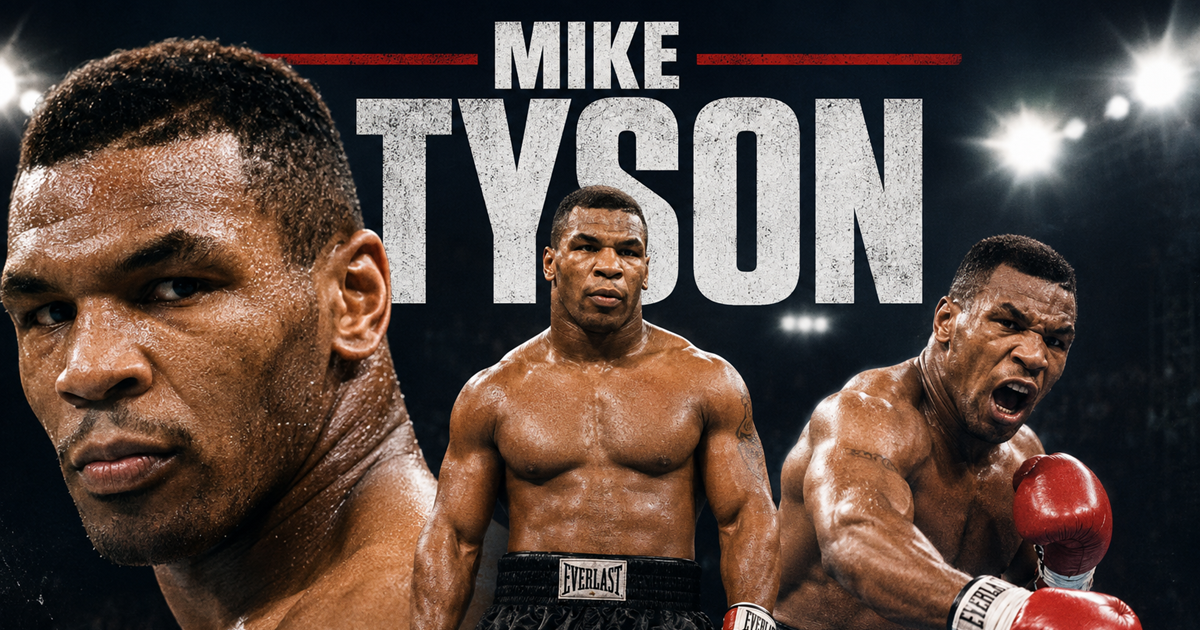
Mike Tyson reached boxing’s summit with a speed that felt almost unnatural. He was only 20 when he became a heavyweight world champion, yet he already carried the menace, technique and public presence of a fighter built for the sport’s biggest stage.
The knockouts made him famous. The sight of opponents retreating before the opening bell made him feared. However, Tyson’s prime involved far more than raw aggression. His success came from explosive footwork, educated head movement, compact combinations and an ability to close distance before much taller heavyweights could establish their jab.
His career ultimately became one of the most dramatic in sporting history. Tyson rose from a troubled childhood in Brooklyn to become the youngest heavyweight champion on record. He unified the division, demolished Michael Spinks in 91 seconds and became one of the world’s most recognisable athletes.
The story also includes a shocking championship defeat, a rape conviction and imprisonment, destructive controversies, unsuccessful attempts to reclaim his former dominance. And an extraordinary return to a professional ring at the age of 58.
Tyson’s record alone cannot explain his place in boxing. His significance comes from the intensity of his peak, the technical qualities behind his power and the complicated legacy left by everything that followed.
For more heavyweight features, records and fight analysis, visit World in Sport’s boxing coverage.
A Difficult Childhood in Brownsville
Michael Gerard Tyson was born in Brooklyn, New York, on 30 June 1966. He spent much of his childhood in Brownsville, an area affected by poverty, crime and social deprivation.
Tyson frequently became involved in street fights and criminal activity as a boy. His behaviour eventually led to his placement at the Tryon School for Boys, a juvenile facility in upstate New York.
That move changed the direction of his life.
At Tryon, counsellor and former amateur boxer Bobby Stewart noticed Tyson’s physical strength and interest in fighting. Stewart began teaching him the basics but soon believed the teenager needed a more experienced trainer.
He introduced Tyson to Cus D’Amato, the respected boxing figure who had previously guided Floyd Patterson and José Torres to world titles.
D’Amato saw exceptional potential in Tyson. The teenager moved into the trainer’s home in Catskill, where boxing became the centre of his daily life. D’Amato provided accommodation, discipline and a detailed education in the psychological and technical demands of the sport.
When Tyson’s mother died in 1982, D’Amato became his legal guardian. Their relationship went well beyond the traditional boxer-trainer arrangement, although Kevin Rooney and other members of the Catskill team also played important roles in developing Tyson’s style.
Read more about the trainer’s methods and influence in World in Sport’s profile of Cus D’Amato and his boxing legacy.
Amateur Success Prepared Tyson for the Professional Ranks
Tyson quickly established himself as an outstanding amateur heavyweight.
He won gold medals at the Junior Olympic Games in 1981 and 1982 before claiming the National Golden Gloves heavyweight title in 1984. However, defeats to Henry Tillman prevented him from representing the United States at the 1984 Olympic Games in Los Angeles.
Tillman went on to win the heavyweight gold medal, while Tyson turned professional without the Olympic recognition that helped launch many leading American fighters of the era.
His professional debut took place against Hector Mercedes in Albany, New York, on 6 March 1985. Tyson stopped Mercedes in the first round and then began one of the fastest rises the heavyweight division had seen.
He fought frequently, sometimes returning to the ring only weeks after his previous appearance. The schedule allowed him to gain experience while building a growing collection of early stoppages.
Cus D’Amato died in November 1985, before seeing Tyson complete the championship journey he had predicted. Rooney remained in Tyson’s corner and helped refine the movements that would define his peak.
What Made Mike Tyson’s Style so Effective?
Tyson was short for an elite heavyweight, standing approximately 5ft 10in. He could not rely on controlling fights from long range against taller opponents, so his team built a system around closing distance safely and explosively.
The foundation was D’Amato’s peek-a-boo style. Tyson held both gloves high, moved his head from side to side and bent at the waist as he advanced. Rather than following opponents in straight lines, he slipped outside punches and attacked from new angles.
His legs were essential. Tyson generated power by driving upwards from a low stance and rotating his hips through hooks and uppercuts. He often targeted the body before switching the same combination towards the head.
One of his most recognisable sequences began with a right hand to the body followed by a right uppercut through the middle. He could also slip a jab, move outside an opponent’s lead shoulder and deliver a left hook before the other fighter had reset.
His hand speed made those combinations particularly dangerous. Heavyweights expected power from Tyson, but many struggled more with how quickly he crossed the ring and how little warning preceded his attacks.
The intimidation surrounding him was real, although it developed because the technique repeatedly produced decisive results. Tyson did not simply charge forwards and swing. At his best, he used rehearsed movements to create openings and then attacked without hesitation.
Tyson Becomes the Youngest Heavyweight Champion
Tyson entered his first world-title fight with a 27-0 professional record.
Trevor Berbick held the WBC heavyweight championship when the pair met in Las Vegas on 22 November 1986. Tyson overwhelmed the champion and ended the contest in the second round.
Berbick attempted to rise after the decisive knockdown but repeatedly lost his balance.
The victory made Tyson a world heavyweight champion at 20 years and 145 days, an age record that Guinness World Records continues to recognise.
The WBC belt was only the beginning.
Tyson defeated James “Bonecrusher” Smith on points in March 1987 to add the WBA championship. Five months later, he beat Tony Tucker by unanimous decision to claim the IBF title.
That victory made Tyson the first heavyweight to hold the WBC, WBA and IBF championships simultaneously. At 21, he had become the undisputed champion of boxing’s most celebrated division.
His reign included wins over Tyrell Biggs, former champion Larry Holmes and Tony Tubbs. Holmes had never previously been stopped, but Tyson knocked him out in the fourth round in January 1988.
Each victory strengthened the sense that Tyson represented a new version of the heavyweight champion: shorter than many of his opponents but quicker, more explosive and relentlessly aggressive once he entered punching range.
Michael Spinks Falls in 91 Seconds
Tyson’s defining performance came against Michael Spinks in Atlantic City on 27 June 1988.
Spinks was unbeaten and held a legitimate claim to the lineal heavyweight championship after twice defeating Holmes. He had never lost as a professional and had already won world titles at light-heavyweight and heavyweight.
The contest was presented as a meeting between the division’s two leading fighters. It lasted only 91 seconds.
Tyson immediately cut down the space between them. A right hand to the body dropped Spinks for the first time in his career. Spinks rose, but Tyson quickly landed a left hook followed by a powerful right hand.
The second knockdown ended the fight.
The result became the clearest demonstration of Tyson’s peak. Spinks was an accomplished, intelligent champion, yet Tyson denied him the time and distance needed to settle into the contest.
Tyson followed the victory with stoppages of Frank Bruno and Carl Williams. By the end of 1989, his professional record stood at 37-0.
Buster Douglas Produces a Historic Upset
Tyson defended the undisputed championship against James “Buster” Douglas in Tokyo on 11 February 1990.
Douglas entered the fight as a major outsider, but he controlled long periods behind a disciplined jab and straight right hand. He refused to be intimidated and repeatedly caught Tyson as the champion attempted to close the distance.
Tyson dropped Douglas with an uppercut in the eighth round, but the challenger recovered and resumed his effective work.
In the tenth, Douglas landed a powerful uppercut before following with a combination that sent Tyson down. The champion searched for his mouthguard while attempting to beat the count but could not rise in time.
The defeat ended Tyson’s unbeaten record and his first world-title reign.
Arguments have continued over Tyson’s preparation and the stability of his team by that stage. Those issues provide context, but they should not diminish Douglas’s performance. He outboxed the champion, recovered from a knockdown and earned one of the most famous victories in sporting history.
Conviction and Imprisonment Interrupt Tyson’s Career
Tyson returned with four victories after losing to Douglas, including two wins over Donovan “Razor” Ruddock.
A proposed fight with Evander Holyfield did not take place at that stage. Tyson withdrew because of injury before his career was halted by events outside the ring.
In February 1992, an Indiana jury convicted Tyson of raping Desiree Washington. The court sentenced him to six years in prison, followed by probation. Tyson has continued to maintain that the encounter was consensual, but his conviction and unsuccessful appeals remain matters of legal record.
He was released in March 1995 after serving nearly three years.
The conviction forms an unavoidable part of Tyson’s life story. It should neither be removed from accounts of his career nor treated as a minor interruption between fights.
Tyson Regains Two World Titles
Tyson returned to enormous public interest when he faced Peter McNeeley in August 1995. The fight ended in the opening round after McNeeley’s corner entered the ring, causing a disqualification.
Two further victories gave Tyson another world-title opportunity against Frank Bruno in March 1996.
Bruno had performed bravely against Tyson in their first fight seven years earlier, but the rematch was more decisive. Tyson stopped him in the third round to regain the WBC heavyweight championship.
He later relinquished that title rather than face mandatory challenger Lennox Lewis. Tyson then stopped Bruce Seldon in the first round in September 1996 to win the WBA belt.
In less than 13 months, he had returned from prison and reclaimed two versions of the heavyweight championship. However, the comeback did not restore the complete fighter who had dominated the late 1980s.
The head movement became less consistent. Tyson often searched for one decisive punch rather than constructing combinations through footwork and body attacks. He remained dangerous, but opponents who survived the early pressure could find opportunities that had rarely existed during his peak.
Holyfield Exposes the Weaknesses in Tyson’s Comeback
Evander Holyfield challenged Tyson for the WBA title in Las Vegas on 9 November 1996.
Holyfield entered the contest as an underdog after uneven recent performances, but he refused to concede ground. He disrupted Tyson at close range, matched him physically and controlled the exchanges with short punches.
The referee stopped the contest in the 11th round, giving Holyfield a victory that transformed the heavyweight picture.
Their rematch on 28 June 1997 became one of boxing’s most infamous events. Tyson bit Holyfield’s ears during the third round and was disqualified. Nevada officials later revoked his licence and issued a financial penalty.
Tyson complained about Holyfield’s use of his head, but nothing justified the bites. The disqualification caused lasting damage to his reputation and overshadowed the tactical questions raised by their two fights.
Holyfield’s strength, composure and inside work had denied Tyson the space needed to produce his most effective combinations.
Read World in Sport’s full account of Evander Holyfield’s career.
The Final Pursuit of Another Championship
Tyson returned to competition in 1999 and remained capable of producing destructive moments. He stopped Francois Botha and recorded further wins over Julius Francis, Lou Savarese and Brian Nielsen.
His fight with Andrew Golota initially ended in a Tyson victory but was later changed to a no contest after Tyson tested positive for cannabis.
The last major championship opportunity of his career came against Lennox Lewis in Memphis on 8 June 2002.
Lewis used his height, reach, jab and control of distance to dominate the contest. Tyson showed courage but struggled to move beyond the champion’s lead hand. Lewis ended the fight with a right hand in the eighth round.
The defeat underlined how much the heavyweight division had changed. Tyson could still punch, but he no longer possessed the sustained movement or conditioning required to pressure an elite champion for a full fight.
Lewis, by contrast, remained disciplined and forced Tyson to attack from an ineffective range.
World in Sport’s Lennox Lewis profile explores the British champion’s path to becoming the final undisputed heavyweight champion of the three-belt era.
Tyson recorded his 50th professional win against Clifford Etienne in February 2003. Losses to Danny Williams and Kevin McBride followed, and he retired after the McBride fight in June 2005.
Exhibitions and the Jake Paul Fight
Tyson’s retirement did not end public interest in seeing him inside a ring.
He took part in a limited exhibition tour in 2006 before returning for a widely watched exhibition against former four-weight world champion Roy Jones Jr in November 2020. The eight-round contest ended in an unofficial draw.
Four years later, Tyson faced Jake Paul in a sanctioned professional bout at AT&T Stadium in Texas.
The event on 15 November 2024 used eight two-minute rounds and heavier gloves. Tyson started aggressively but could not maintain his early movement. Paul used his youth, reach and activity to win a clear unanimous decision.
Tyson was 58, while Paul was 27. The age difference made the sporting value of the contest debatable, but the result was added to both fighters’ professional records.
The loss left Tyson with an official record of 50 wins, seven defeats and 44 victories by knockout, alongside two no contests.
Mike Tyson’s Record and Major Achievements
| Category | Mike Tyson’s record | Context |
|---|---|---|
| Professional record | 50 wins, seven defeats and two no contests | Includes the sanctioned 2024 defeat to Jake Paul |
| Knockout victories | 44 | Tyson stopped 88% of the opponents he defeated |
| Major world titles | WBC, WBA and IBF heavyweight championships | Held all three belts simultaneously during his first reign |
| Youngest heavyweight champion | 20 years and 145 days | Defeated Trevor Berbick on 22 November 1986 |
| Undisputed championship reign | 1987 to 1990 | Unified the WBC, WBA and IBF titles |
| The Ring awards | Fighter of the Year in 1986 and 1988 | Recognised his rapid rise and dominant championship performances |
| Hall of Fame | Inducted in 2011 | Member of the International Boxing Hall of Fame |
How Should Mike Tyson Be Remembered?
Tyson belongs in discussions about the most destructive heavyweight champions, but assessing his career requires more than replaying his fastest knockouts.
His first championship reign was historically significant. He became the youngest heavyweight champion, unified three major belts and defeated several former or current title-holders. The victories over Berbick, Holmes and Spinks remain essential parts of heavyweight history.
His technical ability also deserves greater recognition. Tyson’s power depended on balance, positioning, speed and timing. He was not simply a muscular puncher. During his best years, his defence created his offence, while his footwork enabled him to compete against much taller men.
However, his period of complete dominance was relatively short. The Douglas defeat, the interruption caused by his conviction and imprisonment, the Holyfield losses and the one-sided defeat to Lewis all affect his position in all-time rankings.
Tyson did not sustain championship excellence for as long as Joe Louis or Muhammad Ali. Nor did he respond to every form of adversity with the consistency shown by Holyfield and Lewis.
That does not make his peak insignificant. Few heavyweights have combined speed and power so effectively, and even fewer have created the same sense of danger before a punch was thrown.
His wider legacy remains complicated. The rape conviction and the Holyfield disqualification cannot be separated from his public story. Later appearances in films, television, live shows and digital media introduced him to audiences who may never have watched his championship reign, but popularity does not erase the most serious parts of his past.
Tyson’s place in boxing history rests on that tension. He was a technically sophisticated and devastating young champion whose career became increasingly unstable. His finest performances showed what an unusually gifted heavyweight could achieve. His setbacks showed how quickly dominance could disappear.
For a broader comparison of his achievements with other champions, see World in Sport’s ranking of the greatest heavyweight boxers.
The image that endures is still Tyson at his peak: black trunks, black boots, no socks and no traditional robe. He crossed the ring behind a high guard, slipped the first punch and attacked with a speed few heavyweights could match.
That version of Mike Tyson did not last for long. While it lasted, it changed how an entire generation viewed the heavyweight division.
