
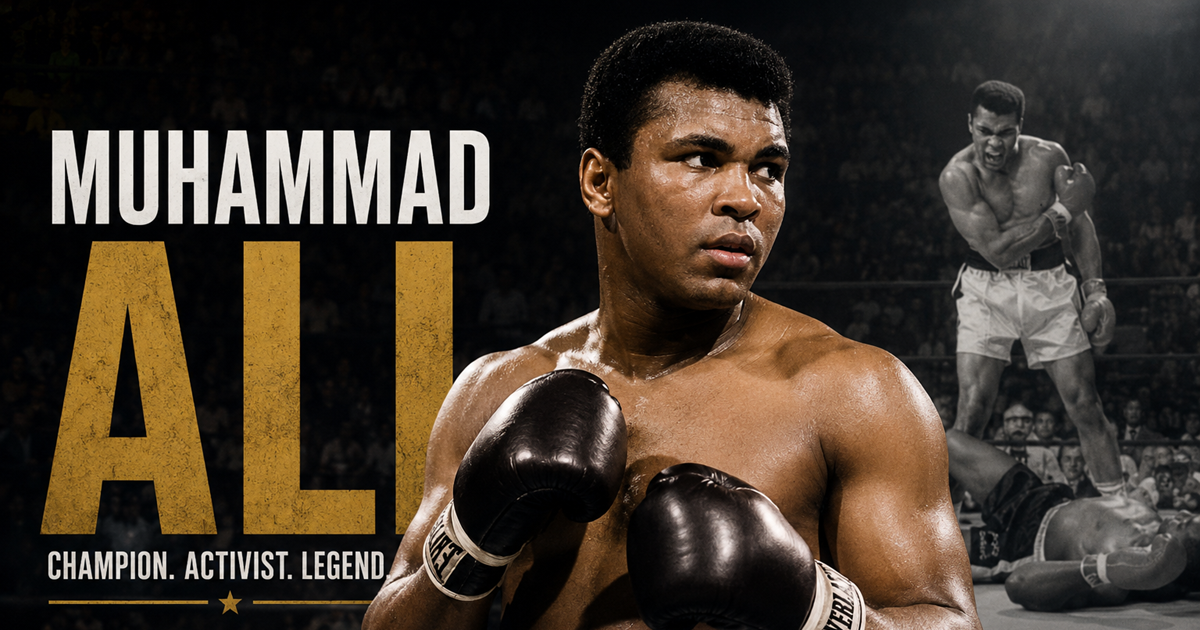
Muhammad Ali did not simply become the world heavyweight champion. He changed what the champion could look and sound like.
He moved with the speed of a far lighter fighter, predicted his victories, challenged opponents before they entered the ring and refused to soften his personality for public approval. His fights became international events, while his decisions away from boxing placed him at the centre of arguments about race, religion, war and personal conviction.
Ali’s professional record of 56 wins, five defeats and 37 knockouts tells only part of his story. He won the world heavyweight championship three times, defeated several leading fighters from one of the division’s strongest eras and returned from more than three years of enforced inactivity to regain the sport’s biggest prize.
The victories over Sonny Liston, George Foreman and Joe Frazier remain essential chapters in boxing history.
Yet Ali’s lasting significance also comes from the way he combined sporting excellence with an unwillingness to let others define him.
Louisville Gave Ali His Start
Ali was born Cassius Marcelo’s Clay Jr. in Louisville, Kentucky, on 17 January 1942. He grew up in the segregated American South, where racial discrimination formed part of daily life.
His introduction to boxing came at the age of 12. After his bicycle was stolen, Clay told police officer Joe Martin that he wanted to confront the thief. Martin, who also trained young boxers, advised him to learn how to fight first.
That chance encounter gave Clay a place in the gym and an outlet for his energy. He developed quickly, building an accomplished amateur career through speed, discipline and a confidence that was already difficult to miss.
His first major international breakthrough arrived at the 1960 Olympic Games in Rome. The 18-year-old won four contests to claim the light-heavyweight gold medal, defeating Poland’s Zbigniew Pietrzykowski in the final.
His full Olympic results are recorded in the official Muhammad Ali Olympic profile.
The medal introduced Clay to a wider audience. More importantly, it confirmed that he could turn his unusual style into results against elite opposition.
Ali Moved Like No Heavyweight Before Him
Clay made his professional debut on 29 October 1960, earning a six-round points victory over Tunney Hunker in Louisville.
Over the next three years, he progressed from promising Olympic champion to leading heavyweight contender. Victories over Archie Moore, Doug Jones and Britain’s Henry Cooper moved him towards a world-title opportunity.
The Cooper fight at Wembley Stadium in June 1963 exposed both sides of the young contender. Clay’s speed and combinations caused serious damage, but Cooper dropped him heavily with a left hook near the end of the fourth round. Clay recovered and won by stoppage in the fifth when cuts around Cooper’s eye forced the contest to end.
That vulnerability did not disappear. Ali often carried his hands low and pulled his head backwards from punches rather than using more conventional defensive movement. Against a well-timed left hook, he could be caught.
However, opponents first had to close the distance.
Ali’s footwork allowed him to move around the perimeter of the ring without becoming trapped. He changed direction quickly, controlled range with a fast jab and delivered straight punches before heavier opponents could set their feet. His balance allowed him to attack while moving, an uncommon skill among heavyweights of the period.
He also understood the psychological contest. His predictions, poems and relentless talking brought attention to his fights, but they served a tactical purpose. By making opponents angry, Ali encouraged them to abandon patience and pursue him recklessly.
Liston Victory Transformed the Heavyweight Division
Few observers expected Clay to defeat Sonny Liston when they met in Miami Beach on 25 February 1964.
Liston had destroyed Floyd Patterson twice in the first round and carried a reputation as the most intimidating heavyweight in boxing. Clay, meanwhile, was viewed by many as talented but inexperienced.
The challenger refused to fight Liston’s fight. He used his feet to keep the champion turning, fired quick combinations and avoided prolonged exchanges. Liston struggled to close the distance and retired on his stool after the sixth round because of a shoulder injury.
At 22, Clay was the world heavyweight champion.
Soon afterwards, he publicly adopted the name Muhammad Ali, reflecting his Islamic faith. The change was central to how he wished to be known, although sections of the sporting establishment and media continued to use his birth name.
Ali stopped Liston in the first round of their May 1965 rematch before beginning a demanding run of title defences. He beat Floyd Patterson, George Chuvalo, Henry Cooper, Brian London, Karl Mildenberger, Cleveland Williams, Ernie Terrell and Zara Foley.
The Cleveland Williams performance in November 1966 is often presented as Ali at his athletic peak. He controlled the contest with speed, movement and precise combinations before earning a third-round stoppage.
He was 29–0 after defeating Foley in March 1967. At 25, Ali appeared to have several of his best sporting years ahead of him.
Instead, his career stopped.
Ali Lost His Title After Refusing Military Induction
Ali refused induction into the United States Army in April 1967 during the Vietnam War. He based his decision on his religious beliefs and his claim for conscientious-objector status.
Authorities convicted him of refusing induction. He received a five-year prison sentence and a fine, although he remained free while appealing the decision.
Boxing commissions withdrew his licence, and the sport stripped him of his championship recognition. Ali did not fight professionally for more than three years, covering a period that would usually represent a heavyweight’s physical prime.
His position divided public opinion. Some viewed him as unpatriotic, while others saw his refusal as an act of principle during an increasingly unpopular war. Whatever the interpretation, the decision carried substantial personal and professional consequences.
Ali lost his title, income and sporting momentum. Yet the exile also turned him into a figure whose influence reached far beyond boxing. He spoke at colleges and public events, addressing war, racial inequality, religion and individual conscience.
The United States Supreme Court reversed his conviction in June 1971. By then, Ali had already regained permission to box, but the years away had altered him as a fighter.
The Returning Ali Had to Solve Different Problems
Ali returned against Jerry Quarry in October 1970 and won by stoppage after three rounds. He then stopped Oscar Bonavena in the 15th round, setting up an unbeaten heavyweight showdown with Joe Frazier.
Ali and Frazier met at Madison Square Garden on 8 March 1971 in a contest promoted as the Fight of the Century. Both had legitimate claims to the heavyweight championship, and both entered with unbeaten professional records.
Frazier’s pressure presented a demanding test for Ali after his long absence. He moved forward behind a compact guard, attacked the body and looked to land his powerful left hook whenever Ali pulled away from exchanges.
Ali produced strong periods, particularly when he created space for his jab and right hand. Frazier nevertheless maintained his pressure and dropped him with a left hook in the final round. He won a unanimous decision after 15 rounds.
The loss ended Ali’s unbeaten record, but it began one of sport’s defining rivalries.
A fuller examination of Frazier’s career can be found in World in Sport’s profile of Joe Frazier and his heavyweight reign.
Ali rebuilt through a busy schedule. He defeated Jimmy Ellis, Buster Mathis, Jargon Bain, Mac Foster, George Chuvalo, Jerry Quarry, Floyd Patterson and Bob Foster before suffering his second professional defeat against Ken Norton in March 1973.
Norton broke Ali’s jaw and won a split decision. Ali reversed the result in their rematch six months later before earning a unanimous decision over Frazier in January 1974.
Those victories secured a challenge against George Foreman.
The Rumble in the Jungle Showed Ali’s Tactical Intelligence
Foreman appeared to present an even greater physical threat than Liston had a decade earlier.
The champion had stopped Frazier and Norton within two rounds. His strength, heavy jab and ability to cut off the ring made him a clear favourite when he faced Ali in Kinshasa, Zaire, on 30 October 1974.
Ali could no longer rely on continuous movement in the way he had during the 1960s. Rather than attempt to recreate his younger style, he adjusted.
He spent long periods close to the ropes, where he blocked, parried and absorbed Foreman’s punches across his arms and body. Ali clinched when necessary, talked to the champion and countered with short, straight punches between Foreman’s attacks.
The approach later became known as the rope-a-dope, although it was more complex than simply allowing Foreman to tire. Ali managed distance even while close to the ropes, reduced the clean target available and watched for the moment when Foreman’s movements became slower and less controlled.
That moment came in the eighth round. Ali escaped the ropes, landed a sharp combination and dropped Foreman for the count.
Ten years after defeating Liston, Ali had regained the world heavyweight championship. The victory showed that his success did not depend entirely on speed. He could assess an opponent, adapt under pressure and find a route to victory when his original physical advantages had diminished.
World in Sport’s feature on Muhammad Ali’s 15 career-defining rounds explores the decisive moments behind this and his other major fights.
Manila Pushed Ali and Frazier Towards Their Limits
Ali defended the championship against Chuck Weiner, Ron Lyle and Joe Bugger before meeting Frazier for a third time on 1 October 1975.
The Thrills in Manila became their most punishing contest.
Ali started quickly, using his jab and combinations to control the early rounds. Frazier gradually worked his way inside, where his hooks to the head and body forced Ali into exhausting exchanges.
The heat inside the Araneta Coliseum added to the physical strain. Both fighters slowed, but neither gave the other a comfortable round. Ali found another surge late in the contest, landing repeated right hands as swelling around Frazier’s eyes restricted his vision.
Frazier’s trainer, Eddie Futch, stopped the fight after the 14th round. Ali had retained the title, although the contest left both men physically drained.
The fight illustrated Ali’s competitive resilience, but it also raised a harder question about the price of his career. He had become more willing to absorb punches as his movement declined. His durability helped him survive demanding contests, yet it also allowed fights to continue when a less resilient boxer might have been stopped.
Angelo Dundee’s partnership with Ali was particularly important during this period. Dundee did not attempt to remove the personality or improvisation that made Ali different. Instead, he provided calm advice, practical adjustments and stability in the corner.
A Third Championship Came Late in Ali’s Career
Ali remained champion through a series of uneven performances. He beat Jean-Pierre Chapman, Jimmy Young, Richard Dunn, Ken Norton, Alfredo Evangelists and Ernie Shavers, although the Norton and Shavers fights placed him under sustained pressure.
Leon Spinks then produced a major upset in February 1978. Fighting in only his eighth professional contest, Spinks outworked Ali and won a split decision over 15 rounds.
Ali pursued an immediate rematch. Seven months later, he controlled Spinks more effectively and earned a unanimous decision, becoming the first boxer to win the world heavyweight championship three times.
It was an important achievement, but it did not mean Ali remained close to his peak. Years of difficult fights had reduced his speed, reactions and stamina.
He initially retired in 1979 before returning to challenge Larry Holmes in October 1980. Holmes dominated the contest until Dundee stopped it after the tenth round. Ali fought once more, losing a ten-round decision to Trevor Berwick in December 1981.
The final years should not define his career, but they form part of an honest assessment. Ali stayed in boxing longer than his performances justified, as many great champions have. His reputation and determination helped prolong the career, even when his body could no longer produce the movements that had once made him exceptional.
| Career detail | Muhammad Ali record | Context |
|---|---|---|
| Professional record | 56 wins, five defeats and 37 knockouts | Ali competed in 61 professional contests |
| Olympic achievement | Light-heavyweight gold | Won at the 1960 Rome Olympic Games |
| World championship reigns | Three | Won the heavyweight title in 1964, 1974 and 1978 |
| Professional debut | 29 October 1960 | Defeated Tunney Hunsaker on points |
| Final fight | 11 December 1981 | Lost on points to Trevor Berbick |
Ali Combined Speed, Judgement and Personality
Ali’s style remains difficult to copy because it depended on a rare collection of physical and mental qualities.
His jab was fast enough to score without always being thrown from a fixed stance. His feet carried him away from attacks before opponents could respond, while his hand speed allowed him to complete combinations without remaining in range for long.
He also possessed exceptional awareness. Ali often appeared relaxed with his hands low, but he watched opponents closely and reacted to their movements. The danger came when age reduced the speed of those reactions.
His technique was unconventional rather than careless. Pulling straight backwards from punches and carrying the lead hand low would usually create serious defensive problems. Ali made those habits effective through timing, distance control and confidence in his reflexes.
Later, he became a different boxer. The returning Ali used clinches, rope work, counter-punching and psychological pressure to overcome opponents he could no longer outmanoeuvre.
His personality also changed how fights were promoted. Ali understood that supporters responded to stories, rivalries and clearly defined characters. His interviews could be humorous, provocative or cruel, particularly during the Frazier rivalry. That side of his approach should not be ignored when considering his influence.
Ali was charismatic, but he was not universally gentle. He used personal attacks to unsettle opponents, and some caused lasting resentment. His complexity makes him a more significant subject than a flawless sporting hero would have been.
Ali’s Influence Extended Beyond the Ring
Ali’s refusal of military induction became one of the most consequential decisions made by a leading athlete.
It placed his livelihood at risk and brought criticism at a time when prominent sportspeople were generally expected to avoid political controversy. Over time, his stance became part of a wider reassessment of the Vietnam War and the role athletes could play in public debate.
Ali later worked as a humanitarian and travelled internationally on charitable and diplomatic missions. He supported efforts involving hunger relief, education and reconciliation, while his public profile gave those causes unusual visibility.
Doctors diagnosed him with Parkinson’s disease in 1984. Although the condition gradually affected his movement and speech, he continued to make major public appearances.
One of the most memorable came at the 1996 Olympic Games in Atlanta, when Ali lit the cauldron during the opening ceremony. The image of his visibly trembling hand holding the torch provided a powerful contrast with the speed and control of his boxing career.
He received the Presidential Medal of Freedom in 2005. That same year, Muhammad and Lonnie Ali opened the Muhammad Ali Center in Louisville. The centre preserves his sporting and social history while promoting principles including confidence, conviction, dedication and respect.
More information about his life beyond boxing is available through the Muhammad Ali Center.
Ali died on 3 June 2016 at the age of 74.
Muhammad Ali’s Legacy Cannot Be Reduced to a Record
Debates about the greatest boxer will always depend on the criteria being used.
Sugar Ray Robinson built a stronger traditional pound-for-pound case. Joe Louis produced a longer uninterrupted heavyweight reign. Rocky Marciano retired unbeaten, while later champions competed in a larger and more fragmented title system.
Ali’s claim rests on the quality of his victories, his adaptability and the scale of his wider influence.
He defeated Liston when few believed he could withstand the champion. He returned from exile to compete with Frazier, Norton and Foreman. He regained the heavyweight championship after losing years of his athletic prime and later became the first man to win it three times.
His record matters, but so does the range of problems he solved. Ali won through movement, speed and precision during his first reign. Later, he depended on resilience, preparation and tactical improvisation.
He also made the heavyweight champion a global cultural figure. Athletes who speak openly about politics, identity or social injustice now operate in a sporting landscape that Ali helped to reshape, even when their positions differ from his.
That does not make every decision he made correct or every performance great. His later career exposed the danger of remaining in boxing too long, while his treatment of some opponents remains open to criticism.
Nevertheless, very few athletes have combined elite performance, personality, controversy and lasting cultural influence on the same scale.
Ali called himself The Greatest long before the description carried widespread acceptance. The nickname endures not because it ended every argument, but because his career gave each generation a reason to continue it.
For more comparisons between Ali and other leading champions, read World in Sport’s assessment of the greatest boxers of all time.
