
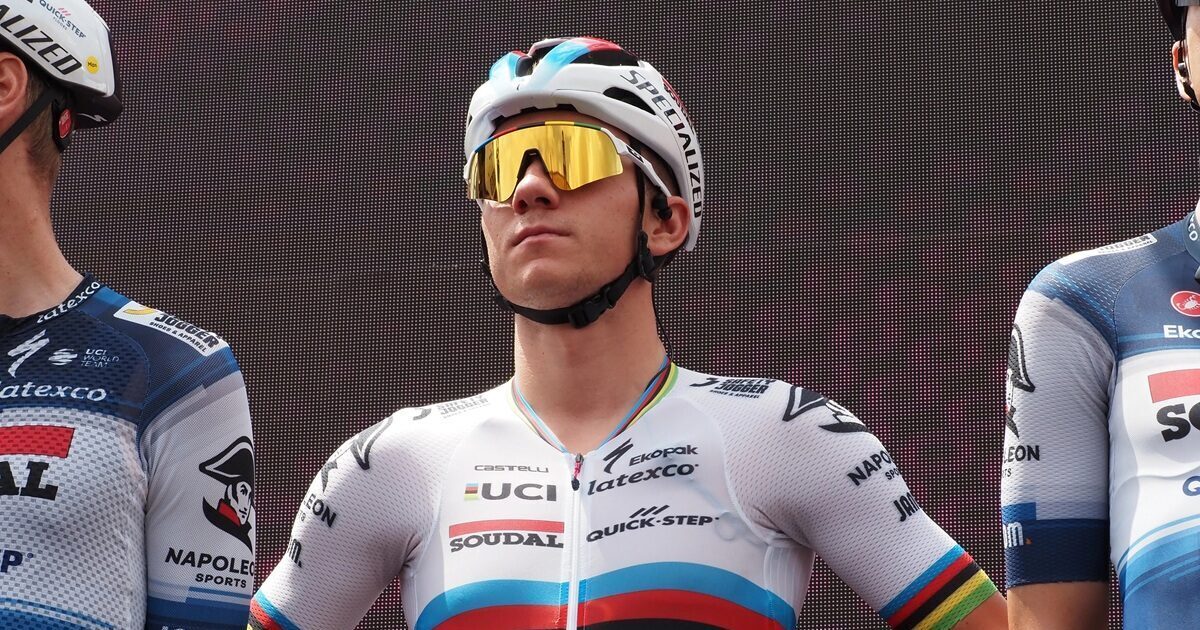
Remco Evenepoel has built one of modern cycling’s most varied palmer’s. The Belgian has won a Grand Tour, world titles on the road and against the clock, two Olympic gold medals and some of the sport’s most demanding one-day races.
His individual time-trial ability remains his clearest advantage, but reducing his career to aerodynamic speed would overlook the range of his achievements. Evenepoel has won Liège–Bastogne–Liège twice, conquered the Vuelta a España and progressed from third to second at the Tour de France.
His path has rarely followed cycling’s traditional development route. Evenepoel spent much of his childhood pursuing a football career, switched sports as a teenager and moved directly from the junior ranks into the WorldTour.
That accelerated rise created extraordinary expectations. Serious crashes, interrupted Grand Tour campaigns and questions about his high-mountain consistency then tested whether his early promise could translate into a lasting career at the top.
By July 2026, Evenepoel had answered many of those questions.
His second place at the 2026 Tour de France, supported by a summit victory. And another dominant time-trial performance, represented his strongest three-week showing since winning the Vuelta four years earlier.
Early Life and Football Background
Remco Evenepoel was born on 25 January 2000 in Aalst, Belgium. His father, Patrick Evenepoel, briefly raced as a professional cyclist and won the Grand Prix de Wallonie in 1993, but Remco initially directed his own sporting ambitions towards football.
He joined Anderlecht’s youth system as a young child before spending time with PSV Eindhoven in the Netherlands. He later returned to Anderlecht and represented Belgium at under-15 and under-16 level, mainly playing as a defensive midfielder or left-back.
Football developed traits that would later benefit him in cycling. Coaches valued his stamina, competitive nature and willingness to take responsibility. However, injuries and diminishing opportunities disrupted his progress, and he eventually left the academy pathway.
Evenepoel began cycling seriously in 2017. He was inexperienced in bunch racing and initially lacked the bike-handling background accumulated by riders who had competed since childhood. His aerobic capacity and appetite for sustained effort, however, quickly separated him from his age-group rivals.
An Extraordinary Junior Career
Evenepoel’s rise through junior cycling was brief and emphatic.
In 2018, he won both the road race and individual time trial at the European Junior Road Championships. He repeated the double at the UCI Junior Road World Championships later that year.
The road-race victories revealed more than raw strength. Evenepoel was prepared to attack from a distance, ride alone, and maintain a pace that discouraged an organised pursuit behind him. Those qualities became recurring features of his professional career.
Rather than spend several seasons progressing through under-23 competition, he joined Deceuninck–Quick-Step for 2019. The move placed an exceptionally talented but comparatively inexperienced 19-year-old directly into cycling’s highest professional level.
His first season justified the decision. Evenepoel won the Tour of Belgium and became the youngest winner of a WorldTour one-day race when he attacked to claim the Clásica de San Sebastián.
Success at that level made him more than a promising prospect. It also ensured that every subsequent performance would be measured against unusually high expectations.
The Crash That Interrupted His Rise
Evenepoel continued winning in early 2020, taking overall victories at the Vuelta a San Juan, Volta ao Algarve, Vuelta a Burgos and Tour de Pologne.
His season changed abruptly at Il Lombardia in August. While descending the Muro di Serrano, he struck a low wall and fell from a bridge into the ravine below.
Evenepoel fractured his pelvis and suffered a contusion to his right lung. The severity of the accident ended his season and interrupted the momentum of a rider who had appeared capable of winning almost every stage race he entered.
He did not return to competition until the 2021 Giro d’Italia. Entering a Grand Tour without a preparatory race was an ambitious choice, and he eventually withdrew before the finish.
The campaign exposed the difference between exceptional physical potential and the accumulated experience required to manage three weeks of positioning, recovery, descending and repeated mountain stages.
Evenepoel’s response was significant. He won the Tour of Belgium and Brussels Cycling Classic later in 2021, while further victories against the clock reinforced his position among the world’s leading time triallists.
Grand Tour Breakthrough at the Vuelta
The 2022 season transformed Evenepoel’s career.
He won Liège–Bastogne–Liège after attacking alone before the finish, delivering the kind of sustained, high-speed performance that had defined his junior career. He later secured another victory at the Clásica de San Sebastián.
The central achievement came at the Vuelta a España. Evenepoel gained time in the race’s opening mountain stages, won the individual time trial and defended his lead through the final week to claim his first Grand Tour.
At 22, he became the youngest Vuelta winner since 1961. More significantly for Belgian cycling, he was the country’s first male Grand Tour champion since Johan De Muynck won the 1978 Giro d’Italia.
The victory also challenged the idea that Evenepoel was only suited to shorter stage races or controlled efforts against the clock. Over three weeks, he managed changing terrain, pressure and the threat posed by established Grand Tour contenders.
The UCI’s account of his Vuelta victory placed the result alongside his successes at Liège and San Sebastián as the season that moved him into a different competitive category.
Several weeks later, Evenepoel added the elite road-race world title in Wollongong. He again made the decisive move from distance and completed a solo victory, ending the year as a Grand Tour winner, Monument champion and world champion.
Time-Trial Dominance and Olympic History
Evenepoel won his first elite individual time-trial world championship in 2023. He retained the title in 2024 and completed a third consecutive victory on a climbing-heavy course in Kigali in 2025, catching and passing Tadej Pogačar despite starting two. And a half minutes behind him.
His 2024 Olympic campaign in Paris carried even greater historical weight.
Evenepoel first won the men’s individual time trial in wet conditions. One week later, he attacked during the road race and rode alone through central Paris to take a second gold medal.
He became the first male cyclist to win the Olympic road race and individual time trial at the same Games. The achievement was particularly notable because the two events demand different tactical skills: one requires an individually paced effort, while the other involves positioning, attacks. And decisions within a changing race.
The official Olympic account recorded a road-race victory that ended at the Trocadéro. Despite suffering a late mechanical problem, he had enough time to retain his advantage.
Tour de France Progress
The 2024 Tour de France marked Evenepoel’s first appearance in cycling’s biggest stage race. He won the individual time trial, finished third overall behind Pogačar and Jonas Vingegaard, and secured the white jersey as the race’s leading young rider.
Third place represented a strong debut, although the final margin showed the scale of the challenge. Evenepoel finished nine minutes and 18 seconds behind Pogačar, while repeated high-mountain stages continued to favour the two riders ahead of him.
His 2025 Tour was less successful. Evenepoel won the Stage Five time trial in Caen but withdrew after Stage 14 due to health issues. The abandonment followed a disrupted preparation caused by the injuries he had suffered in a December 2024 training collision with a postal vehicle.
A move from Sandal Quick-Step to Red Bull–BORA–hansgrohe followed for the 2026 season. The transfer gave Evenepoel a new performance structure and a team assembled with Grand Tour development as a central priority.
His first Tour with the team produced clear progress.
Evenepoel won Stage 15 at Plateau de Solaison, securing his first Tour summit-finish victory. He followed it by winning the Stage 16 individual time trial and then defended second place through the final Alpine stages.
He completed the Tour six minutes and 26 seconds behind Pogačar and three minutes and 16 seconds ahead of Isaac del Toro. It was Belgium’s best result in the men’s Tour since Lucien Van Impe finished second in 1981.
The runner-up finish did not establish Evenepoel as Pogačar’s equal over three weeks. It did, however, demonstrate improved mountain endurance and an ability to remain competitive deep into the final week.
For wider context on the era’s leading stage-race riders, World in Sport has also profiled Tadej Pogačar’s all-round dominance and Chris Froome’s Grand Tour career.
How Evenepoel Rides
Evenepoel’s most recognisable strength is his ability to maintain high power while holding an efficient aerodynamic position.
An individual time trial requires riders to judge their effort without the aerodynamic shelter provided by a group. Evenepoel combines disciplined pacing with an ability to sustain speed on flat, rolling and moderately climbing courses.
Those qualities also shape his approach to road races. Rather than wait for a short sprint, he often attempts to create separation well before the finish. Once clear, his time-trial power makes him difficult to catch because the chasing riders must cooperate effectively while he controls his own pace.
He has also developed a more varied range of finishes. His 2026 Amstel Gold Race victory came in a two-rider sprint against defending champion Mattias Skjelmose. Showing that opponents cannot always rely on beating him if they follow his long-range attack.
His limitations have attracted as much discussion as his strengths. Evenepoel is not built like a pure high-mountain specialist, and critics have questioned whether he can repeatedly match the lightest climbers at altitude.
His 2026 Tour performance provided a strong response without ending the debate. He climbed consistently enough to finish second and won at Plateau de Solaison, but Pogačar still completed the race with a substantial overall advantage.
Setbacks and Difficult Grand Tours
Not every interruption in Evenepoel’s career has resulted from a crash.
At the 2023 Giro d’Italia, he won both individual time trials and reclaimed the pink jersey after Stage Nine. He then tested positive for COVID-19 and withdrew before the following stage.
Later that year, his Vuelta title defence unravelled during a difficult day in the Pyrenees. Rather than leave the race, he changed his objective and pursued stage victories and the mountains classification.
He won three stages during that Vuelta and secured the polka-dot jersey. The result did not repair the lost general-classification challenge, but it illustrated his ability to redirect a campaign after a major setback.
That willingness to race aggressively has contributed to his popularity, although his direct public manner and the intense attention surrounding him in Belgium have occasionally created friction. Evenepoel has rarely occupied the quiet middle ground: his victories prompt major expectations, while an unsuccessful mountain stage can lead to disproportionate scrutiny.
Major Career Honours
The following honours are current to 31 July 2026.
| Competition | Achievement | Year |
|---|---|---|
| Olympic Games | Road race gold medal | 2024 |
| Olympic Games | Individual time-trial gold medal | 2024 |
| Vuelta a España | Overall winner | 2022 |
| Tour de France | Second overall | 2026 |
| Tour de France | Third overall and young rider classification | 2024 |
| UCI Road World Championships | Elite road-race world champion | 2022 |
| UCI Road World Championships | Elite individual time-trial world champion | 2023, 2024 and 2025 |
| Liège–Bastogne–Liège | Winner | 2022 and 2023 |
| Clásica de San Sebastián | Winner | 2019, 2022 and 2023 |
| Amstel Gold Race | Winner | 2026 |
What Comes Next
Evenepoel entered professional cycling with expectations created by an almost unprecedented junior career. He has since experienced enough adversity to make his record more revealing than an uninterrupted sequence of victories would have been.
He recovered from the Il Lombardia crash, rebuilt after disrupted Grand Tours and expanded his range beyond time trials. Olympic gold, a Vuelta title, multiple world championships and Monument victories already give him one of the most substantial records of his generation.
The Tour de France remain the largest unresolved ambition.
Second place in 2026 established that Evenepoel can sustain a challenge through the final week while winning on both a major climb and in his strongest discipline. The remaining task is considerably harder: finding enough improvement in the mountains to overcome Pogačar, Vingegaard and the next generation of Grand Tour contenders.
Whether he eventually wins the yellow jersey will shape the final assessment of his stage-racing career, but it will not define his entire significance.
Evenepoel has already shown that a rider can arrive via an unconventional route, compete in the Grand Tours and Classics, and use time-trial power as the foundation for a far broader career. His next seasons will determine how much further that combination can take him.
For more rider profiles, results and analysis, visit the World in Sport cycling section.
