
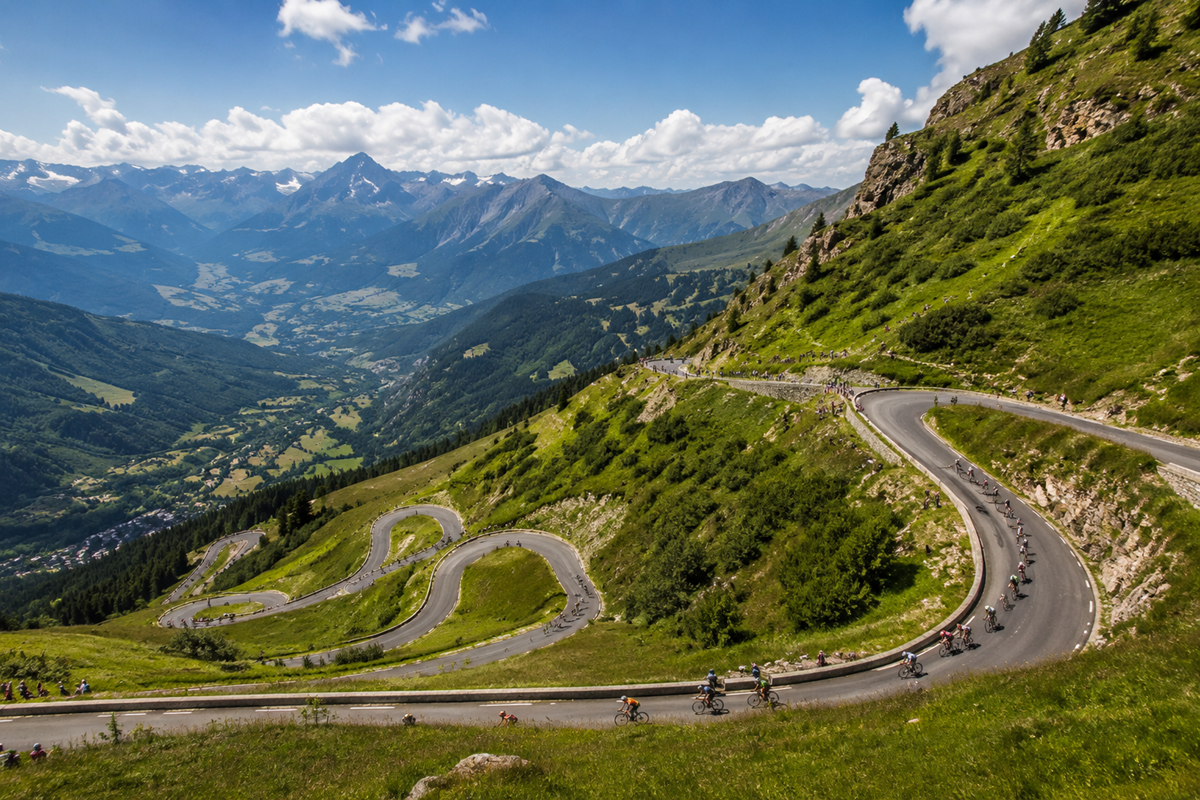
On Friday 24 July and Saturday 25 July, the peloton will finish at Alpe d’Huez on consecutive days. The two stages share a destination, but almost nothing else.
Stage 19 offers the familiar climb through the 21 hairpins from Bourg d’Oisans. Stage 20 approaches the resort from the opposite direction after crossing some of the hardest and highest roads in the French Alps.
Together, they provide the final major opportunity to change the general classification before the race reaches Paris on Sunday.
For the latest reports throughout the decisive weekend, follow World in Sport’s cycling news and analysis.
What is the Tour de France Alpe d’Huez double-header?
The 2026 Tour includes two consecutive finishes at Alpe d’Huez, but the race will use a different approach on each day.
Stage 19 runs for 127.9km from Gap to Alpe d’Huez and includes 3,500 metres of climbing. It finishes with the traditional 13.7km ascent from Bourg d’Oisans, averaging 8.1 per cent.
Stage 20 is considerably harder. The 170.9km route from Le Bourg d’Oisans contains 5,450 metres of climbing and crosses the Col de la Croix de Fer, Col du Télégraphe, Col du Galibier and Col de Sarenne before reaching Alpe d’Huez.
The double-header follows Stage 18’s summit finish at Orcières-Merlette, creating three consecutive mountain stages at the end of an already exhausting Tour.
World in Sport’s wider Tour de France 2026 final-week guide explains how the mountain stages fit into the closing sequence of the race.
What is the general classification before Alpe d’Huez?
Tadej Pogačar retained a commanding lead after Stage 16’s individual time trial from Évian-les-Bains to Thonon-les-Bains.
Remco Evenepoel won the time trial by 28 seconds, reducing Pogačar’s advantage to four minutes and 32 seconds. Isaac del Toro remained third, 6.51 behind the race leader, while Paul Seixas sat only 20 seconds further back.
Juan Ayuso moved into fifth after Florian Lipowitz crashed during the time trial and left the race with a collarbone injury.
The yellow jersey contest had already changed significantly when Jonas Vingegaard abandoned following his Stage 15 crash. His withdrawal removed one of Pogačar’s strongest expected rivals before the Alpine finale.
The size of Pogačar’s advantage means Evenepoel and the other challengers cannot rely on one late acceleration. They may need to attack earlier, isolate the race leader and turn the final mountain stages into tests of endurance rather than controlled summit sprints.
Stage 19 brings the classic Alpe d’Huez test
Stage 19 is short enough to encourage aggressive racing from the opening kilometres.
The official Stage 19 route begins climbing almost immediately. Col Bayard arrives after only 4.8km and measures 4.8km at an average gradient of 7.2 per cent.
The Col du Noyer follows soon afterwards. It is only 7.2km long, but an average of 8.5 per cent makes it difficult enough for a strong team to place rivals under pressure early.
A longer, less demanding middle section should allow some regrouping. However, the Col d’Ornon provides another test before the race descends towards Bourg d’Oisans and the foot of Alpe d’Huez.
The final climb measures 13.7km at 8.1 per cent and carries the highest mountain classification. The average gradient tells only part of the story. Several early ramps rise above 10 per cent, while the repeated hairpins make it difficult for riders to settle into a comfortable rhythm.
Why Stage 19 could expose the yellow jersey
A stage of 127.9km leaves little room for a slow build-up.
Breakaway riders will want to establish a move before Col du Noyer, while teams with general classification ambitions may try to place support riders further up the road. Those riders could become valuable later if the leading group splits before Alpe d’Huez.
UAE Team Emirates-XRG have the strongest position. Pogačar holds the yellow jersey, while del Toro sits third overall. The team can use that numerical advantage to control attacks or force Evenepoel’s squad to chase.
However, control requires energy. If UAE ride hard throughout Stage 19, they could weaken their support for the much harder stage the following day.
Evenepoel must decide how much to invest. A major attack on the first Alpe d’Huez finish could reduce his deficit, but an unsuccessful move may leave him exposed on Stage 20.
That tension gives Stage 19 its importance. The stage may not settle the Tour on its own, but it can reveal who still has the legs, teammates and confidence to win it.
For a complete look at the race’s earlier decisive stages, read World in Sport’s Tour de France 2026 route preview.
Stage 20 is the final mountain examination
Stage 20 is the day most likely to decide the final yellow jersey.
The official Stage 20 route contains 5,450 metres of climbing across 170.9km. It starts in Le Bourg d’Oisans but immediately heads away from the classic Alpe d’Huez road.
The Col de la Croix de Fer provides the first major test. The climb stretches for 24km at 5.2 per cent, with an uneven profile that contains sections considerably steeper than the average suggests.
After descending into the Maurienne valley, the riders face the Col du Télégraphe. Its 11.9km at 7.1 per cent leads towards Valloire and the lower slopes of the Galibier.
The Col du Galibier then rises for 17.7km at 6.9 per cent and reaches 2,642 metres, the highest point of the 2026 Tour. Altitude, accumulated fatigue and the long distance already covered could reduce the group to the strongest climbers.
The race then descends towards the Col du Lautaret before turning towards the Col de Sarenne. That final categorised climb measures 12.8km at 7.3 per cent and reaches its summit with only 14.4km remaining.
From there, riders enter the Alpe d’Huez resort from the opposite side to the traditional 21-hairpin road. It is a completely different finish from Stage 19, reached after a much longer and more damaging day.
Where could the 2026 Tour de France be won?
The most likely decisive section begins on the Col du Galibier and continues through the Col de Sarenne.
A challenger who still needs several minutes cannot afford to wait until the final kilometres. By then, the road may be too short, and the leading rider may still have teammates available.
The Galibier offers space for a long-range attack. Its altitude and length can expose a rider who has not recovered from Stage 19. It can also remove domestiques before the race reaches the final climb.
The descent and road towards Sarenne will then turn physical strength into a tactical contest. A rider who attacks over the Galibier will need support, descending confidence and enough energy to survive the next ascent.
Sarenne may provide the final direct battleground. Its average gradient is demanding enough to create meaningful gaps, particularly after more than 150km and three major climbs.
The yellow jersey can also be won defensively. If UAE keep Pogačar surrounded, close dangerous moves and maintain a controlled pace over the Galibier, they can prevent Evenepoel from creating the chaotic race he needs.
That is why the Tour may be decided before the riders reach Alpe d’Huez itself. The result at the finish will reflect battles fought much earlier on the road.
Which riders have the most at stake?
Pogačar enters the decisive block with the strongest position. He does not need to attack from distance, but he cannot allow a dangerous group containing Evenepoel or another leading contender to escape.
Evenepoel faces the opposite problem. His time-trial victory showed excellent form, but a deficit of more than four minutes demands ambition. He may need to attack before the final climb, even if that means taking significant risks.
Del Toro has two responsibilities. He must help protect Pogačar while also defending his own podium position and white jersey. His presence gives UAE tactical flexibility because rival teams cannot simply allow him to ride away.
Seixas sits close enough to del Toro to challenge for third place and the youth classification. The Frenchman can concentrate on the podium battle rather than making an unrealistic attempt to recover the entire deficit to Pogačar.
Ayuso has less to lose. At more than nine minutes behind, he may receive greater freedom to attack from distance, chase a stage victory or place pressure on the riders immediately above him.
Alpe d’Huez carries history as well as consequence
Alpe d’Huez hosted the first uphill finish in Tour de France history in 1952, when Fausto Coppi won the stage, took the yellow jersey and went on to win the race.
The climb later became one of the Tour’s defining landmarks. Dutch riders enjoyed so much success there that it gained the nickname “the Dutch mountain”, while Italian and French champions added their own victories.
The two most recent men’s Tour winners at Alpe d’Huez were British. Geraint Thomas won in yellow in 2018, while Tom Pidcock took a memorable breakaway victory in 2022.
The mountain also produced one of the closest endings in major stage-race history during the 2024 Tour de France Femmes. Demi Vollering won the final stage, but Kasia Niewiadoma protected the overall title by only four seconds.
That history adds pressure, but the 2026 design adds something new. For the first time, riders will finish at Alpe d’Huez on consecutive days using two different approaches.
What should fans watch during the double-header?
Recovery may matter as much as climbing ability.
Riders who attack deeply on Stage 19 must repeat the effort less than 24 hours later. Teams must also manage food, cooling, massage and sleep while preparing for a stage containing more than 5,000 metres of elevation.
Team strength will provide another key indicator. A race leader with three teammates on the Galibier can control the pace. A race leader left alone faces repeated attacks and must personally respond to every move.
Fans should also watch for riders joining the breakaway as tactical support. A contender may send a teammate ahead early and later use that rider in the valley, on a descent or before Sarenne.
For UK broadcast information and daily highlights times, see the Tour de France 2026 UK TV guide.
The first day can weaken the leader, but the second can take yellow
Stage 19 provides the emotional spectacle most fans associate with Alpe d’Huez. It brings the 21 hairpins, dense crowds and a summit where the strongest riders can gain meaningful time.
Stage 20 provides the deeper sporting test.
Its length, altitude and 5,450 metres of climbing leave almost nowhere to hide. A rider who struggles on the Croix de Fer can lose teammates. A rider who struggles on the Galibier can lose contact. A rider who cracks on Sarenne can lose the Tour.
Pogačar’s advantage gives him control, but it does not guarantee safety. Evenepoel’s time-trial victory gives him encouragement, but he still needs to turn speed into a successful mountain attack.
Stage 19 should reveal who is vulnerable.
Stage 20 should decide who has enough left to wear yellow in Paris.
The race winner will also collect the largest share of the event’s overall prize money, explained in World in Sport’s guide to Tour de France 2026 prize money.
