
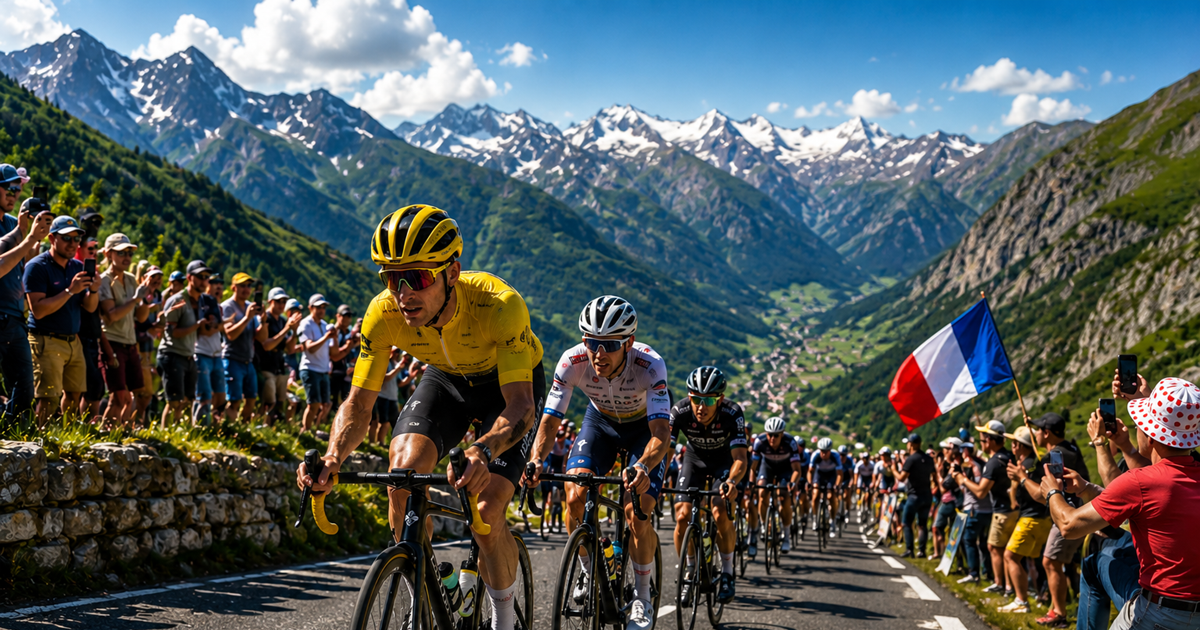
Tadej Pogačar will begin the final weekend of the 2026 Tour de France with one hand firmly on the yellow jersey after strengthening his overall lead on Alpe d’Huez.
The UAE Team Emirates-XRG leader won Stage 19 on Friday and now holds a lead of seven minutes and 11 seconds over Remco Evenepoel. Isaac del Toro sits third at nine minutes and 42 seconds, with Paul Seixas only 24 seconds further back in fourth.
Those gaps mean Pogačar is strongly placed to secure a fifth Tour de France title in Paris. However, Saturday’s final mountain stage remains capable of changing the podium, young rider classification and polka dot jersey battle.
Stage 20 contains 5,450 metres of climbing across four major Alpine passes before the race reaches Alpe d’Huez for a second successive day. It is the last realistic opportunity for the general classification contenders to make a significant difference before Sunday’s finale in Paris.
The previous Alpe d’Huez double-header preview outlined why these two stages represented the decisive point of the race. Friday answered the main yellow jersey question, but several important battles remain unresolved.
Where the Tour stands after Stage 19
Pogačar delivered another display of climbing authority on the 127.9km route from Gap to Alpe d’Huez.
He attacked before the final part of the climb and caught the remaining breakaway riders before winning by six seconds from Lenny Martinez. Richard Carapaz finished third, nine seconds behind the stage winner.
Evenepoel crossed the line two minutes and 29 seconds behind Pogačar, increasing the Belgian’s overall deficit to more than seven minutes. Pogačar also completed the Alpe d’Huez ascent in a reported record time of approximately 35 minutes and 27 seconds.
The size of Pogačar’s advantage changes how his team can approach Saturday. He does not need to attack to win the Tour. UAE Team Emirates-XRG can instead control dangerous moves, protect their leader and avoid unnecessary risks.
Pogačar may still race aggressively if another stage victory becomes available. His ability to win across mountains, time trials and one-day races has already placed him among cycling’s most complete champions, as explored in our Tadej Pogačar profile.
Stage 20 gives the podium one final Alpine test
Saturday’s 170.9km Stage 20 runs from Le Bourg-d’Oisans to Alpe d’Huez and includes four major classified climbs.
The official Stage 20 route begins climbing almost immediately. The peloton will tackle the Col de la Croix de Fer, Col du Télégraphe, Col du Galibier. col de Sarenne during a day containing 5,450 metres of elevation gain.
The Croix de Fer comes after only 33.7km, which could produce an immediate fight for the breakaway. Any rider targeting the mountains classification will need to move early rather than wait for the final hour.
The Télégraphe and Galibier then arrive in quick succession. Together, they create a long period of high-altitude climbing where teams can isolate rivals and force the yellow jersey group to use valuable support riders.
The Galibier reaches 2,642 metres and carries the Souvenir Henri Desgrange. From there, the race descends before climbing the Col de Sarenne.
The Sarenne route changes the Alpe d’Huez finish
Stage 20 will not simply repeat Friday’s traditional ascent through the famous 21 hairpin bends.
Instead, the peloton will reach the Alpe d’Huez resort from the Col de Sarenne side. The Sarenne summit comes 14.4km from the finish, followed by the final approach towards Alpe d’Huez.
That route creates a different tactical challenge. Riders must judge their effort on the Sarenne while retaining enough concentration and energy for the technical roads that follow.
A strong climber could attack on the Galibier or Sarenne, but a long-range move will require cooperation. A rider who attacks alone too early could become exposed on the flatter or descending sections between the climbs.
The stage is also likely to produce a substantial breakaway. Teams without a realistic general classification objective will see Saturday as their final chance to win in the mountains.
Yellow looks secure, but the podium does not
Evenepoel must recover seven minutes and 11 seconds to take yellow from Pogačar.
Under normal racing conditions, that gap should prove too large. Even an outstanding mountain attack would struggle to gain seven minutes against a rider who has looked stronger throughout the race.
A crash, illness, major mechanical problem or sudden physical collapse could still change the Tour. However, Pogačar can afford to ride defensively and follow Evenepoel rather than respond to every attack.
The contest behind them is far closer.
Del Toro holds third place, but Seixas trails him by only 24 seconds. That leaves the final podium and white jersey classification vulnerable to one attack, a poorly timed mechanical problem or a difficult moment on the Galibier.
Evenepoel also cannot treat second place as secure. Del Toro starts Stage 20 two minutes and 31 seconds behind him. That is a meaningful advantage, but it is not impossible to lose during such a demanding mountain stage.
Martinez, who impressed by finishing second on Stage 19, is three minutes and 18 seconds behind Del Toro. His greater priority may be a stage victory or an attempt to move closer to the top four.
The white and polka dot jerseys remain open
Del Toro leads the young rider classification because he holds third place overall. Seixas is his closest threat and begins the final mountain stage only 24 seconds behind.
That creates a direct race within the general classification. Neither rider can afford to focus only on defending a podium position because the white jersey remains within reach of both.
Our guide to the Tour de France jersey colours explains how the young rider competition uses the same cumulative times as the overall classification.
The mountains competition could become even more aggressive.
Carapaz took over the polka dot jersey after Stage 19 and leads the classification with 91 points. Stage 20 offers 20 points on the Croix de Fer, 10 on the Télégraphe, 20 on the Galibier and another 20 on the Sarenne.
A maximum of 70 climbing points is therefore available to one rider across the stage. That gives Carapaz an opportunity to strengthen his position, but it also allows his rivals to challenge if they enter the early breakaway.
Mads Pedersen remains the green jersey leader with 502 points. The sprinters’ main concern on Saturday will be reaching the finish inside the time limit before Sunday offers one last chance to score heavily.
Stage 21 brings Montmartre back into the Paris finale
Sunday’s 132.5km final stage begins in Thoiry and finishes on the Champs-Élysées.
The early kilometres should retain the traditional celebratory atmosphere, with the yellow jersey wearer able to acknowledge teammates and pose for photographs before the racing becomes more serious.
However, the Paris circuit is no longer designed only for the pure sprinters.
The official Stage 21 route includes the Côte du Pavé des Gardes before three ascents of the Côte de la Butte Montmartre. The Montmartre climb measures one kilometre at an average gradient of 6.5%.
Those climbs give classics specialists, powerful puncheurs and late attackers a better opportunity to disrupt the sprint teams. Riders must also handle narrow roads, changes of direction and repeated accelerations before returning to the Champs-Élysées.
A bunch finish remains possible, but the sprinters’ teams will need to control attacks rather than simply guide their leaders around a flat finishing circuit.
The final stage awards 50 green jersey points to the winner and 25 at the intermediate sprint. That could keep the points classification relevant, depending on the margins after Saturday.
Tour de France final weekend UK timings
Stage 20 is scheduled to begin with a neutralised start at 10.20am BST on Saturday. The expected finish is between approximately 3.11pm and 3.50pm BST, depending on the average speed.
Stage 21 begins at 3.15pm BST on Sunday. The race looks likely to finish on the Champs-Élysées between approximately 6.25pm and 6.43pm BST.
UK viewers can watch the live action through TNT Sports and HBO Max, while 5 is showing free-to-air daily highlights.
Full details are available in the World in Sport Tour de France 2026 UK TV guide.
What must happen for the yellow jersey to change?
Evenepoel or another rival must gain more than seven minutes and 11 seconds on Pogačar before the race reaches Paris.
Stage 20 provides enough climbing for major time gaps, but the yellow jersey will not need to chase every attack. Pogačar only needs to remain close to Evenepoel and avoid losing substantial time.
The most realistic threat would come from circumstances rather than a straightforward tactical move. Illness, a crash or a mechanical problem at the wrong moment could reopen the contest.
Without such an incident, Stage 20 is more likely to decide the remaining podium positions than the race winner.
Sunday’s Montmartre circuit offers a more competitive finale than the Tour’s old flat procession, but recovering several minutes in Paris would be extremely unlikely. Any serious yellow jersey challenge must begin in the Alps.
Final weekend verdict
Pogačar has transformed the final weekend from a balanced yellow jersey battle into a test of control.
His Stage 19 victory gives him enough time to race cautiously on Saturday. Unless the race takes an unexpected turn, he should reach Paris as a five-time Tour de France winner.
The wider stage remains compelling. Evenepoel must defend second place, Del Toro and Seixas are separated by only 24 seconds, Carapaz faces a demanding mountains classification battle. Numerous teams have one last opportunity to win an Alpine stage.
Stage 20 should provide the final major reshuffling of the overall standings. Stage 21 will then bring the race into Paris, where Montmartre attacks and a possible sprint will decide the final stage winner.
For reports, results and further analysis throughout the weekend, follow the latest World in Sport cycling coverage.
