
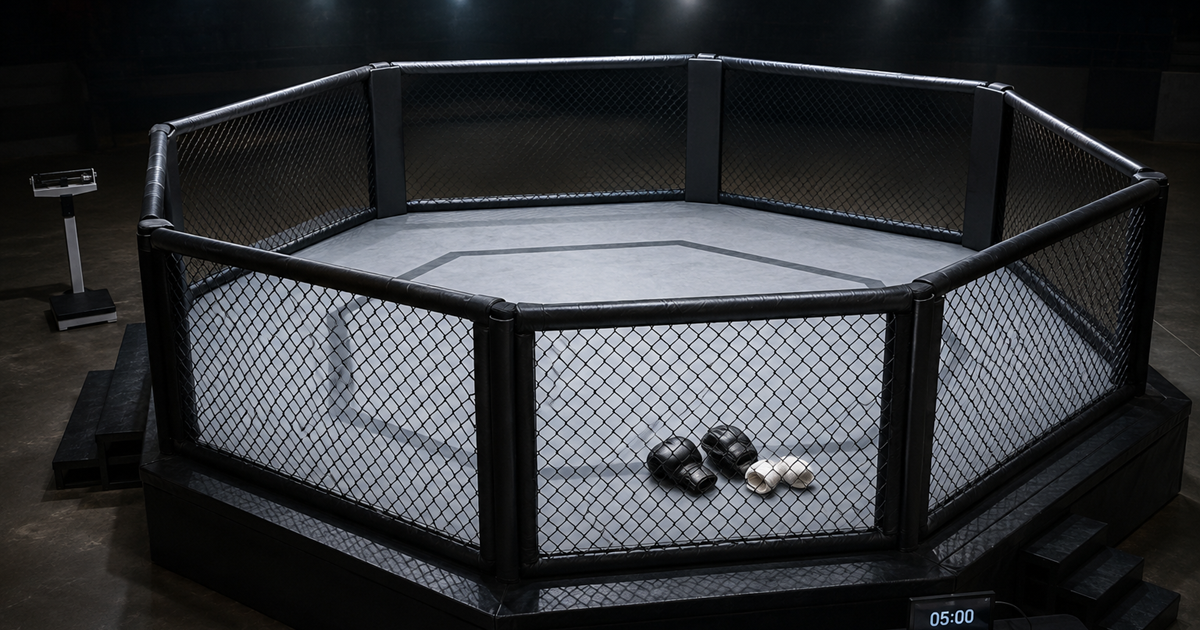
Mixed martial arts is governed by detailed rules that vary by jurisdiction, with professional events usually following the ABC Unified Rules and amateur events using IMMAF standards. The guide outlines fight length, scoring, legal techniques, fouls, stoppages, and the role of commissions, referees and doctors.
It also explains weight classes, weigh-ins, and how foul penalties or accidental injuries affect outcomes. Amateur MMA differs through shorter rounds, extra equipment and stricter restrictions on certain strikes and submissions.
Mixed martial arts allows fighters to combine striking, wrestling and submissions, but every regulated contest operates within a detailed sporting framework. The rules determine how long a fight lasts, how judges score each round, which techniques are legal, when the referee must intervene and how competitors are separated into weight classes.
Professional MMA does not have one worldwide regulator applying an identical rulebook in every country.
This guide primarily follows the Association of Boxing Commissions and Combative Sports’ Unified Rules of MMA, which provide the best-known professional framework.
Individual commissions and regulatory authorities decide which version applies to an event. Amateur differences are based on the IMMAF competition rules.
Rules cut-off: 2 August 2026. The professional sections reflect the ABC rules amended in August 2025 and its July 2025 judging clarification. IMMAF states that its amateur rules remain under review and currently directs competitors back to its 2021 junior and senior edition.
Which Rules Govern MMA?
A promoter organises the contest, but the relevant commission or regulatory authority normally licences the event, appoints or approves officials, and determines the applicable rules.
That distinction matters. UFC is one MMA promotion rather than the sport’s governing body. Its contests generally use commission-approved versions of the Unified Rules, but other organisations may operate under different regional regulations.
World in Sport’s separate UFC rules guide explains how those rules are applied within that promotion.
The term “Unified Rules” should only be used for the official ABC version. A commission that changes the regulations is applying its own rule set, even when most of its provisions remain similar.
How Long Is an MMA Fight?
Under the professional Unified Rules, each round lasts five minutes and is followed by a one-minute rest period.
A contest may contain between one and five rounds, but it cannot exceed five rounds or 25 minutes of fighting time. The regulations also prevent a competitor from fighting for more than five rounds or 25 minutes in a single 24-hour period.
Three rounds are common in standard professional contests, while five rounds are common in championships and selected main events. However, that is a competition format rather than a universal MMA rule. The promotion, bout agreement and sanctioning authority determine the scheduled number of rounds.
IMMAF amateur contests use three rounds of three minutes, with one minute between rounds. National amateur federations may introduce different formats for beginners, younger age groups or domestic competitions.
What Happens Before the Fight Begins?
Competitors must pass the medical, licensing and weigh-in requirements imposed by the relevant regulatory authority. Inspectors also check the fighters’ hand wraps, gloves, clothing and protective equipment.
Under the Unified Rules, every fighter must wear a mouthpiece. Male competitors must wear approved groin protection, while all competitors must use suitable trunks and gloves. Shoes and jewellery are prohibited.
Female competitors may wear an approved sports bra or close-fitting rash guard. Loose tops, exposed zips, pockets and unsafe fastenings are not permitted. Hair must also be secured when it could obstruct either fighter’s vision or create a safety issue.
The referee is the sole official authorised to stop the contest. A ringside doctor may examine an injury and advise that the fight should end, but the referee formally calls the stoppage.
Instant replay may be available under the applicable commission’s procedures. Under the Unified Rules, it may only review a fight-ending sequence after the contest has been stopped. Once replay has been used, the fight cannot restart.
How Can an MMA Fight Be Won?
An MMA contest can end before the scorecards or continue until the scheduled time expires.
A submission occurs when a fighter physically taps, verbally submits or otherwise signals that they no longer wish to continue. A scream caused by pain may be treated as a verbal submission.
A technical submission occurs when a legal hold renders a fighter unconscious or causes a broken or dislocated bone or joint before they can submit.
A knockout records a strike-related stoppage when the affected fighter cannot intelligently defend. A technical knockout can include a referee stoppage due to unanswered strikes, a serious cut, a corner withdrawal, failure to answer the bell or a medical stoppage.
When the full distance is completed, three judges’ scorecards determine the result. The outcome may be a unanimous decision, a split decision, a majority decision, or one of the recognised forms of draw.
A disqualification can follow a serious intentional foul, repeated offences or flagrant refusal to obey the referee. A no contest usually applies when an accidental incident ends the fight before enough rounds have been completed for the scorecards to decide the outcome.
How MMA Scoring Works
Professional MMA uses the 10-point must system. A minimum of three judges score every round separately. The winner normally receives 10 points, while the losing fighter receives nine or fewer.
Judges first assess effective offensive work. The current ABC clarification places the greatest value on damage caused through legal striking or grappling. This can include knockdowns, heavy strikes, visible injuries, damaging submissions and actions that significantly reduce an opponent’s ability or willingness to compete.
Dominance and duration help judges measure how successfully and for how long one fighter imposed effective offence. Merely holding a dominant position without producing attacks, submission threats or damaging work should not carry the same value.
Successful striking and successful grappling are considered equal. A clean takedown does not automatically win part of a round simply because the opponent touches the canvas. Judges assess what the fighter achieves through the takedown, such as damage, an effective submission attempt or a meaningful attacking position.
Effective aggression becomes relevant only when the judges cannot separate the fighters through their striking and grappling. Control of the fighting area is the final consideration. Defence is not scored as an offensive achievement.
| Round score | When it applies | Key point |
|---|---|---|
| 10-10 | Neither fighter establishes an advantage | Extremely rare in a completed round and more likely in a short partial round |
| 10-9 | One fighter wins through more effective offensive work | The standard score for a close or clearly won round |
| 10-8 | One fighter produces significant damage or combines damage with sustained dominance | Positional control without damage is not normally enough |
| 10-7 | One fighter overwhelms the opponent through damage and domination throughout the round | Reserved for exceptionally one-sided rounds |
The referee, rather than the judges, decides whether a foul warrants a point deduction. The scorekeeper subtracts that penalty from the offending fighter’s score after the judges have evaluated the round.
Which MMA Techniques Are Legal?
Professional MMA generally permits punches, kicks, knees, elbows, takedowns, throws, sweeps, reversals, chokes and joint locks.
A technique is not automatically legal simply because it appears in another martial art. Its target, direction and the opponent’s position can determine whether the action is permitted.
Fighters may strike an opponent on the ground with legal punches and elbows. They may also attack the body with permitted kicks and knees. However, kicking or kneeing the head of a grounded opponent remains illegal under the Unified Rules.
The current definition states that a fighter is grounded when any part of the body other than the hands or feet touches the canvas. Placing one or both hands on the floor does not, by itself, make the fighter grounded. A knee, hip, forearm, torso, or another body part touching the canvas does.
The former professional ban on the straight downward “12-to-6” elbow was removed from the current ABC rules following the 2024 amendments. However, commissions must adopt amended rules within their own jurisdictions, so an event’s official rule briefing remains decisive.
Which Actions Are MMA Fouls?
The Unified Rules contain an extensive list of fouls. Major prohibited actions include:
- Headbutting, eye-gouging, biting, spitting, fish-hooking and hair-pulling.
- Deliberate attacks to the groin, throat, trachea, spine or back of the head.
- Extending the fingers towards an opponent’s face or eyes.
- Kicking or kneeing the head of a grounded opponent.
- Stomping a grounded fighter.
- Spiking an opponent directly onto the head or neck.
- Manipulating individual fingers or toes.
- Grabbing an opponent’s gloves or shorts to control movement.
- Holding the fence or ropes to gain a positional advantage.
- Throwing an opponent out of the fighting area.
- Attacking after the bell, during a break or while the opponent is under the referee’s care.
- Ignoring the referee, faking an injury, avoiding contact or interfering from the corner.
A fighter may place a hand or foot against the fence to push away. The foul begins when the fingers or toes hook through and grip the fence to control position or prevent a takedown.
Small-joint manipulation involves targeting individual fingers or toes. Wrists, ankles, knees, elbows and shoulders are treated as large joints, although any particular hold must still comply with the event’s rules.
What Happens when a Fighter Commits a Foul?
The referee decides whether an illegal action has occurred. Judges cannot independently deduct points for something the referee did not call.
The referee may stop the action, move the fighters to neutral positions and assess the injured competitor. The ringside doctor may then examine the injury.
A fighter affected by a groin strike or eye poke may receive up to five minutes to recover when the doctor and referee believe continuation remains possible. The full five minutes are available, but the bout can resume earlier when the fighter is ready and medically cleared. Coaching is not permitted during a foul timeout.
Warnings and point deductions depend on the nature, effect and intent of the foul. However, the Unified Rules require a two-point deduction when an intentional foul causes an injury, but the contest is allowed to continue.
When an intentional foul causes an injury serious enough to end the fight immediately, the offending fighter loses by disqualification.
An accidental foul that ends a three-round bout before two rounds have been completed normally produces a no contest. In a five-round fight, three rounds must have been completed. After those thresholds are met, the judges score the contest, and a technical decision may be awarded. Partial rounds can also be scored under the current procedures.
What Are the MMA Weight Classes?
The Unified Rules provide regulatory weight boundaries ranging from atomweight to super heavyweight. Not every promotion offers every listed division.
For example, some organisations omit the super-lightweight, super-welterweight, super-middleweight, and cruiserweight categories. A promotion may instead use broader divisions, provided the bout complies with its commission-approved regulations.
The ABC’s professional boundaries are listed below, with metric conversions first.
| Weight class | Official range |
|---|---|
| Atomweight | Up to 47.6kg (105lb) |
| Strawweight | Over 47.6kg to 52.2kg (105lb to 115lb) |
| Flyweight | Over 52.2kg to 56.7kg (115lb to 125lb) |
| Bantamweight | Over 56.7kg to 61.2kg (125lb to 135lb) |
| Featherweight | Over 61.2kg to 65.8kg (135lb to 145lb) |
| Lightweight | Over 65.8kg to 70.3kg (145lb to 155lb) |
| Super lightweight | Over 70.3kg to 74.8kg (155lb to 165lb) |
| Welterweight | Over 74.8kg to 77.1kg (165lb to 170lb) |
| Super welterweight | Over 77.1kg to 79.4kg (170lb to 175lb) |
| Middleweight | Over 79.4kg to 83.9kg (175lb to 185lb) |
| Super middleweight | Over 83.9kg to 88.5kg (185lb to 195lb) |
| Light heavyweight | Over 88.5kg to 93kg (195lb to 205lb) |
| Cruiserweight | Over 93kg to 102.1kg (205lb to 225lb) |
| Heavyweight | Over 102.1kg to 120.2kg (225lb to 265lb) |
| Super heavyweight | Over 120.2kg (265lb), with no listed upper limit |
A commission may approve a catchweight contest outside the standard divisions. It may also reject a contest when the difference between the fighters creates an unacceptable safety concern.
Readers looking for the divisions used by one particular promotion can find more detail in World in Sport’s UFC guide and wider UFC coverage.
How Amateur MMA Rules Differ
Amateur MMA is not simply professional MMA without payment. IMMAF uses shorter contests and additional restrictions intended to support athlete development and safety.
Its current senior and junior rules specify three-minute rounds. Competitors use padded gloves weighing between 6oz and 8oz, as well as shin guards, shorts and close-fitting rash guards.
Elbows and forearm strikes are prohibited. Knees to the head are also banned regardless of whether the opponent is standing or grounded. Heel hooks and several submissions that place direct pressure on the neck or spine are forbidden.
IMMAF tournaments may also use an overtime round when a winner must advance, and the original contest ends level. That procedure applies to tournament progression and should not be presented as a universal professional MMA rule.
National federations may adjust amateur rules according to local legislation, age categories and experience levels. Competitors should therefore check the specific technical handbook for their event rather than assuming that every amateur contest follows the same rules.
Frequently Asked Questions
Does a Takedown Automatically Win an MMA Round?
No. Judges assess the effect of the takedown and the offence that follows. A takedown that leads to damage, a serious submission attempt or sustained effective attack carries more value than a change of position that produces no meaningful offence.
Is a Fighter Grounded by Touching the Canvas with One Hand?
Not under the current ABC definition. A fighter becomes grounded when a body part other than the hands or feet touches the canvas. A knee, hip, forearm or torso would qualify.
Are 12-to-6 Elbows Illegal?
The specific ban was removed from the current ABC Unified Rules. However, the commission sanctioning the event must have adopted that version, so local rules remain decisive.
Can the Referee Stand Fighters up from the Ground?
Yes. The referee may separate or stand the fighters when neither competitor shows real, significant or sustained effort to advance towards a finish. Simply holding a superior position does not guarantee unlimited time on the ground.
Does UFC Create the Rules of MMA?
No. UFC is a promotion. Its contests operate under the rules approved by the athletic commission or regulatory authority responsible for the event.
For more fan-focused explanations across different sports, visit World in Sport’s Sports Guides.
