
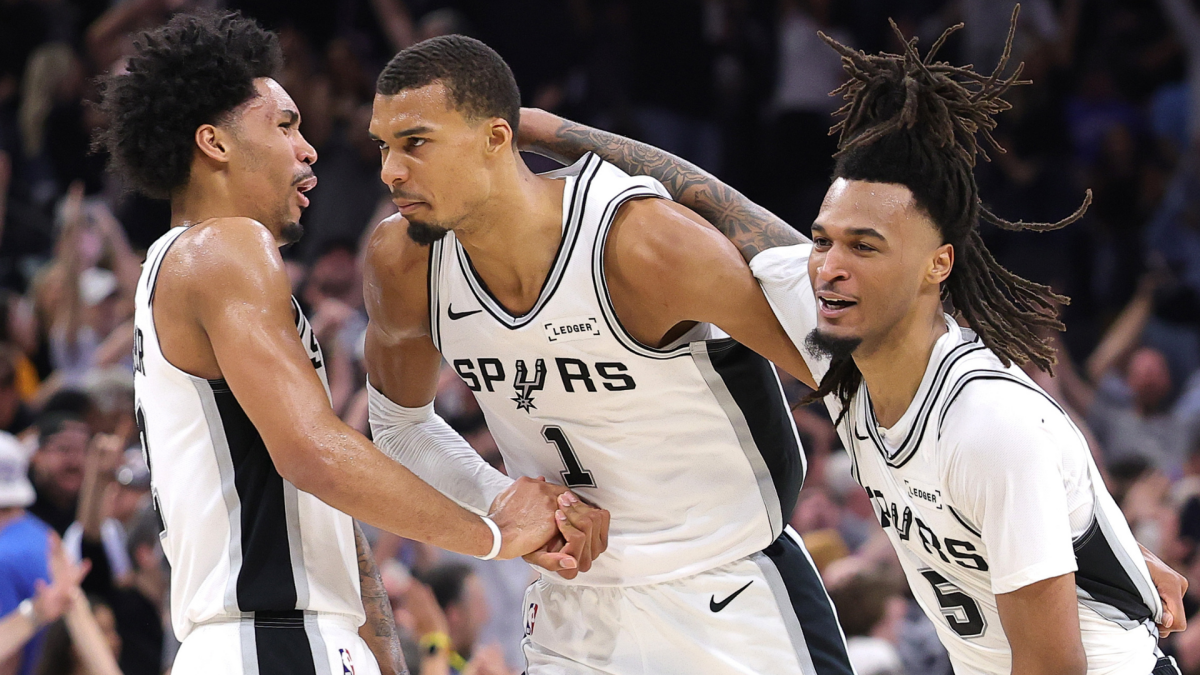
The biggest competitive advantage the San Antonio Spurs currently enjoy is having their three best players still on rookie-scale contracts. Dylan Harper still has three years left on his. Stephon Castle has two. The best of the three, Victor Wembanyama, just finished his third season and will make $16.9 million this coming season.
Wembanyama could well be the best player in the league. To have that kind of player making that kind of money is a gift from the basketball gods. It opens up so many doors that are slammed shut for most teams whose best players have long graduated from their rookie contracts and moved on to market-rate deals.
This is how the Spurs can still afford to pay De’Aaron Fox almost $50 million this season, and another $45 million for Devin Vassell and Keldon Johnson, without even crossing the first apron. But the good times cannot last forever. Or can they?
As we speak, Wembanyama is eligible to sign a five-year, $251 million extension that would start in 2027-28. But on Friday, a report from The Stein Line’s Jake Fischer trickled out that Wembanyama is considering taking a discounted deal to give the Spurs greater financial flexibility moving forward.
Around the time the report surfaced, Wembanyama fired off this tweet.
As if this guy isn’t popular enough in San Antonio, now he’s considering taking less money so more can be doled out to his teammates, most notably Castle and Harper — whose first non-rookie paydays will both eventually overlap with Wembanyama’s next contract.
It’s the Jalen Brunson blueprint, and it just won the New York Knicks a championship in five games over Wembanyama and the Spurs. As was well chronicled at the time, Brunson signed a $156 million deal in the summer of 2024 when he could’ve signed for $269 million a year later.
It looked like a $113 million sacrifice on paper, but with Brunson structuring a player option into the fourth year of the deal, which he will surely opt out of for a new contract beginning in 2028-29, the savings were actually closer to $37 million for the Knicks.
Nonetheless, it was a hell of a sacrifice. Brunson could get hurt between now and 2028, or he could even wait until 2029 and sign for more than $400 million. If that happens, he will make his money back by hitting his free agency a year earlier.
But his production could fall off by that point. Pushing your biggest possible payday down the road so the team can put a championship roster together is pretty selfless stuff. And that’s what the Knicks did. With more money freed up, the Knicks traded for Mikal Bridges and then extended him for $150 million, re-signed OG Anunoby for $212 million, and traded for Karl-Anthony Towns and his $220 million.
When the dust settled on this past year’s championship, Brunson, despite being the best player and Finals MVP, was the third-highest-paid player on the team. Without his willingness to give up all that guaranteed money, the Knicks wouldn’t have been able to pay all those other guys while staying under the second apron, which team owner James Dolan just refused to cross even after winning the title.
This is when championship teams start having to break up. They win, and everyone gets corresponding raises. The team gets too expensive, and salaries start getting trimmed. When the Celtics won it all in 2024, Jaylen Brown was making $31.8 million. The next season, his super-max extension started and suddenly he was making $49.2 million. Last year, that number increased to $53 million, coinciding with the start of Jayson Tatum’s own super-max at $54.1 million.
Neither of those guys took the Brunson discount, and that meant bye-bye to Jrue Holiday, Al Horford, Kristaps Porzingis, and Luke Kornet. And now Brown is gone in large part because he makes too much money.
The next Jaylen Brown? Three high-paid NBA players whose contracts could eventually make them trade candidates
Sam Quinn
The Spurs haven’t won a championship yet, but we can all see it building toward that end, perhaps as soon as this coming year. Wembanyama doesn’t want anything to get in the way of that happening, and it appears he’s willing to put his money where his mouth is.
It’s easy to brush that off and say, “Big deal, this dude’s going to make a billion dollars in salary alone by the time his career is over,” but that’s not really the point. He doesn’t have to do it. Many other people, in fact most people, would not do it.
But as we move forward, at least under this current Collective Bargaining Agreement, you have to wonder if this will become more of an unspoken expectation for stars to take less money than they could make. Not to put more in the pockets of even richer owners, but to preserve roster-building flexibility when the alternative is breaking up championship teams, or worse, teams that haven’t gotten to a championship yet and need more time together or one more player to get over the hump.
It’s a sticky subject. There are probably a lot of players who look at what Brunson did and what it sounds like Wembanyama is prepared to do, and feel it puts pressure on them to do the same. Everyone’s situation is different. If you’re later in your career and this is your last chance at a big contract, or you don’t have the sort of appetite for risk that is required to postpone paydays, you shouldn’t be expected to do this. At the same time, if more of your competitors do start doing it, you’re going to be at a real disadvantage.
