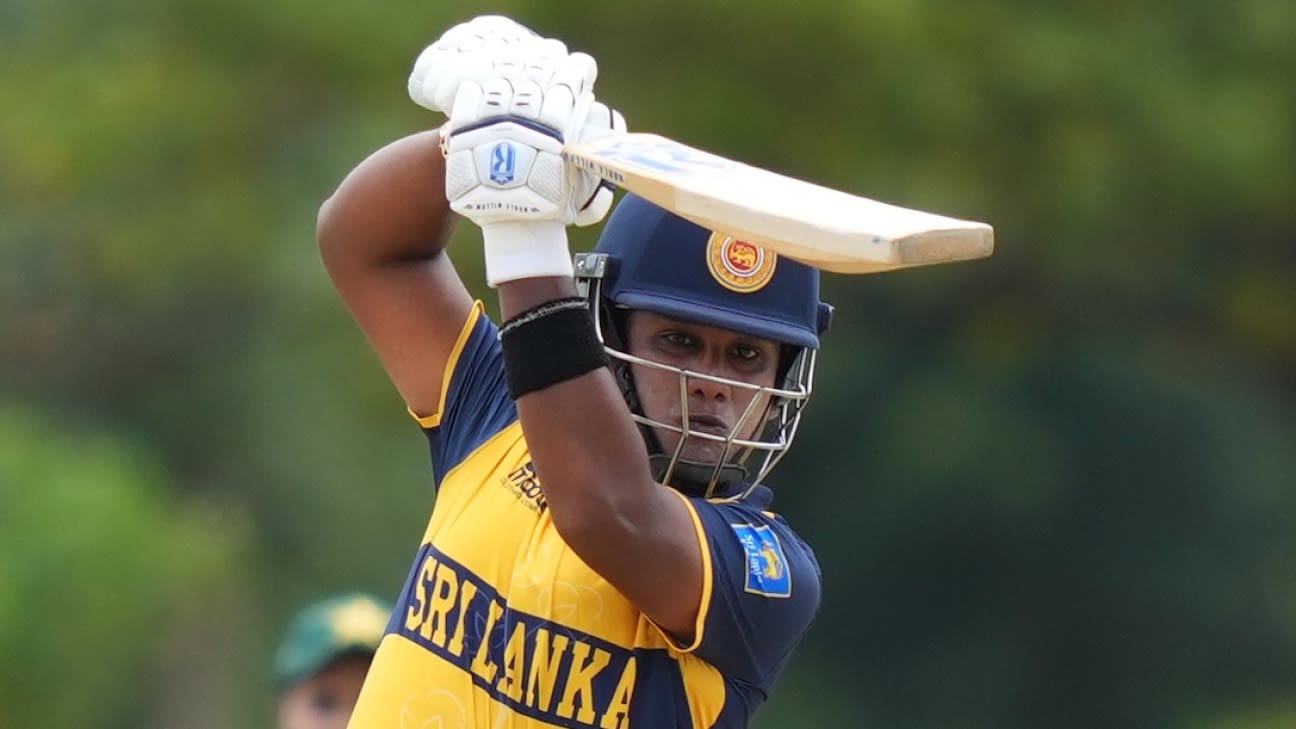
Chamari Athapaththu and Pathum Nissanka stole the spotlight at the Sri Lanka Cricket Awards, walking away with the Women’s and Men’s Cricketer of the Year honours. The lavish ceremony, held on Thursday night, celebrated outstanding individual performances across the Test, ODI, and T20I formats for the 2025 calendar year, recognised efforts in domestic cricket, and honoured legendary figures for their lifelong contributions to the sport.
The awards also looked ahead to the future of Sri Lankan cricket, honouring two talents who had breakthrough years. Kamil Mishara was named the Men’s Emerging Player of the Year, while Imesha Dulani took home the title of Women’s Emerging Player of the Year. Twenty-five-year-old Mishara’s year was propped up primarily by his T20I exploits, where he struck 336 runs in ten matches at a strike rate of 131.25 from the top of the order. Dulani, 24, played just the one ODI but her three T20I innings brought 106 runs with a high score of 50.
But for both Mishara and Dulani, one suspects that their most recent performances might have swung the jury’s opinion: Mishara lit up the ongoing Lanka Premier League, while Dulani just this past week struck an unbeaten 101 off 64 deliveries against Pakistan.
The night though belonged to Athapaththu and Nissanka, with the former’s legendary status in the women’s game further cemented as she swept multiple categories, proving her unmatched impact on the game. Athapaththu, a threat with both bat and ball, swept the ODI and T20I allrounder awards. But in a sign of the growing stature of the women’s game, wasn’t even nominated for the best ODI batter award. Harshitha Samarawickrama’s 441 runs in 13 innings beat out Nilakshika de Silva’s 389 runs in the same number of innings in that category.
Athapaththu did, however, take the best batter award in T20Is, for her 190 runs in seven innings at a strike rate of 113.77. She also claimed the best bowler award for ODIs, picking up 13 wickets across 11 innings with her offbreaks. Kavisha Dilhari was named best bowler in T20Is with eight wickets in as many innings.
Meanwhile, Nissanka’s prolific scoring across formats rightfully earned him the crown as the pinnacle of men’s cricket in Sri Lanka, in a year that fetched him 1414 runs at an average of 40.40. Despite playing just five innings across the entire year, in what was a limited opportunity year as a whole for Sri Lankan Test cricket, Nissanka managed 388 runs inclusive of two centuries; In ODIs, Nissanka wasn’t able to match his vintage 2024, but still struck a respectable 401 runs in 12 matches at an average of 30.84; it was in T20Is that he shone the most, as 18 matches brought 625 at a strike rate of 149.16 – the most prolific year of his career.
This meant Nissanka rounded out his awards with the best batter prize in Tests and T20Is, though for ODIs he was beaten to the accolade by Charith Asalanka. The former skipper struck 494 runs, anchoring Sri Lanka’s middle order, at an average of 44.90 – running him close was Kusal Mendis, who had managed 500 runs at an average of 38.46 in the same period.
The best men’s bowler in T20Is was Dushmantha Chameera, whose 22 wickets across 14 games is comfortably the most prolific of his career – and he’s threatening to better that this year, having already notched 20 wickets across 11 T20Is. For ODIs, the award went to Asitha Fernando who too managed a career-best showing with 23 wickets across 12 games.
Dasun Shanaka and Wanindu Hasaranga took home the best allrounder awards for T20Is and ODIs respectively. Shanaka scored 220 runs and eight wickets across 17 matches, while Hasaranga struck 207 runs and picked up 18 wickets in ten ODIs.
In the longest format, Prabath Jayasuriya’s 15 wickets in seven innings earned him the best bowler award, while Test captain Dhananjaya de Silva took home the best Test allrounder award.
The ceremony also focused strongly on the domestic circuit. In the Major Club Women’s 50 Over Tournament, Navy Sports Club clinched the title, leaving Chilaw Marians Cricket Club to settle for the runners-up spot. The women’s individual awards highlighted the country’s top talent, with Athapaththu named the most valuable player, while Samarawickrama took home the best batter award, while veteran spinner Inoka Ranaweera was crowned the best bowler.
The men’s shorter formats saw Colombo Cricket Club emerge as a dominant force, lifting trophies in both the T20 and 50-over competitions. In the Major Club Men’s T20 Tournament, Colombo Cricket Club secured the championship by defeating Panadura Sports Club. Vishen Halambage enjoyed a sensational tournament, sweeping both the best batter and MVP honours. Sampath Nishshanka was recognised as the best bowler, and Dushan Hemantha claimed the title of best allrounder.
Colombo Cricket Club continued their winning streak in the Major Club Men’s 50 Over Tournament, taking the top prize while Police Sports Club finished runners-up. Wicketkeeper Nishan Madushka was named the tournament’s MVP, while Sangeeth Cooray earned the best batter award, Movin Subasingha was named best bowler, and Thanuka Dabare took home the best allrounder accolade.
In the longest format of local cricket, Colts Cricket Club reigned supreme as champions of the prestigious Major Club 3-Day Tournament, finishing ahead of Ace Capital Cricket Club. Young spin-bowling allrounder Wanuja Sahan was judged the MVP for his match-winning exploits. The traditional format also celebrated Lahiru Udara as the best batter and Dilum Sudeera as the best bowler for their consistency over the three-day fixtures.
The essential contributions of match officials were also put in the spotlight during the domestic segment. Veteran official Ravindra Kottahachchi was honoured with the match officials award, taking home the title of Umpire of the Year.
Lifetime achievement awards
The board bestowed Lifetime Achievement Awards upon four individuals whose decades of dedication have shaped the narrative and stature of Sri Lankan cricket, both on and off the field.
Long before Sri Lanka achieved official Test status, Michael Tissera stood as a foundational pillar of Sri Lankan cricket. A classy right-hand batter and a highly respected leader, he famously captained the national team during the pre-Test era. Notably, Tissera led Sri Lanka during their inaugural appearance at the 1975 Cricket World Cup. His legacy spans generations, transitioning smoothly from an elegant player to a vital administrative guide for the national sport.
The next was Anura Tennekoon, widely revered as one of the most accomplished and technically sound batsmen produced by the island in the pre-Test era. He was a regular force for the national team and had the distinct honour of captaining Sri Lanka at the historic 1975 and 1979 Cricket World Cups. Beyond his immense contributions with the bat, Tennekoon later served as the Chief Executive of Sri Lanka Cricket from 2000 to 2003.
On the media front, Reemus Fernando has spent decades tracking and chronicling local sports. Writing for prominent national publications, Fernando’s documentation of domestic tournaments and school cricket has served as an invaluable historical archive for the nation’s sporting triumphs.
Finally there was Kelum Srimal, a media personality who has long been a highly recognised voice in Sri Lankan cricket broadcasting. Combining his skills as a journalist, commentator, and prominent television presenter, Srimal’s lifelong dedication to multi-platform cricket media have made him a household name for local sports fans.
Source link