
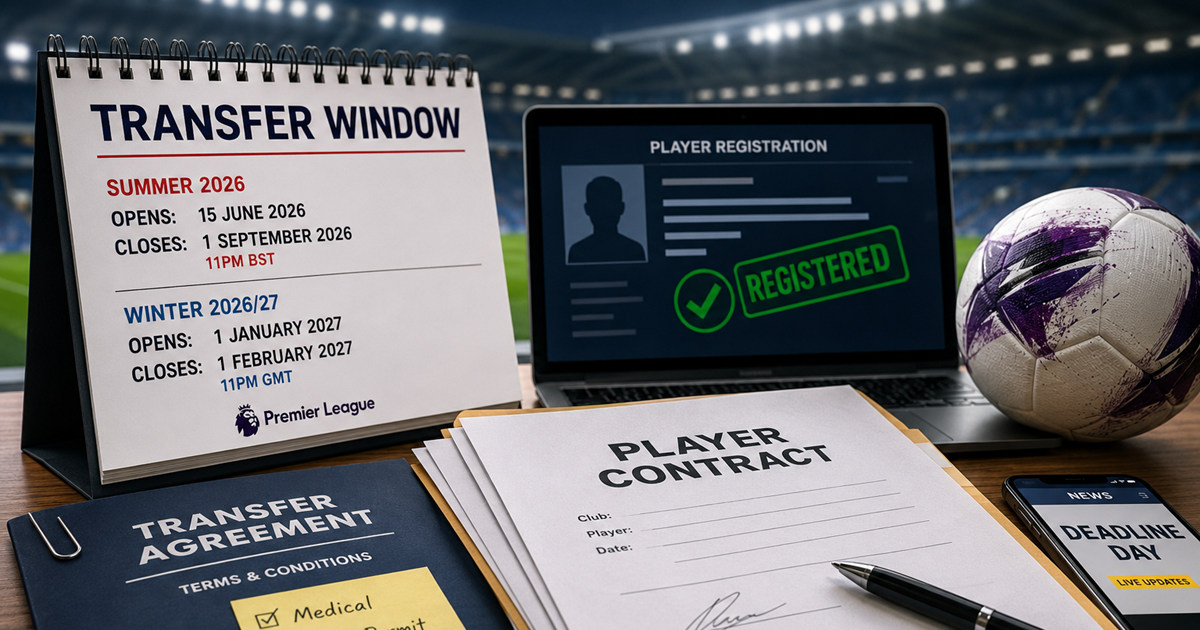
A football transfer window is the period in which a club can register new players for official competition. Clubs may discuss deals, negotiate fees and agree future transfers at other times, but an incoming player normally cannot be registered until the appropriate window is open.
For the 2026/27 Premier League season, the summer transfer window opened on 15 June 2026 and will close at 11pm BST on 1 September. The winter window will open on 1 January and close at 11pm GMT on 1 February 2027. These deadlines apply to Premier League clubs, while other countries and competitions may operate different registration periods.
The distinction between signing and registering a player matters. A club can announce an agreement before every administrative step has been completed. Still, the player cannot represent the club until the relevant authorities confirm the registration and all competition eligibility requirements have been met.
What Is a Football Transfer Window?
The phrase “transfer window” is commonly used, but FIFA’s regulations describe these periods as registration periods.
FIFA allows each member association to set two annual registration periods for professional football. The first normally takes place between seasons and must last between eight and 12 weeks. The second occurs during the season and must last between four and eight weeks. Together, the two periods cannot exceed 16 weeks.
The Football Association sets the relevant framework in England, while the Premier League applies its own competition rules to its member clubs. The EFL, National League, Women’s Super League and leagues in other countries may use different dates, deadlines and loan restrictions.
That is why a transfer window can remain open in one country after it has closed in another.
What Can Clubs Do While the Window Is Open?
During an open registration period, a Premier League club can generally:
- Register a player transferred permanently from another club.
- Register a player arriving on loan.
- Convert a loan into a permanent transfer.
- Recall or return a loan player where the agreement and competition rules permit it.
- Register eligible free agents.
- Complete domestic and international transfers.
Negotiations can begin long before the window opens. Clubs regularly agree fees or announce future signings in advance, particularly when a player will join after an existing contract expires.
However, an agreement between clubs do not automatically make the player eligible to play. The buying club must submit the required documents and receive confirmation that the registration has been accepted. The FA’s 2026/27 rules state that a transferred player remains ineligible until the new club receives written confirmation of registration.
For broader coverage of contracts, clauses and transfer stories, visit the World in Sport football section.
How Does a Football Transfer Become Official?
A transfer involves more than the buying club paying an agreed fee. The clubs, player and relevant football authorities must complete several separate stages.
The usual process includes:
- The buying and selling clubs agree the transfer terms.
- The buying club agrees a playing contract with the player.
- The player may undergo a medical examination.
- Both clubs sign the transfer agreement.
- The buying club submits the contract and registration documents.
- Work permission and international clearance are obtained where required.
- The Premier League and The FA check the documents against their rules.
- The registration is confirmed.
A medical is a common condition of a transfer, but it is not the same as registration. A player passing a medical does not make the move official if the clubs have not signed the agreement or the authorities have not accepted the paperwork.
The transfer agreement must record the financial and other arrangements between the clubs. This includes the agreed fee, payment schedule, contingent payments and any sums for which a club is responsible.
That means the entire transfer fee does not usually have to be paid on deadline day. Clubs can agree instalments, bonuses and future payments, provided the relevant details are properly recorded.
Clauses may include appearance bonuses, performance-related payments or a percentage of a future sale.
Our guide to sell-on clauses in football transfers explains how those arrangements work.
What Happens on Transfer Deadline Day?
Deadline day is the final day on which clubs can submit registrations during that window.
For the 2026 summer window, Premier League clubs must normally complete their incoming business by 11pm BST on 1 September. A transfer does not necessarily need to be announced publicly before that time. What matters is whether the required registration process has been completed or an accepted deadline procedure has been followed.
How Does a Deal Sheet Work?
The Premier League can allow a club to submit a deal sheet when the parties have reached an agreement shortly before the deadline but have not had enough time to provide every remaining document.
The deal sheet must be fully completed and submitted before the window closes. Once accepted, it gives the club a further two hours to deliver the outstanding paperwork. It does not allow clubs to begin negotiating a new deal after the deadline.
International transfers must also comply with FIFA’s Transfer Matching System deadlines. The buying and selling clubs enter the transfer details into TMS, and those details must match before international clearance can be issued.
This explains why clubs sometimes announce a transfer after the window has officially closed. The announcement may be late even though the deal sheet or registration information was submitted on time.
Can a Transfer Collapse After the Deadline?
A deal can still fail if the documentation is incomplete, inaccurate or submitted too late.
Problems can include:
- A missing signature.
- Conflicting information in the transfer documents.
- Unresolved international clearance.
- Failure to obtain the necessary work permission.
- A late or invalid deal sheet.
- Failure to meet the conditions written into the transfer agreement.
- A registration that breaches competition or governing-body rules.
The Premier League reviews the submitted documents and tells the club whether the player has been registered, rejected or left pending until further information arrives.
A club announcement should therefore not be confused with final confirmation of eligibility.
Can Free Agents Sign After the Transfer Window Closes?
Some free agents can be registered outside the normal window, but the rule is more limited than it is often presented.
Under FIFA’s January 2026 regulations, a professional whose contract expired naturally, or was mutually terminated before the engaging club’s registration period ended, may be registered after that period has closed. Other specific exceptions can also apply when a contract has been terminated with just cause or without cause by the former club.
This does not mean that any player can terminate a contract after deadline day and immediately join another club. The circumstances and timing of the termination matter, while domestic competition rules and squad-list requirements still apply.
A free transfer also means that no transfer fee is paid to release the player from an existing senior contract. It does not mean the move is free of all costs. The new club may still pay wages, a signing-on fee, agent fees and other contractual expenses.
How Do Football Loans Work?
A loan allows a player to represent another club for a specified period while remaining registered under a longer-term contract with the parent club.
FIFA requires professional loans to be covered by a written agreement. The agreement must set out the duration and financial conditions, while the player and borrowing club must have a contract covering the loan period. Under the current FIFA framework, a professional loan normally lasts from one registration period to another and cannot exceed one year.
The borrowing club cannot sub-loan the player or transfer them permanently to a third club. Any extension also requires the player’s written consent.
Premier League clubs face additional restrictions on temporary transfers involving other English clubs.
| Premier League loan rule | Limit | What it means |
|---|---|---|
| Domestic loans registered at one time | Two | A club cannot have more than two temporary transfers from English clubs registered simultaneously. |
| Domestic loans during one season | Four | A club can register no more than four temporary transfers from English clubs across the season. |
| Loans from one club | One at a time | A club cannot have two players on loan from the same English club simultaneously. |
| New signing loaned to another Premier League club | Not permitted in the same window | A club cannot buy a player and immediately loan them to another Premier League club during that window. |
| Goalkeepers loaned to another Premier League club | One | A club may loan no more than one of its goalkeepers to another Premier League club. |
These restrictions apply to domestic temporary transfers. Players borrowed from clubs outside England do not count towards the Premier League’s domestic loan quota, although FIFA’s international transfer and loan rules still apply.
Our full guide to how football loan deals work covers loan fees, wage contributions, recalls and options to buy in more detail.
Can a Player Be Recalled from a Loan?
A parent club cannot automatically recall a player whenever it wishes. The loan agreement and relevant competition regulations must permit the recall.
When a player returns, the parent club must submit the recall letter, notice or agreement. The player cannot represent the parent club until the registration has been restored and written confirmation has been received.
A valid registration does not remove other eligibility restrictions. A player could still be unavailable because of a suspension, squad-list rule or competition-specific deadline.
How Do International Transfers Work?
An international transfer involves additional checks because the player’s registration moves between two national associations.
Both clubs must enter matching information into FIFA’s Transfer Matching System. The new association then requests an International Transfer Certificate from the former association. The player cannot be registered for the new association until the required clearance process has been completed.
The information entered by the clubs includes the transfer terms, payment details, player information and relevant agreements. A discrepancy can delay the transfer until the clubs correct or clarify the submission.
International transfers are also subject to FIFA rules on contractual stability, training rewards, loans and the protection of minors.
What Are the Work-Permit Rules?
A player who does not already have the right to work in the UK may need a Governing Body Endorsement from The FA before applying through the relevant immigration route.
The FA’s men’s player criteria for 2026/27 took effect on 15 June 2026. The system considers factors such as international appearances, the quality of the player’s domestic league, continental competition appearances and club minutes.
The FA advises clubs seeking an endorsement during a transfer window to submit the application by midday on deadline day at the latest. That gives the governing body time to process the application, but an endorsement does not itself replace the required immigration permission.
A club may agree and register a transfer while parts of the immigration process remain outstanding. Still, the player cannot undertake employment duties or become eligible to play until the necessary evidence has been provided.
What Happens to Premier League Squad Lists?
Closing the transfer window does not end the administrative process. Premier League clubs must submit updated squad lists after the summer and winter windows.
Clubs can register up to 25 senior players, with no more than 17 allowed to fall outside the Premier League’s home-grown criteria. To submit a full 25-player squad, a club must therefore include at least eight home-grown players.
A home-grown player is someone who, regardless of nationality, was registered with a club affiliated with the FA or Football Association of Wales for at least three full seasons or 36 months before turning 21, or by the end of the season in which they turned 21.
Eligible Under-21 players sit outside the 25-player limit and can represent the club without occupying a senior squad place.
Home-grown status is based on a player’s development and registration history, not their passport. An overseas international can qualify as home-grown, while an English player who developed abroad may not.
The squad rules are separate from the competition’s financial controls.
Read our guide to Premier League financial rules for an explanation of how spending controls can influence transfer decisions.
Can Premier League Clubs Sell Players After Their Window Closes?
A Premier League club can transfer a player to a club in another country if the buying club’s registration window remains open.
The English club does not need its own incoming window to be open to release the player. The important registration takes place in the buying club’s association. However, the Premier League club may be unable to sign a replacement until England’s next window opens.
Different closing dates can therefore create an imbalance. A club may still receive offers after its own recruitment deadline has passed, leaving it to decide whether the fee outweighs the risk of weakening the squad.
Can Players Under 18 Transfer Internationally?
FIFA generally prohibits international transfers involving players under 18. Limited exceptions exist, but they are tightly controlled and require supporting evidence and approval.
Possible exceptions cover circumstances such as a family moving for reasons unrelated to football, certain border arrangements and qualifying education or protection cases. Clubs cannot treat the international recruitment of a minor in the same way as an ordinary senior transfer.
Domestic academy movements follow separate national and competition regulations.
Common Transfer-Window Misunderstandings
“The Club Announced the Player, so the Transfer Is Complete”
Not necessarily. The commercial agreement may be complete while registration, clearance or work permission remains pending.
“All Negotiations Must Stop when the Window Closes”
No. Clubs can continue discussing future transfers. The window controls registration rather than every conversation or agreement.
“Any Free Agent Can Sign at Any Time”
No. The player’s contract status, the date it ended and the relevant competition rules determine whether an outside-window registration is possible.
“All Leagues Use the Same Deadline”
No. National associations set their registration periods within FIFA’s framework. Summer, winter and deadline-day times can differ between countries.
“Every Loan Counts Towards the Premier League Limit”
No. The Premier League’s two-at-a-time and four-per-season limits concern temporary transfers from other English clubs. International loans are governed separately.
“The Two-Hour Extension Applies to Every Late Deal”
No. The club must submit an accepted deal sheet before the window closes. The additional time is for completing documents relating to an agreement already reached.
Football Transfer Window Rules summarised
The transfer window is primarily a registration deadline. It determines when clubs can add most new players to their official playing strength, but it does not prevent them from negotiating future agreements.
Premier League clubs must complete permanent transfers and domestic loans within the applicable registration period unless a recognised exception applies. Deadline-day deal sheets can provide extra time for outstanding paperwork, but they must be submitted before the window closes.
International transfers also require matching TMS information and international clearance. Some players need work permission and an FA Governing Body Endorsement, while every signing must comply with Premier League squad and home-grown rules.
Loans have their own restrictions, and free agents are not automatically eligible to sign at any moment. The player’s contract status, registration history and competition eligibility all matter.
The central rule is straightforward: agreeing a transfer is only part of the process. A player becomes available to represent the new club when the required authorities have accepted the registration and every relevant eligibility condition has been satisfied.
