
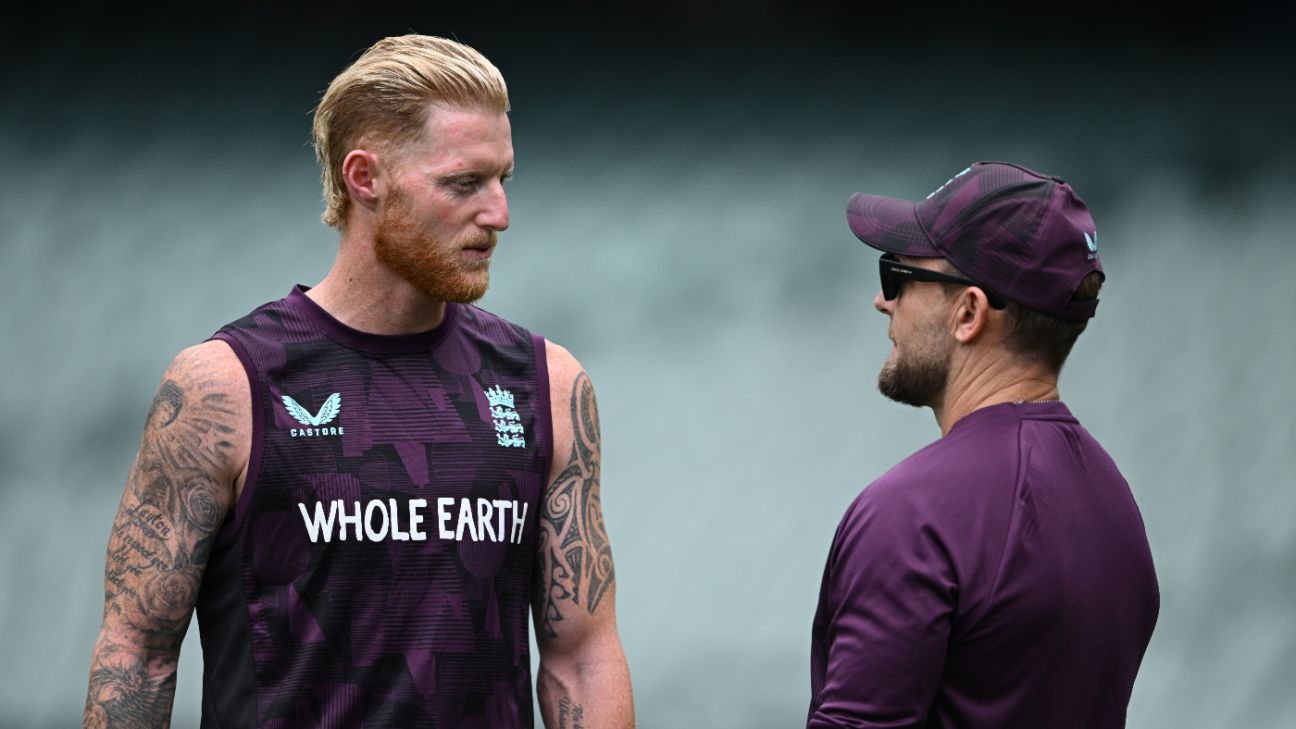
Richard Gould, the ECB’s chief executive, issued a statement shortly after England’s defeat in Sydney confirmed a 4-1 series loss in Australia promising a review into the tour, and said: “Our focus is on regaining the Ashes in 2027.” The review’s conclusion was to keep the status quo, with Gould insisting that England’s management could “adapt and evolve”.
Yet only three Test matches later – including one with England’s captain and opening bowler suspended – McCullum was gone. Stokes was too: after spending five months obsessing over what had gone wrong in Australia, he went into self-destruct mode while celebrating England’s win at Lord’s, breaking curfew at the first opportunity, and departed in a blaze of short-lived glory at Trent Bridge.
England learned nothing against New Zealand. They won a low-scoring shoot-out on a poor pitch at Lord’s, were thrashed with an understrength team at The Oval, and were well beaten by a ruthless side in Nottingham. Ollie Robinson’s long-awaited comeback lasted one match, and Emilio Gay, the opener picked on county form, finished the series reverse-sweeping at No. 6.
If the ECB had acted decisively after the T20 World Cup, it could have been the first series with a new, permanent head coach in charge. We will never know for sure, but a new appointment might have energised Stokes and avoided the feelings of burnout and mental exhaustion he described at Trent Bridge. Instead, in sticking with McCullum, England lost Stokes.
In fact, there is already an expectation in Australia that Stokes will return next summer, fuelled by Andrew McDonald’s recent speculation that he still has “a lot of good cricket left in him” and could make a “fairytale” comeback. Fleming has worked with Stokes before at the IPL and will doubtless have the conversation, though it may be too late to convince him to return.
Fleming plans to travel to the UK later this summer after a break at home with his family in New Zealand, though not in time for England’s Test series against Pakistan in mid-August. Instead, that will be another holding series, with Marcus Trescothick in interim charge for the first three Tests of England’s 10-match run-in to next summer’s Ashes. It is another stop-gap solution.
Of course, England can still learn from that series. Most importantly, they must work out how to balance their side in Stokes’ absence – they lost their last two Tests without him after declining to pick a frontline spinner – and any series win, even against a struggling Pakistan side, would be viewed as a positive after 18 months without one.
But the timeline means that Fleming’s first series is a three-match tour of South Africa, the reigning World Test Champions, and he will be under pressure from the outset. There is recent precedent for England coaches coming in shortly before successful home Ashes series – Flower in 2009, Trevor Bayliss in 2015 – but this summer has been a wasted opportunity.
And then there is the captaincy. It is a damning indictment of England’s succession planning that Root was seen as the best candidate for the role, four years after he resigned from it, and it leaves Harry Brook – seemingly Stokes’ vice-captain in name only – in an awkward spot. How have England found themselves so bereft of leadership candidates?
It is remarkable that Key has emerged from this chaos with his position not only intact, but seemingly as secure as ever before. Gould gave him a glowing endorsement earlier this month and emphasised that he saw him as England’s managing director for the “long term” – though this was only a few months after a similar vote of confidence in McCullum.
It was Key, after all, who made the decision to appoint McCullum as head coach across formats in late 2024 as well as extending his contract. It made the ECB’s position far weaker after the Ashes: McCullum had two years left on a lucrative deal, and sacking him altogether would have cost them an exorbitant sum. Even now, a clean break did not appear to be an option.
Key will speak to the media on Friday – for the first time since he insisted England were “not a national embarrassment” six weeks ago – to spell out his thinking, and to justify the ECB’s decision not to make a fresh start after the Ashes, or at least the T20 World Cup. It will take some explanation to get the English cricketing public back on his side.
Matt Roller is a senior correspondent at Cricinfo. @mroller98
